Studies confirm greenhouse mechanisms even further into past
May 14, 2008
Curves for the Temperature and the Greenhouse Gases

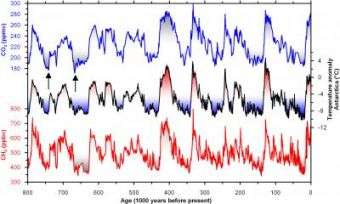
The ice core boring at Dome C in Antarctica shows that the curves for the temperature and the greenhouse gases carbon dioxide and methane follow each other over the past 800,000 years -- with few deviations. (See arrows) Credit: Professor Thomas Blunier, Centre for Ice and Climate, Niels Bohr Institute, University of Copenhagen

The newest analysis of trace gases trapped in Antarctic ice cores now provide a reasonable view of greenhouse gas concentrations as much as 800,000 years into the past, and are further confirming the link between greenhouse gas levels and global warming, scientists reported today in the journal Nature.

They also show that during that entire period of time, there have never been concentrations of carbon dioxide and methane as high as the current levels, said Edward Brook, an associate professor of geosciences at Oregon State University, and author of a Nature commentary on the new studies.

“The fundamental conclusion that today’s concentrations of these greenhouse gases have no past analogue in the ice-core record remains firm,” Brook said in the report. “The remarkably strong correlations of methane and carbon dioxide with temperature reconstructions also stand.”

The latest research, done by members of the European Project for Ice Coring in Antarctica, extend the data on trace gases back another 150,000 years beyond any studies done prior to this, Brook said. Ultimately, researchers would like to achieve data going back as much as 1.5 million years.

The tiny bubbles of ancient air trapped in polar ice cores have been used to provide records of trace gases in the atmosphere at distant points in the past, and better understand the natural fluctuations that have occurred, largely as a result of cyclical changes in Earth’s orbit around the sun.

“These natural cycles that occur on the order of tens or hundreds of thousands of years can help us understand both the forces that have controlled and influenced Earth’s climate in the past, and the implications of current changes on future climate” said Brook, who is co-chair of an international group that organizes global studies in this field.

According to the data, the current levels of primary greenhouse gases – those that are expected to cause global warming - are off the charts.

The concentration of carbon dioxide is now a bit more than 380 parts per million, compared to a range of about 200-300 parts per million during the past 800,000 years. The current concentration of methane is 1,800 parts per billion, compared to a range of about 400-700 parts per billion during that time.

In every case during that extended period, warm periods coincide with high levels of greenhouse gases. Of some interest, the latest studies are showing that the temperature increases have been even more pronounced during the most recent 450,000 years, compared to several hundred thousand years prior to that.

“It appears there may even be very long term natural cycles that have operated on much longer periods of 400,000 years or more,” Brook said. “We still have quite a bit to learn about these past cycles and all the forces that control them.”

Most of the time during the past 800,000 years, the Earth has experienced long, cooler periods about 80,000 to 90,000 years long, which eventually lead to ice ages. Those have been regularly interrupted by “interglacial” periods about 10,000 to 20,000 years long that are considerably warmer – this is the stage the Earth is in right now. Abrupt climate changes on much shorter time scales are also possible, researchers believe, possibly due to shifts in ocean circulation patterns or other forces.

Scientists are continuing to search for the optimal sites in Antarctica that will allow them to take the ice core records back even further, Brook said.

Source: Oregon State University

3.5 /5 (28 votes)  

Filter


Move the slider to adjust rank threshold, so that you can hide some of the comments.


Display comments: newest first

deatopmg
May 14, 2008

Rank: 3.4 / 5 (5)
AND every warming period was FOLLOWED by increased levels of CO2 and CH4 due to de-gassing of the oceans.
Ragtime
May 14, 2008

Rank: 4.7 / 5 (3)
AND every warming period was FOLLOWED by increased levels of CO2 and CH4 due to de-gassing of the oceans.
Which can serve as an argument for antropogenic origin of GW in fact, because during last hundred years the opposite effect is observed: the concentration of CO2 grows faster, then the global temperature (which is mainly the consequence of heat absorbtion in glacier melting, I presume). Something is apparently wrong with current interglacial period: the typical interglacial should be wet, which we are facing the expansion of deserts.
Egnite
May 15, 2008

Rank: 1 / 5 (4)
"...380 parts per million, compared to a range of about 200-300 parts per million during the past 800,000 years. The current concentration of methane is 1,800 parts per billion, compared to a range of about 400-700 parts per billion during that time. "

So for some reason CO2 and CH4 are higher than the usual range. Is this due to humans? And does this not give the impression that the normal cycle no longer exists as we have passed the usual ranges? I'm guessing the earth will warm more than it ever has in the past and the next ice age may never come.
Sophos
May 15, 2008

Rank: 2.3 / 5 (4)
800,000 years is really not that long of a
time period.
The Earth has been warmer, and I have no
doubt that as the Earth's climate warms
there will be mechanisms that kick in to
correct and cool the warming trend.
If only by more violet weather that wipes
out large populations of people and allows
plants to repopulate
Rank 3.5 /5 (28 votes)
Tags

Related Stories
Relevant PhysicsForums posts
  • Discrepancy between oxygen and carbon-dioxide levels
    created17 hours ago
  • where gems are found in the world
    created21 hours ago
  • Wind Waves in Reservoir ~ Wind run-up and Wind set-up
    createdFeb 08, 2012
  • Balance of oxygen in the atmosphere
    createdFeb 01, 2012
  • The case for a methanol-based economy
    createdJan 30, 2012
  • Weather in a rotating cylinder
    createdJan 25, 2012
  • More from Physics Forums - Earth

More news stories

Humans may have helped the decline of African rainforests 3000 years ago

(PhysOrg.com) -- Large areas of rainforests in Central Africa mysteriously disappeared over three thousand years ago, to be replaced by savannas. The prevailing theory has been that the cause was a change ...

Space & Earth / Environment

created 10 hours ago | popularity 5 / 5 (3) | comments 9 | with audio podcast report

Could Venus be shifting gear?

(PhysOrg.com) -- ESA’s Venus Express spacecraft has discovered that our cloud-covered neighbour spins a little slower than previously measured. Peering through the dense atmosphere in the infrared, the ...

Space & Earth / Space Exploration

created 6 hours ago | popularity 5 / 5 (5) | comments 7 | with audio podcast

Mars Science Laboratory computer issue resolved

(PhysOrg.com) -- Engineers have found the root cause of a computer reset that occurred two months ago on NASA's Mars Science Laboratory and have determined how to correct it.

Space & Earth / Space Exploration

created 7 hours ago | popularity 5 / 5 (5) | comments 3 | with audio podcast

Clam fields found at deep, low-temperature Mariana vents

(PhysOrg.com) -- Scientists have marveled at the unusual life forms thriving at high temperature hydrothermal vents of the deep ocean.

Space & Earth / Earth Sciences

created 6 hours ago | popularity not rated yet | comments 0 | with audio podcast

Two new moons for Jupiter

Advances in technology have lead to the discovery of new planets outside of our Solar System, and now even new moons in our own backyard.

Space & Earth / Space Exploration

created 6 hours ago | popularity not rated yet | comments 3


Human cognitive performance suffers following natural disasters, researchers find

Not surprisingly, victims of a natural disaster can experience stress and anxiety, but a new study indicates that it might also cause them to make more errors - some serious - in their daily lives. In their upcoming Human Fa ...

The power of estrogen -- male snakes attract other males

A new study has shown that boosting the estrogen levels of male garter snakes causes them to secrete the same pheromones that females use to attract suitors, and turned the males into just about the sexiest ...

New error-correcting codes guarantee the fastest possible rate of data transmission

Error-correcting codes are one of the triumphs of the digital age. They’re a way of encoding information so that it can be transmitted across a communication channel — such as an optical fiber o ...

Putting the squeeze on planets outside our solar system

(PhysOrg.com) -- Using high-powered lasers, scientists at Lawrence Livermore National Laboratory and collaborators discovered that molten magnesium silicate undergoes a phase change in the liquid state, abruptly ...

Both maternal and paternal age linked to autism

Older maternal and paternal age are jointly associated with having a child with autism, according to a recently published study led by researchers at The University of Texas Health Science Center at Houston (UTHealth).

Curry spice component may help slow prostate tumor growth

Curcumin, an active component of the Indian curry spice turmeric, may help slow down tumor growth in castration-resistant prostate cancer patients on androgen deprivation therapy (ADT), a study from researchers ...