Spin Control: New Technique Sorts Nanotubes by Length
May 14, 2008 Spin Control: New Technique Sorts Nanotubes by Length

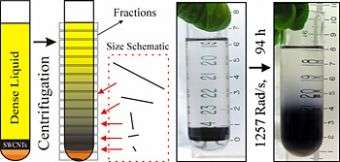
In a schematic of NIST's length separation technique for carbon nanotubes (l.), the nanotubes start at the bottom of a dense fluid. When spun in a centrifuge, the nanotubes begin to migrate through the fluid driven by their buoyancy, but the longer ones move faster, spreading them out by length. Photos (r.) shows a typical sample at the start and after 94 hours of spinning at 1257 radians per second (roughly 12,000 RPM). Credit: NIST

Researchers at the National Institute of Standards and Technology (NIST) have reported a new technique to sort batches of carbon nanotubes by length using high-speed centrifuges. Many potential applications for carbon nanotubes depend on the lengths of these microscopic cylinders, and one of the most important features of the new technique, say the scientists, is that it should be easily scalable to produce industrial quantities of high-quality nanotubes.

So-called single wall carbon nanotubes (SWCNTs) are essentially sheets of carbon atoms only one atom thick that have rolled themselves into tubes with a diameter of approximately one nanometer. They have unique combinations of thermal, mechanical, optical and electronic properties that suggest a wide variety of uses, including circuit elements in molecular electronics, fluorescent tags for diagnostic and therapeutic applications in medicine and light sources for compact, efficient flat-panel displays, among many others.

Unfortunately, the methods for manufacturing carbon nanotubes always create a large percentage of nanojunk in the mix—clumps of carbon, ordinary soot, particles of metal used as a catalyst—and nanotubes come in an enormous range of lengths, from a few tens or hundreds, up to thousands of nanometers.

Refining the lot is essential for most uses. For many potential applications, nanotubes need to be separated by length. In biomedical applications, for example, it has been shown that whether or not nanotubes are taken up in cells depends critically on length (see “Cells Selectively Absorb Short Nanotubes.”) Nanotubes used as components in future microcircuits obviously need to fit in place, and in optical applications, a nanotube’s length determines how strongly it will absorb or emit light (see “Longer is Better for Nanotube Optical Properties.”)

In 2006, researchers found that you could separate nanotubes by “chirality” (a measure of the twist in the carbon atom sheet) by spinning them in a dense fluid in an ultracentrifuge tube because of a relationship between chirality and buoyancy. In this new work, a team of NIST researchers demonstrated that a variation of the same technique can separate nanotubes by length. They showed that while the nanotubes ultimately will move to a point of equilibrium in the centrifuge tube dictated by their buoyancy, due to friction they will move at different rates depending on their lengths.

“When we spin the centrifuge, it turns out that the longer ones move faster. We basically just run a race and the longer ones move farther in the same amount of time,” says researcher Jeffrey Fagan, “Eventually they get separated enough in position that we can just pull off layers and get different lengths.”

What’s particularly exciting, they say, is that while other techniques have been shown to sort nanotubes by length, this is the first approach that could be scaled up to produce commercially important quantities of nanotubes in a given length range. The process also removes much of unwanted junk—particularly metal particles—from the batch. NIST has applied for a patent on the process.

Citation: J.A. Fagan, M.L. Becker, J. Chun and E.K. Hobbie. Length fractionation of carbon nanotubes using centrifugation. Advanced Materials. 2008. 20. 1609–1613.

Source: NIST


print this article email this article download pdf blog this article bookmark this article     Stumble it Digg this share on Facebook retweet share on Reddit add to delicious
Rate this story - 4.8 /5 (14 votes)

Rank Filter

Move the slider to adjust rank threshold, so that you can hide some of the comments.


Display comments: newest first

  • zevkirsh - May 15, 2008
    • Rank: not rated yet
    fascinating use of biology techniques: gel electrophoresis and centruging combined to an industrial engineering purporse. some very creative person figured that by using a the properly dense fluid, the nanotubes would float up very slowly but at different rates--as in gel electrophoresis the larger proteins travel through the volatge-gel slower than the other smaller ones. , but that applying electricity was uneccsasry and that centriguing would do better ---as biologists use centrigues to obtain different fractions off the cell contents .simple....elegant....genius.

May 14, 2008 all stories

Comments: 1

4.8 /5 (14 votes)
  • Stumble this up

  • Digg this

  • share this

  • hide
  • Related Stories


  • hide
  • Relevant PhysicsForums posts

  • Polymer Properties Question
    created 7 hours ago
  • Fatigue Properties of Chinese steel
    created Nov 04, 2009
  • Finding Hardness values
    created Nov 04, 2009
  • Fluid flow, pressure drop simulation in Comsol
    created Nov 04, 2009
  • More from Physics Forums - Materials & Chemical Engineering

Other News

Findings show nanomedicine promising for treating spinal cord injuries

Findings show nanomedicine promising for treating spinal cord injuries

Nanotechnology / Bio & Medicine

created 15 hours ago | popularity 4.5 / 5 (4) | comments 0

(PhysOrg.com) -- Researchers at Purdue University have discovered a new approach for repairing damaged nerve fibers in spinal cord injuries using nano-spheres that could be injected into the blood shortly ...


New Digital 'Electronics' Concept May Continue Moore's Law

New Digital 'Electronics' Concept May Continue Moore's Law

Nanotechnology / Nanophysics

created Nov 05, 2009 | popularity 4.6 / 5 (54) | comments 9

(PhysOrg.com) -- Computers of the future could be operating not on electrons, but on tiny waves traveling through an electron "fluid," if a new proposal is successful. The new circuit design, recently introduced ...


Nanoparticles for gene therapy improve

Nanoparticles for gene therapy improve

Nanotechnology / Bio & Medicine

created Nov 06, 2009 | popularity 5 / 5 (4) | comments 3

(PhysOrg.com) -- About five years ago, Professor Janet Sawicki at the Lankenau Institute in Pennsylvania read an article about nanoparticles developed by MIT's Robert Langer for gene therapy, the insertion ...


Breakthrough in industrial-scale nanotube processing

Breakthrough in industrial-scale nanotube processing

Nanotechnology / Nanomaterials

created Nov 02, 2009 | popularity 4.9 / 5 (20) | comments 3

(PhysOrg.com) -- Rice University scientists today unveiled a method for the industrial-scale processing of pure carbon-nanotube fibers that could lead to revolutionary advances in materials science, power ...


Scientists witness nature's complexity unfold in self-assembling quasicrystals

Scientists witness nature's complexity unfold in self-assembling quasicrystals

Nanotechnology / Nanomaterials

created Oct 31, 2009 | popularity 4.9 / 5 (17) | comments 3

(PhysOrg.com) -- Just a few decades ago, scientists believed that all ordered matter consists of self-repeating building blocks -- atoms, ions or molecules. In this view, the ordinary solids of everyday life ...