Physicists Demonstrate How Information Can Escape From Black Holes
May 14, 2008
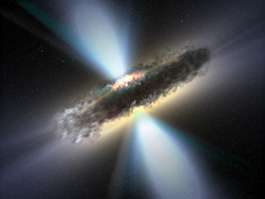
An artist's depiction of the accretion of a thick ring of dust into a supermassive black hole. The accretion produces jets of gamma rays and X-rays. Credit: ESA / V. Beckmann (NASA-GSFC)
Physicists at Penn State have provided a mechanism by which information can be recovered from black holes, those regions of space where gravity is so strong that, according to Einstein's theory of general relativity, not even light can escape. The team's findings pave the way toward ending a decades-long debate sparked by renowned physicist Steven Hawking. The team's work will be published in the 20 May 2008 issue of the journal Physical Review Letters.
In the 1970s, Hawking showed that black holes evaporate by quantum processes; however, he asserted that information, such as the identity of matter that is gobbled up by black holes, is permanently lost. At the time, Hawking's assertion threatened to turn quantum mechanics--the most successful physical theory posited by humankind--on its head, since a fundamental tenet of the theory is that information cannot be lost.
Hawking's idea was generally accepted by physicists until the late 1990s, when many began to doubt the assertion. Even Hawking himself renounced the idea in 2004. Yet no one, until now, has been able to provide a plausible mechanism for how information might escape from a black hole.
A team of physicists led by Abhay Ashtekar, Holder of the Eberly Family Chair in Physics and director of the Penn State Institute for Gravitation and the Cosmos, now has discovered such a mechanism. Broadly, their findings expand space-time beyond its assumed size, thus providing room for information to reappear.
To explain the issue, Ashtekar used an analogy from Alice in Wonderland. "When the Cheshire cat disappears, his grin remains," he said. "We used to think it was the same way with black holes. Hawking's analysis suggested that at the end of a black hole's life, even after it has completely evaporated away, a singularity, or a final edge to space-time, is left behind, and this singularity serves as a sink for unrecoverable information."
But Ashtekar and his collaborators, Victor Taveras, a graduate student in the Penn State Department of Physics, and Madhavan Varadarajan, a professor at the Raman Research Institute in India, suggest that singularities do not exist in the real world. "Information only appears to be lost because we have been looking at a restricted part of the true quantum-mechanical space-time," said Ashtekar. "Once you consider quantum gravity, then space-time becomes much larger and there is room for information to reappear in the distant future on the other side of what was first thought to be the end of space-time."
According to Ashtekar, space-time is not a continuum as physicists once believed. Instead, it is made up of individual building blocks, just as a piece of fabric, though it appears to be continuous, is made up of individual threads. "Once we realized that the notion of space-time as a continuum is only an approximation of reality, it became clear to us that singularities are merely artifacts of our insistence that space-time should be described as a continuum."
To conduct their studies, the team used a two-dimensional model of black holes to investigate the quantum nature of real black holes, which exist in four dimensions. That's because two-dimensional systems are simpler to study mathematically. But because of the close similarities between two-dimensional black holes and spherical four-dimensional black holes, the team believes that this approach is a general mechanism that can be applied in four dimensions. The group now is pursuing methods for directly studying four-dimensional black holes.
Source: Penn State
-
For Facebook 'Hacker Way' is way of life
Feb 05, 2012 |
3 / 5 (1) |
1
-
Debris from way out there
Jan 25, 2012 |
5 / 5 (4) |
1
-
Briton with locked-in syndrome wants right to die
Jan 23, 2012 |
5 / 5 (1) |
0
-
Binary star system found by following gamma-ray signal
Jan 13, 2012 |
5 / 5 (3) |
0
-
Astronomers release unprecedented data set on celestial objects that brighten and dim
Jan 12, 2012 |
4.8 / 5 (6) |
0
-
Engineers build first sub-10-nm carbon nanotube transistor
Feb 01, 2012 |
4.9 / 5 (31) |
30
-
Something old, something new: Evolution and the structural divergence of duplicate genes
Jan 31, 2012 |
4.6 / 5 (7) |
1
-
The hidden nanoworld of ice crystals: Revealing the dynamic behavior of quasi-liquid layers
Jan 30, 2012 |
5 / 5 (3) |
1
-
Stock market network reveals investor clustering
Jan 27, 2012 |
3.9 / 5 (23) |
8
-
Of microchemistry and molecules: Electronic microfluidic device synthesizes biocompatible probes
Jan 26, 2012 |
5 / 5 (1) |
0
-
How to calculate theoretical initial velocity?
1 hour ago
-
Question about Gravity?
2 hours ago
-
Wearing black in a desert
3 hours ago
-
Did space exist before mass?
3 hours ago
-
How can E&M Waves be polarized?
3 hours ago
-
Does light travel for ever?
4 hours ago
- More from Physics Forums - General Physics
More news stories
Putting the squeeze on planets outside our solar system
(PhysOrg.com) -- Using high-powered lasers, scientists at Lawrence Livermore National Laboratory and collaborators discovered that molten magnesium silicate undergoes a phase change in the liquid state, abruptly ...
11 hours ago |
4.3 / 5 (7) |
0
|
Hovering not hard if you're top-heavy, researchers find
Top-heavy structures are more likely to maintain their balance while hovering in the air than are those that bear a lower center of gravity, researchers at New York University's Courant Institute of Mathematical Sciences ...
12 hours ago |
5 / 5 (1) |
1
|
SLAC, Stanford team focuses on high-energy electrons to treat cancer
Accelerator physicists at SLAC and cancer specialists from Stanford are working on a new technology that could dramatically reduce the time needed for cancer radiation treatments. The team ran an initial experiment ...
15 hours ago |
5 / 5 (2) |
0
Measurements from high-energy collisions lead to better understanding of why meson particles disappear
For several years, physicists at the Relativistic Heavy Ion Collider (RHIC) at Brookhaven National Laboratory (BNL), USA, have studied an unusual state of matter called the quarkgluon plasma, which they ...
15 hours ago |
4.5 / 5 (4) |
0
Explained: Sigma
It's a question that arises with virtually every major new finding in science or medicine: What makes a result reliable enough to be taken seriously? The answer has to do with statistical significance -- but ...
Feb 09, 2012 |
5 / 5 (16) |
53
Google users warned of threat to smartphone wallets
Users of Google smartphone wallets were being warned on Friday that there is a way to crack pass codes intended to thwart thieves from going on illicit shopping sprees.
Anonymous knocks CIA website offline (Update)
The website of the Central Intelligence Agency was inaccessible on Friday after the hacker group Anonymous claimed to have knocked it offline.
New error-correcting codes guarantee the fastest possible rate of data transmission
Error-correcting codes are one of the triumphs of the digital age. Theyre a way of encoding information so that it can be transmitted across a communication channel such as an optical fiber o ...
Humans may have helped the decline of African rainforests 3000 years ago
(PhysOrg.com) -- Large areas of rainforests in Central Africa mysteriously disappeared over three thousand years ago, to be replaced by savannas. The prevailing theory has been that the cause was a change ...
New power source discovered
(PhysOrg.com) -- Researchers at the Massachusetts Institute of Technology (MIT) and RMIT University have made a breakthrough in energy storage and power generation.
Complex wiring of the nervous system may rely on a just a handful of genes and proteins
Researchers at the Salk Institute have discovered a startling feature of early brain development that helps to explain how complex neuron wiring patterns are programmed using just a handful of critical genes. ...
May 14, 2008
Rank: 3.3 / 5 (9)
There is no accepted theory of quantum gravity.
> According to Ashtekar, space-time is not a continuum as physicists once believed.
Which experiment can confirm it?
Both quantum gravity and whether space-time is discreet or continuous are much bigger, older and more importent unsolved puzzles of physics.
May 14, 2008
Rank: 2.7 / 5 (6)
In my opinion, however, I do not see how information can be perfectly preserved because information is also dependent upon context. If the information emitted by black holes is not emitted in a manner that preserves context, then conservation of information is still violated.
May 14, 2008
Rank: 1.6 / 5 (9)
May 14, 2008
Rank: 1.7 / 5 (7)
For example the water droplets are rather transparent for light waves, but they're behaving like tiny reflecting singularities with respect of sound wave spreading. By analogous way, the black holes are behaving like singularities with respect of light waves, but they're should remain quite transparent for gravitational waves, and so on.
So that only observational perspective can define, what can be considered a singularity or not.
May 14, 2008
Rank: 2 / 5 (7)
May 14, 2008
Rank: 2 / 5 (3)
Or maybe I am wrong?
May 14, 2008
Rank: 3.3 / 5 (4)
Is it just me, or is this brutally obvious?
(assuming quantum gravity works)
May 14, 2008
Rank: 3 / 5 (5)
That is actually an increase in information, as more data is required to model the state of the universe at each moment. Equivalent to thermodynamics.
May 15, 2008
Rank: 1 / 5 (8)
May 15, 2008
Rank: 2.7 / 5 (3)
May 15, 2008
Rank: 1.5 / 5 (2)
But here's still apparent caveat, because the singularity solution of GR is steady state solution and as such it doesn't care, when this situation will occur. As we know, the BH is formed by collapse of dense matter and the speed of energy spreading is the more slow, the more dense such matter is. From this follows, the infinitely dense matter (i.e. the singularity) should form just in infinite time. Which is apparently unrealistic assumption, if we consider the finite age of Universe.
From this insight follows, only sufficiently small BH can form the singular solution, the heavier ones cannot form a singularity, if they were formed just after Universe formation. Note, that such conclusion is consistent with the AWT explanation of information paradox, linked above ( http://tinyurl.com/6rpud3 )
May 15, 2008
Rank: 1.5 / 5 (2)
May 15, 2008
Rank: 3 / 5 (2)
In my opinion, you are right and wrong. This research still has value. If they can work out a model where a discrete space-time and quantum gravity are required to explain macroscopic phenomenas (e.g.: black holes), they will be building a stronger case for those hypothesis.
May 18, 2008
Rank: 2.5 / 5 (2)
By the same token, research into why faeries do not exist, is also an excellent waste of taxpayer dollars.
May 19, 2008
Rank: 3 / 5 (1)