Key molecule discovered in Venus's atmosphere
May 15, 2008 Key molecule discovered in Venus's atmosphere

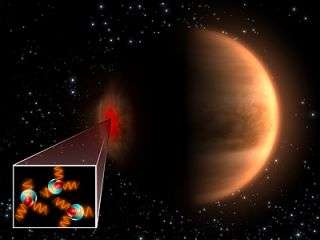
Hydroxyl, an important but difficult-to-detect molecule, is made up of a hydrogen and oxygen atom each. It has been found in the upper reaches of the Venusian atmosphere, some 100 km above the surface, by Venus Express’s Visible and Infrared Thermal Imaging Spectrometer, VIRTIS. Credits: ESA (Image by C. Carreau)

Venus Express has detected the molecule hydroxyl on another planet for the first time. This detection gives scientists an important new tool to unlock the workings of Venus’s dense atmosphere.

Hydroxyl, an important but difficult-to-detect molecule, is made up of a hydrogen and oxygen atom each. It has been found in the upper reaches of the Venusian atmosphere, some 100 km above the surface, by Venus Express’s Visible and Infrared Thermal Imaging Spectrometer, VIRTIS.

The elusive molecule was detected by turning the spacecraft away from the planet and looking along the faintly visible layer of atmosphere surrounding the planet’s disc. The instrument detected the hydroxyl molecules by measuring the amount of infrared light that they give off.

The band of atmosphere in which the glowing hydroxyl molecules are located is very narrow; it is only about 10 km wide. By looking at the limb of the planet, Venus Express looked along this faint atmospheric layer, increasing the signal strength by about 50.

Hydroxyl is thought to be important for any planet’s atmosphere because it is highly reactive. On Earth it has a key role in purging pollutants from the atmosphere and is thought to help stabilise the carbon dioxide in the martian atmosphere, preventing it from converting to carbon monoxide. On Mars it is also thought to play a vital role in sterilising the soil, making the top layers hostile to microbial life.

The reactive molecule has been seen around comets, but the method of production there is thought to be completely different from the way it forms in planetary atmospheres.

“Because the venusian atmosphere had not been studied extensively before Venus Express arrived on the scene, we have not been able to confirm much of what our models tell us by observing what is actually happening. This detection will help us refine our models and learn much more,” says one of the Principal Investigators of the VIRTIS experiment, Giuseppe Piccioni, from the Istituto di Astrofisica Spaziale e Fisica Cosmica in Rome, Italy.

On Earth, the glow of hydroxyl in the atmosphere has been shown to be closely linked to the abundance of ozone. From this study, the same is thought to be true at Venus. Now, scientists can set about estimating the amount of ozone in the planet’s atmosphere.

Venus Express has shown that the amount of hydroxyl at Venus is highly variable. It can change by 50% from one orbit to the next and this may be caused by differing amounts of ozone in the atmosphere.

“Ozone is an important molecule for any atmosphere, because it is a strong absorber of ultraviolet radiation from the Sun,” says Piccioni. The amount of the radiation absorbed is a key parameter driving the heating and dynamics of a planet’s atmosphere. On Earth, it heats the stratosphere (layer of the atmosphere) making it stable and protecting the biosphere from harmful ultraviolet rays.

Computer models will now be able to tell how this jump and drop in ozone levels over short intervals affects the restless atmosphere of that world.

“Venus Express has already shown us that Venus is much more Earth-like than once thought. The detection of hydroxyl brings it a step closer,” says Piccioni.

He and his colleagues are only reporting the initial detection from a few orbits in their latest paper. They are working on the analysis of data from about 50 other orbits and more observations will follow.

First detection of hydroxyl in the atmosphere of Venus by G. Piccioni et al. has been published in today's issue of Astronomy & Astrophysics Letters.

Source: European Space Agency


print this article email this article download pdf blog this article bookmark this article     Stumble it Digg this share on Facebook retweet share on Reddit add to delicious
Rate this story - 4.5 /5 (32 votes)

Rank Filter

Move the slider to adjust rank threshold, so that you can hide some of the comments.


Display comments: newest first

  • Ensa - May 19, 2008
    • Rank: not rated yet
    "On Mars it is also thought to play a vital role in sterilising the soil, making the top layers hostile to microbial life." :) lol

May 15, 2008 all stories

Comments: 1

4.5 /5 (32 votes)
  • Stumble this up

  • Digg this

  • share this

  • hide
  • Related Stories

  • Watching Venus glow in the dark
    created Feb 24, 2009 | popularity not rated yet | comments 0
  • STAR TRAK for November: Mars is prominent again
    created Nov 02, 2009 | popularity not rated yet | comments 0
  • Interactions with Aerosols Boost Warming Potential of Some Gases
    created Oct 29, 2009 | popularity not rated yet | comments 0
  • Galileo's Jupiter Journey Began Two Decades Ago
    created Oct 19, 2009 | popularity not rated yet | comments 0
  • How the Moon produces its own water
    created Oct 15, 2009 | popularity not rated yet | comments 0


  • hide
  • Relevant PhysicsForums posts

  • The shape of our solar system's orbits.
    created 21 hours ago
  • Above or Below the Line of Nodes
    created Nov 07, 2009
  • Supernova vs. Nova?
    created Nov 07, 2009
  • Supernova's Gamma Rays and Comets
    created Nov 06, 2009
  • More from Physics Forums - General Astronomy

Other News

Deep creep means milder, more frequent earthquakes along Southern California's San Jacinto fault

Deep creep means milder, more frequent earthquakes along Southern California's San Jacinto fault

Space & Earth / Earth Sciences

created 6 hours ago | popularity 4.7 / 5 (3) | comments 0

With an average of four mini-earthquakes per day, Southern California's San Jacinto fault constantly adjusts to make it a less likely candidate for a major earthquake than its quiet neighbor to the east, the ...


Success in 'space elevator' competition (AP)

Success in 'space elevator' competition (Update 3)

Space & Earth / Space Exploration

created Nov 05, 2009 | popularity 4.3 / 5 (33) | comments 50

(AP) -- A robot powered by a ground-based laser beam climbed a long cable dangling from a helicopter on Wednesday to qualify for prize money in a $2 million competition to test the potential reality of the ...


'Dropouts' pinpoint earliest galaxies

'Dropouts' pinpoint earliest galaxies

Space & Earth / Astronomy

created Nov 06, 2009 | popularity 4.2 / 5 (10) | comments 12

Astronomers, conducting the broadest survey to date of galaxies from about 800 million years after the Big Bang, have found 22 early galaxies and confirmed the age of one by its characteristic hydrogen signature ...


Space hotel taking bookings for 2012 opening

Space hotel taking bookings for 2012 opening

Space & Earth / Space Exploration

created Nov 05, 2009 | popularity 4.4 / 5 (20) | comments 11

(PhysOrg.com) -- The first orbiting space hotel is on track to open for its first customers in 2012, but hurry, as bookings are filling fast.


In a Galaxy Far, Far Away...

In a Galaxy Far, Far Away...

Space & Earth / Astronomy

created Nov 06, 2009 | popularity 4.8 / 5 (5) | comments 13

(PhysOrg.com) -- Astronomers have published the discovery of the farthest known object in the cosmos: a star that exploded when the universe was only 630 million years old -- only 4.6% of its current age. ...