Crystal (eye) ball: Study says visual system equipped with 'future seeing powers'
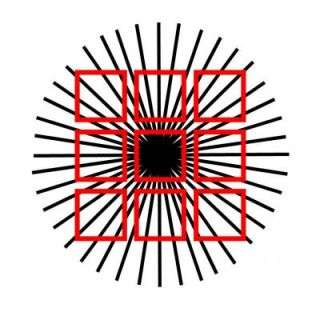
May 15, 2008 Orbison Illusion

In the Orbison geometric illusion, the squares closer to the center of the image seem larger than those on the outside of the drawing. Evolution has seen to it that drawings like this elicit in us premonitions of the near future. Credit: Rensselaer/Changizi

Catching a football. Maneuvering through a room full of people. Jumping out of the way when a golfer yells "fore." Most would agree these seemingly simple actions require us to perceive and quickly respond to a situation. Assistant Professor of Cognitive Science at Rensselaer Polytechnic Institute Mark Changizi argues they require something more—our ability to foresee the future.

It takes our brain nearly one-tenth of a second to translate the light that hits our retina into a visual perception of the world around us. While a neural delay of that magnitude may seem minuscule, imagine trying to catch a ball or wade through a store full of people while always perceiving the very recent (one-tenth of a second prior) past. A ball passing within one meter of you and traveling at one meter per second in reality would be roughly six degrees displaced from where you perceive it, and even the slowest forward-moving person can travel at least ten centimeters in a tenth of a second.

Changizi claims the visual system has evolved to compensate for neural delays, allowing it to generate perceptions of what will occur one-tenth of a second into the future, so that when an observer actually perceives something, it is the present rather than what happened one-tenth of a second ago. Using his hypothesis, called “perceiving-the-present,” he was able to systematically organize and explain more than 50 types of visual illusions that occur because our brains are trying to perceive the near future. His findings are described in May-June issue of the journal Cognitive Science.

“Illusions occur when our brains attempt to perceive the future, and those perceptions don’t match reality. There has been great success at discovering and documenting countless visual illusions. There has been considerably less success in organizing them,” says Changizi, who is lead author on the paper. “My research focused on systematizing these known incidents of failed future seeing into a ‘periodic table’ of illusion classes that can predict a broad pattern of the illusions we might be subject to.”

More than meets the eye

To picture one, think of the Hering illusion, which looks like a bike spoke with two vertical lines drawn on either side of the center vanishing point. Although the lines are straight, they seem to bow out away from the vanishing point. The optical illusion occurs because our brains are predicting the way the underlying scene would project in the next moment if we were moving in the direction of the vanishing point.

“Evolution has seen to it that geometric drawings like this elicit in us premonitions of the near future,” says Changizi. “The converging lines toward a vanishing point are cues that trick our brains into thinking we are moving forward—as we would in the real world, where the door frame seems to bow out as we move through it—and we try to perceive what that world will look like in the next instant.”

Beyond geometric, Changizi was able to identify 27 other classes of illusions. He organized them into 28 predictable categories classified on a matrix that distributes them among four columns based on the type of visual feature that is misperceived (size, speed, luminance, and distance) and among seven rows based on the different optical features that occur when an observer is moving forward.

He then culled hundreds of previously documented illusions to test whether they would follow the appropriate prediction as determined by the table, and found that they did, indeed, follow the patterns he laid out in the matrix.

This new organization of illusions presents a range of potential applications, including more effective visual displays and enhanced visual arts. It especially may help constrain neuroscientists aiming to understand the mechanisms underlying vision, according to Changizi.

Source: Rensselaer Polytechnic Institute


print this article email this article download pdf blog this article bookmark this article     Stumble it Digg this share on Facebook retweet share on Reddit add to delicious
Rate this story - 4.5 /5 (46 votes)

Rank Filter

Move the slider to adjust rank threshold, so that you can hide some of the comments.


Display comments: newest first

  • minorwork - May 16, 2008
    • Rank: 4 / 5 (1)
    From the retina, to the thalamus, to the visual cortex, back to the thalamus. A tenth of a second to process the position of that fast ball. Then coordinate with the various muscle control groups. No wonder the pitchers throw curve balls. Still, it seems the thalamus is the center for the feedback. Dare I ask; Could this be the "soul," the ghost in the machine?
  • dvn_visionary - May 17, 2008
    • Rank: 5 / 5 (1)
    You have undoubtedly seen a novice batter, swing amazingly late at a ball that is not thrown that fast. Over a relatively short period of repetitive trials, the batter does not become all that stronger or faster, they get better at predicting how to swing the bat to meet the point in space that the ball will be. Pretty cool ability for any organized system, to be able to predict the most likely of futures!

May 15, 2008 all stories

Comments: 2

4.5 /5 (46 votes)
  • Stumble this up

  • Digg this

  • share this

  • hide
  • Related Stories

  • Optical illusions: Variety makes us perceive smaller quantities
    created Mar 31, 2009 | popularity not rated yet | comments 0
  • In game of tennis, seeing isn't always believing
    created Oct 27, 2008 | popularity not rated yet | comments 0
  • Scientists create touch-based illusion
    created Jul 17, 2008 | popularity not rated yet | comments 0
  • Scientists set out to measure how we perceive naturalness
    created Jul 03, 2008 | popularity not rated yet | comments 0
  • The hand can't be fooled, study shows
    created Mar 10, 2008 | popularity not rated yet | comments 0


  • hide
  • Relevant PhysicsForums posts

  • Improving the brain through chemistry
    created Nov 07, 2009
  • Sleep / REM Sleep and homeostasis
    created Nov 07, 2009
  • The Biceps Reflex
    created Nov 05, 2009
  • Consequenses of striking a Vein and an artery?
    created Nov 05, 2009
  • More from Physics Forums - Medical Sciences

Other News

Deepening the search  for clues to rheumatoid arthritis

Deepening the search for clues to rheumatoid arthritis

Medicine & Health / Genetics

created 9 minutes ago | popularity not rated yet | comments 0

(PhysOrg.com) -- The gnawing pain of rheumatoid arthritis is a signal that the body’s immune system has hit the wrong target: its own cartilage and bone.


Of Mutants and Mechanisms: Researching Growth-Regulation Proteins That Underlie Cancer

Of Mutants and Mechanisms: Researching Growth-Regulation Proteins That Underlie Cancer

Medicine & Health / Cancer

created 6 minutes ago | popularity not rated yet | comments 0

(PhysOrg.com) --A University of Arkansas researcher will study potential cancer-causing mutants of a protein involved in cell growth regulation, thanks to a supplemental grant from the National Institutes ...


Breast density associated with increased risk of cancer recurrence

Medicine & Health / Cancer

created 3 hours ago | popularity not rated yet | comments 0

A new study finds that women treated for breast cancer are at higher risk of cancer recurrence if they have dense breasts. Published in the December 15, 2009 issue of Cancer, a peer-reviewed journal of the American Cancer ...


Scientists uncover new key to the puzzle of hormone therapy and breast cancer

Scientists uncover new key to the puzzle of hormone therapy and breast cancer

Medicine & Health / Cancer

created 3 hours ago | popularity 5 / 5 (1) | comments 0

The use of postmenopausal hormone therapy has decreased over time in the United States, which researchers suggest may play a key role in the declining rate of atypical ductal hyperplasia, a known risk factor ...


Young tennis players who play only 1 sport are more prone to injuries

Young tennis players who play only one sport are more prone to injuries

Medicine & Health / Health

created 3 hours ago | popularity not rated yet | comments 0

Gifted young athletes are under increasing pressure to play only one sport year round.