Embryonic pathway delivers stem cell traits
Studies of how cancer cells spread have led to a surprising discovery about the creation of cells with adult stem cell characteristics, offering potentially major implications for regenerative medicine and for cancer treatment.
Some cancer cells acquire the ability to migrate through the body by re-activating biological programs that have lain dormant since the embryo stage, as the lab of Whitehead Member Robert Weinberg has helped to demonstrate in recent years. Now scientists in the Weinberg lab have shown that both normal and cancer cells that are induced to follow one of these pathways may gain properties of adult stem cells, including the ability to self-renew.
In a paper published online by Cell on May 15, former postdoctoral researcher Sendurai Mani and his colleagues demonstrated in mice and in human cells that cells that have undergone an “epithelial-to-mesenchymal” (EMT) transition acquire several important characteristics of stem cells. Conversely, the researchers also showed that naturally existing normal stem cells as well as tumor-seeding cancer stem cells show characteristics of the post-EMT cells, including the acquisition of mesenchymal cell traits, which are usually associated with connective tissue cells.
Epithelial cells, which make up most of the human body, bind together in sheet-like structures. In embryonic development, the EMT process breaks up cell-cell adhesion in the epithelial layer, and converts epithelial cells into more loosely associated mesenchymal cells. In the context of cancer development, some cancer cells within a primary cancer may undergo an EMT, migrate through the body to their end destination, and there resume their epithelial form through a reverse process (the mesenchymal-to-epithelial transition).
Mani and his colleagues have identified FOXC2, one of the key genes involved in invasion and metastasis. In addition, FOXC2 appears to program the metastatic ability of some breast cancers.
Mani knew that during embryonic development, FOXC2 expression is restricted to mesoderm and mesoderm-derived cells when they are in an undifferentiated state, and its expression disappears once these cells differentiate. Similarly, his experiments showed that epithelial cells that undergo EMT express FOXC2, but that expression is lost when they revert back to an epithelial state.
In collaboration with Andrea Richardson and Jeffery Kutok, pathologists at Boston’s Brigham and Women’s Hospital, Mani went on to study FOXC2 expression in normal human breast tissue. It turned out that such cells were located precisely where researchers expect to find mammary epithelial stem cells.
As he pondered these findings and the earlier results about FOXC2’s role in metastasis, Mani wondered: Just what were these cells generated by EMT that expressed FOXC2"
Were they simply fibroblasts, the most common cells in normal connective tissue" Or were they actually stem cells"
“I asked Mai-Jing Liao, another postdoc in the Weinberg lab, to check whether the cells generated by EMT would have any stem cell properties,” recalls Mani, now an assistant professor in the department of molecular pathology at the University of Texas’s M. D. Anderson Cancer Center in Houston. “He said, ‘You must be out of your mind, but it won’t take more than half an hour to check.’”
Much to Liao’s surprise, when he examined cells that had undergo an EMT, his tests did highlight surface proteins that are key markers for stem cells.
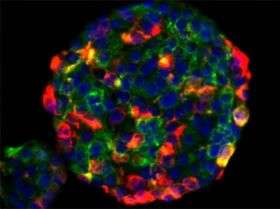
The researchers found that the cells that underwent the EMT process were mesenchymal-like in appearance and demonstrated stem-cell surface markers. The cells also displayed an increased ability to grow in suspension, forming structures called mammospheres—another trait of mammary stem cells. Some cells in the resulting mammospheres showed, in turn, stem cell markers, indicating they could differentiate into two kinds of mammary cells. And cells in the mammospheres retained their stem cell properties even after the EMT induction process was stopped.
Furthermore, when the Weinberg lab scientists isolated stem-cell-like cells from cultured human mammary epithelial cells or from mouse breast tissue, their properties were very similar to the EMT-induced cells. Working with Kornelia Polyak of Dana-Farber Cancer Institute and Harvard Medical School, Mani found that this was also true with normal and tumor cells obtained from human patients.
“This for us is a very exciting discovery, not only because of its unexpectedness but because it offers a route by which one could in principle generate unlimited numbers of stem cells committed to create a specific cell type,” says Weinberg, who is also a professor of biology at Massachusetts Institute of Technology. “One could imagine, for example, that if one takes skin cells and induces them to undergo an EMT, they could become skin stem cells.”
Importantly, the researchers also demonstrated that inducing the EMT process can produce cells with many characteristics of cancer stem cells. (Beginning in 2003, scientists in various labs have identified these self-renewing, tumor-seeding cells in a number of solid tumors.)
This finding could help to answer a key question about metastasis: When tumor cells spread into different sites, how do they multiply enough to form a dangerous new tumor"
“If you take a population of human cancer cells that normally form a tumor very inefficiently and induce an EMT, their tumor-initiating abilities increase by about a hundred-fold, so that it takes about 10,000 cells rather than a million cells to form a tumor,” says Wenjun Guo, co-lead author on the paper and postdoctoral researcher in the Weinberg lab. “This suggests cancer stem cells are using pre-existing normal stem cell machinery to propagate their own self-renewal and therefore their tumor-initiating ability.”
Mani is continuing his research on the EMT/cancer stem cell connection and its role in cancer metastasis at the M. D. Anderson Cancer Center. Researchers in the Weinberg lab will investigate the EMT process with other cell lines. They also will attempt to give final proof in mice that the process creates completely defined stem cells, by taking cells from mouse mammary fat pads, inducing an EMT for some of the cells, returning the resulting cells to the fat pad, and seeing if they can regenerate the mammary gland.
Source: Whitehead Institute for Biomedical Research


