MIT Creates New Material For Fuel Cells, Increases Power Output By 50 Percent
May 15th, 2008 New material for fuel cells created

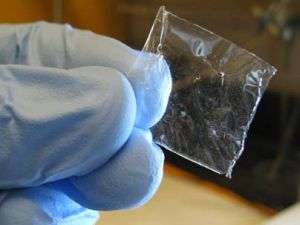
The new, thin material developed by MIT engineers for use in methanol fuel cells. Photo courtesy / Avni Argun and Nathan Ashcraft, MIT

MIT engineers have improved the power output of one type of fuel cell by more than 50 percent through technology that could help these environmentally friendly energy storage devices find a much broader market, particularly in portable electronics.

The new material key to the work is also considerably less expensive than its conventional industrial counterpart, among other advantages.

“Our goal is to replace traditional fuel-cell membranes with these cost-effective, highly tunable and better-performing materials,” said Paula T. Hammond, Bayer Professor of Chemical Engineering and leader of the research team. She noted that the new material also has potential for use in other electrochemical systems such as batteries.

The work was reported in a recent issue of Advanced Materials by Hammond, Avni A. Argun and J. Nathan Ashcraft. Argun is a postdoctoral associate in chemical engineering; Ashcraft is a graduate student in the same department.

Like a battery, a fuel cell has three principal parts: two electrodes (a cathode and anode) separated by an electrolyte. Chemical reactions at the electrodes produce an electronic current that can be made to flow through an appliance connected to the battery or fuel cell. The principal difference between the two" Fuel cells get their energy from an external source of hydrogen fuel, while conventional batteries draw from a finite source in a contained system.

The MIT team focused on direct methanol fuel cells (DMFCs), in which the methanol is directly used as the fuel and reforming of alcohol down to hydrogen is not required. Such a fuel cell is attractive because the only waste products are water and carbon dioxide (the latter produced in small quantities). Also, because methanol is a liquid, it is easier to store and transport than hydrogen gas, and is safer (it won't explode). Methanol also has a high energy density-a little goes a long way, making it especially interesting for portable devices.

The DMFCs currently on the market, however, have limitations. For example, the material currently used for the electrolyte sandwiched between the electrodes is expensive. Even more important: that material, known as Nafion, is permeable to methanol, allowing some of the fuel to seep across the center of the fuel cell. Among other disadvantages, this wastes fuel-and lowers the efficiency of the cell-because the fuel isn't available for the reactions that generate electricity.

Using a relatively new technique known as layer-by-layer assembly, the MIT researchers created an alternative to Nafion. “We were able to tune the structure of [our] film a few nanometers at a time,” Hammond said, getting around some of the problems associated with other approaches. The result is a thin film that is two orders of magnitude less permeable to methanol but compares favorably to Nafion in proton conductivity.

To test their creation, the engineers coated a Nafion membrane with the new film and incorporated the whole into a direct methanol fuel cell. The result was an increase in power output of more than 50 percent.

The team is now exploring whether the new film could be used by itself, completely replacing Nafion. To that end, they have been generating thin films that stand alone, with a consistency much like plastic wrap.

This work was supported by the DuPont-MIT Alliance through 2007. It is currently supported by the National Science Foundation.

Source: Massachusetts Institute of Technology


print this article email this article download pdf blog this article bookmark this article     Digg this Stumble it share on Facebook share on Reddit add to delicious save to Yahoo! bookmarks
4.4/5 after 49 votes

Rank Filter

Move the slider to adjust rank threshold, so that you can hide some of the comments.


Display comments: newest first

  • lengould100 - Aug 14, 2008
    • Rank: not rated yet
    I think the PR group is greatly exaggerating the benefits of methanol. Energy dense compared to what? Certainly not any currently common fuel.

May 15th, 2008 all stories
Physics / Condensed Matter

Comments: 1
Rank: 4.4/5 after 49 votes

  • Stumble this up

  • Digg this

  • Share it:
  • share on Facebook
  • share on MySpace
  • share on Slashdot
  • rss-newsfeed
  • share on Google
  • share on Reddit
  • add to delicious
  • save to Yahoo! bookmarks
  • share on Windows Live
  • Add to Mixx!
Rating: 4.4/5 after 49 votes


Tags


  • Physicists Demonstrate Quantum Memory with Matter Qubits
    Physicists Demonstrate Quantum Memory with Matter Qubits
    Physics / General Physics
    created 13 hours ago | popularity 4.8 / 5 (8) | comments 1
  • 'Holey' Nanosheets for Wastewater Dye Removal
    Nanotechnology / Nanomaterials
    created Jul 01, 2009 | popularity 5 / 5 (5) | comments 1
  • Jellyfish Robot Swims Like its Biological Counterpart
    Jellyfish Robot Swims Like its Biological Counterpart
    Electronics / Robotics
    created Jun 26, 2009 | popularity 4.4 / 5 (7) | comments 1
  • Could Maxwell's Demon Exist in Nanoscale Systems?
    Could Maxwell's Demon Exist in Nanoscale Systems?
    Physics / General Physics
    created Jun 24, 2009 | popularity 4.4 / 5 (18) | comments 29
  • Living Safely with Robots, Beyond Asimov's Laws
    Living Safely with Robots, Beyond Asimov's Laws
    Electronics / Robotics
    created Jun 22, 2009 | popularity 4.6 / 5 (50) | comments 39
  • Other News

    Physicists Demonstrate Quantum Memory with Matter Qubits

    Physicists Demonstrate Quantum Memory with Matter Qubits

    Physics / General Physics

    created 13 hours ago | popularity 4.8 / 5 (8) | comments 1

    (PhysOrg.com) -- For the first time, scientists have successfully operated a quantum gate between two remote particles of matter, marking an important step toward the development of a quantum computer. In ...


    Scientists create first electronic quantum processor

    Scientists create first electronic quantum processor

    Physics / General Physics

    created Jun 28, 2009 | popularity 4.8 / 5 (49) | comments 38

    A team led by Yale University researchers has created the first rudimentary solid-state quantum processor, taking another step toward the ultimate dream of building a quantum computer.


    Fermilab's CDF observes Omega-sub-b baryon

    Fermilab's CDF observes Omega-sub-b baryon

    Physics / General Physics

    created Jun 29, 2009 | popularity 4.6 / 5 (13) | comments 7

    (PhysOrg.com) -- At a recent physics seminar at the Department of Energy’s Fermi National Accelerator Laboratory, Fermilab physicist Pat Lukens of the CDF experiment announced the observation of a new particle, ...


    New insights, and a new angle, on high-temperature superconductivity

    New insights, and a new angle, on high-temperature superconductivity

    Physics / Superconductivity

    created Jun 29, 2009 | popularity 4.8 / 5 (12) | comments 6

    (PhysOrg.com) -- A Princeton-led research team has revealed surprising information about how electron behavior influences the conduction of electricity in a class of high-temperature superconductors. An increased ...


    The art of invisibility and the perfect cat's eye

    The art of invisibility and the perfect cat's eye

    Physics / Optics & Photonics

    created Jun 30, 2009 | popularity 3.9 / 5 (7) | comments 6

    (PhysOrg.com) -- In recent years scientists have explored the impossible by developing invisibility or 'cloaking' devices, but can the same technology also help make things more visible?