Scientists solve gravity-defying bird beak mystery
May 15th, 2008 Scientists solve gravity-defying bird beak mystery

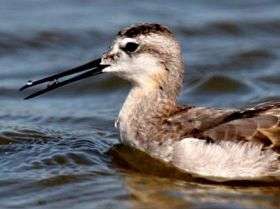
MIT researchers found that phalaropes depend on a surface interaction known as contact angle hysteresis to propel drops of water containing prey upward to their throats. Photo / Robert Lewis

As Charles Darwin showed nearly 150 years ago, bird beaks are exquisitely adapted to the birds' feeding strategy. A team of MIT mathematicians and engineers has now explained exactly how some shorebirds use their long, thin beaks to defy gravity and transport food into their mouths.

The phalarope, commonly found in western North America, takes advantage of surface interactions between its beak and water droplets to propel bits of food from the tip of its long beak to its mouth, the research team reports in the May 16 issue of Science.

These surface interactions depend on the chemical properties of the liquid involved, so phalaropes and about 20 other birds species that use this mechanism are extremely sensitive to anything that contaminates the water surface, especially detergents or oil.

“Some species rely exclusively on this feeding mechanism, and so are extremely vulnerable to oil spills,” said John Bush, MIT associate professor of applied mathematics and senior author of the paper.

Wildlife biologists have long noted the unusual feeding behavior of phalaropes, which spin in circles on the water, creating a vortex that sweeps small crustaceans up to the surface, just like tea leaves in a swirling tea cup.

The birds peck at the surface, picking up millimetric droplets of water with their prey trapped inside. Since the birds point their beaks downward during the feeding process, gravity must be overcome to get those droplets from the tip of the bird's long beak to its mouth. Until now, scientists have been puzzled as to how that happens.

Scientists speculated that the feeding strategy depended on the drop's surface tension. Surface tension normally dominates fluid systems that are small relative to raindrops (for example, the world of insects), but it was not clear how it could benefit shorebirds. A key observation was that in order to propel the drop, the birds open and close their beaks in a tweezering motion.

To unravel the mystery, Bush teamed up with Manu Prakash, a graduate student in MIT's Center for Bits and Atoms, and David Quere, of the Ecole Polytechnique in Paris, a visiting professor in MIT's math department at the time of the study. They built a mechanical model of the phalarope beak that allowed them to study the process in slow motion.

The process depends on a surface interaction known as contact angle hysteresis, typically an impediment to drop motion on solids. For example, raindrops stick to window panes due to contact angle hysteresis. In the case of the bird beak, the time-dependent beak geometry couples with contact angle hysteresis to propel the drop upward.

“This may be the first known example where droplet motion is enabled rather than resisted by contact angle hysteresis,” Bush said.

As the beak scissors open and shut, each movement propels the water droplet one step closer to the bird's mouth. Specifically, when the beak closes, the drop's leading edge proceeds toward the mouth, while the trailing edge stays put. When the beak opens, the leading edge stays in place while the trailing edge recedes toward the mouth.

In this stepwise ratcheting fashion, the drop travels along the beak at a speed of about 1 meter per second.

The efficiency of the process, which the authors dub the “capillary ratchet,” depends on the beak shape: Long, narrow beaks are best suited to this mode of feeding. The study highlights the sensitivity of this mechanism to the opening and closing angles of the beak: “Varying these angles by a few degrees can change the drop speed by a factor of 10,” Quere said.

The capillary ratchet also depends critically on the beak's wettability--a measure of a liquid's tendency to bead up into droplets or spread out to wet its surface. Oil is much more “wetting” than water, so if the beak is soaked in oil from a spill, this process won't work.

The researchers note a potential application of nature's design: “We are currently exploring microfluidic devices in which this mechanism could be exploited for directed droplet transport, allowing for controlled stepwise motion of microliter droplets,” Prakash said.

Source: Massachusetts Institute of Technology


print this article email this article download pdf blog this article bookmark this article     Digg this Stumble it share on Facebook share on Reddit add to delicious save to Yahoo! bookmarks
4.2/5 after 22 votes


May 15th, 2008 all stories
Other Sciences / Mathematics

Comments: 0
Rank: 4.2/5 after 22 votes

  • Stumble this up

  • Digg this

  • Share it:
  • share on Facebook
  • share on MySpace
  • share on Slashdot
  • rss-newsfeed
  • share on Google
  • share on Reddit
  • add to delicious
  • save to Yahoo! bookmarks
  • share on Windows Live
  • Add to Mixx!
Rating: 4.2/5 after 22 votes

  • Related Stories

  • Boom in wood stork numbers sparks debate over endangered status
    created Jul 01, 2009 | popularity not rated yet | comments 0
  • Researchers investigate new suspect in West Nile deaths of pelicans
    created Sep 28, 2007 | popularity not rated yet | comments 0
  • Colour pattern spurs speciation in tropical fish
    created May 28, 2007 | popularity not rated yet | comments 0
  • Dinosaurs -- stones did not help with digestion
    created Dec 20, 2006 | popularity not rated yet | comments 0
  • Engineers discover why toucan beaks are models of lightweight strength
    created Nov 30, 2005 | popularity not rated yet | comments 0

Tags


  • Physicists Demonstrate Quantum Memory with Matter Qubits
    Physicists Demonstrate Quantum Memory with Matter Qubits
    Physics / General Physics
    created Jul 03, 2009 | popularity 4.4 / 5 (17) | comments 1
  • 'Holey' Nanosheets for Wastewater Dye Removal
    Nanotechnology / Nanomaterials
    created Jul 01, 2009 | popularity 5 / 5 (5) | comments 1
  • Jellyfish Robot Swims Like its Biological Counterpart
    Jellyfish Robot Swims Like its Biological Counterpart
    Electronics / Robotics
    created Jun 26, 2009 | popularity 4.4 / 5 (8) | comments 1
  • Could Maxwell's Demon Exist in Nanoscale Systems?
    Could Maxwell's Demon Exist in Nanoscale Systems?
    Physics / General Physics
    created Jun 24, 2009 | popularity 4.4 / 5 (18) | comments 29
  • Living Safely with Robots, Beyond Asimov's Laws
    Living Safely with Robots, Beyond Asimov's Laws
    Electronics / Robotics
    created Jun 22, 2009 | popularity 4.6 / 5 (52) | comments 40
  • Other News

    Creation Museum president Ken A. Ham

    Paleontologists brought to tears, laughter by Creation Museum

    Other Sciences / Other

    created Jun 30, 2009 | popularity 4.3 / 5 (41) | comments 120

    For a group of paleontologists, a tour of the Creation Museum seemed like a great tongue-in-cheek way to cap off a serious conference.


    Tourists enjoy a "Pineapple Tour" in Costa Rica

    Costa Rica tops happiness, 'green living' poll

    Other Sciences / Social Sciences

    created 23 hours ago | popularity 2 / 5 (2) | comments 0

    Costa Rica is the happiest place on earth, and one of the most environmentally friendly, according to a new survey by a British non-governmental group.


    Mummified dinosaur skin yields up new secrets

    Mummified dinosaur skin yields up new secrets

    Other Sciences / Archaeology & Fossils

    created Jul 01, 2009 | popularity 4.7 / 5 (14) | comments 10

    (PhysOrg.com) -- Scientists from The University of Manchester have identified preserved organic molecules in the skin of a dinosaur that died around 66-million years ago.


    Liberal? Conservative? Stanford study says mental nudge can make voters flip-flop

    Liberal? Conservative? Stanford study says mental nudge can make voters flip-flop

    Other Sciences / Social Sciences

    created Jul 02, 2009 | popularity 3.8 / 5 (5) | comments 4

    (PhysOrg.com) -- No doubt you’ve worked hard for your success. But chances are you’ve also had some help and lucky breaks along the way.


    Probing Question: How do Ponzi Schemes work?

    Other Sciences / Economics

    created Jul 02, 2009 | popularity 5 / 5 (1) | comments 2

    Imagine the shock, the horror, and the sheer panic that would come with learning that the financial plan you’d sunk your life savings into was a sham, the financial experts you trusted were crooks, and all your money was ...