First evidence of native dendritic cells in brain
May 15, 2008 First evidence of native dendritic cells in brain

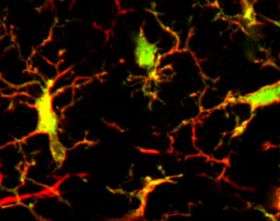
Immunity inside. The brain's population of immunity-directing dendritic cells (green and yellow) can be seen here in the subventricular zone — an area of postnatal neuron development.

In a finding that has the potential to change the way researchers think about the brain, scientists at Rockefeller University have found dendritic cells where they’ve never been seen before: among this organ’s neurons and connective cells.

The immunity-directing dendritic cell had previously been seen in the human nervous system only after brain injury or disease. But the new study, published next month in the Journal of Comparative Neurology, shows for the first time that the brain has its own, resident population of dendritic cells that may serve as a line of defense against pathogens that sneak past the blood-brain barrier.

The brain is packed with different types of microglia — cells that perform a variety of immune functions in the central nervous system. Until now, however, no one had identified dendritic cells among them. Research associate professor Karen Bulloch and her colleagues made their discovery using mice bred to have a fluorescent marker attached to a dendritic-cell specific protein.

Originally developed by Rockefeller scientists to help them visualize dendritic cells in immune tissues, Bulloch reasoned that the mice might be helpful in determining whether dendritic cells are also in the central nervous system. Bulloch, who’s spent a lot of time studying microglia, knew exactly where in the brain to look. But what she saw when she first peered through the microscope surprised her so much, she says, “I literally almost fell off my chair.”

Once they had confirmed that the brain seems to develop its own population of dendritic cells, the researchers, with the help of graduate student Melinda Miller, mapped the cells’ locations. “They ended up in places I just didn’t understand,” Bulloch says. So she did a bit of digging and discovered that the protective dendritic cells appeared in areas of the brain associated with postnatal neuron formation, as well as along nasal-associated pathways through which viruses, bacteria and toxic chemicals can gain direct access to the brain. “The dendritic cells serve both as shepherds of newborn nerve cells and as gatekeepers, which police intruding molecules that may come into the brain through these pathways.”

The discovery that some dendritic cells that are native to the brain, rather than just infiltrating during traumatic events, comes with a wide range of implications. “Their location suggests a multiplicity of functions, ranging from surveillance to participation in a number of events in the brain,” says Bruce McEwen, Alfred E. Mirsky Professor and head of the Harold and Margaret Milliken Hatch Laboratory of Neuroendocrinology, where the work was conducted. But their position might also be an important factor to consider when evaluating drug administration, since certain vaccines and medications are now given nasally.

“In a way, it’s reassuring that there are cells there monitoring for invaders. On the other hand, it raises questions about the wisdom of that vaccine approach in the first place. The degree to which these drug molecules might alter the immune system of the brain is unknown,” McEwen says.

Citation: The Journal of Comparative Neurology 508(5): 687-710 (June 10, 2008)

Source: Rockefeller University


print this article email this article download pdf blog this article bookmark this article     Stumble it Digg this share on Facebook retweet share on Reddit add to delicious
Rate this story - 4.7 /5 (10 votes)


May 15, 2008 all stories

Comments: 0

4.7 /5 (10 votes)
  • Stumble this up

  • Digg this

  • share this

  • hide
  • Related Stories

  • Could some forms of mental retardation be treated with drugs?
    created Oct 20, 2009 | popularity not rated yet | comments 0
  • Researchers identify key behavior of immune response to Listeria
    created Oct 06, 2009 | popularity not rated yet | comments 0
  • Function of a neglected structure in neurons revealed after 50 years
    created Sep 08, 2009 | popularity not rated yet | comments 0
  • Getting wired: How the brain does it
    created Aug 26, 2009 | popularity not rated yet | comments 0
  • Traffic jam in brain causes schizophrenia symptoms
    created Aug 10, 2009 | popularity not rated yet | comments 0


  • hide
  • Relevant PhysicsForums posts

  • Swine flu vaccination
    created 6 hours ago
  • Improving the brain through chemistry
    created Nov 07, 2009
  • Sleep / REM Sleep and homeostasis
    created Nov 07, 2009
  • The Biceps Reflex
    created Nov 05, 2009
  • More from Physics Forums - Medical Sciences

Other News

FDA approved leukemia drugs shows promise in ovarian cancer cells

Medicine & Health / Cancer

created 8 minutes ago | popularity not rated yet | comments 0

The drug Sprycel, approved for use by the U.S. Food and Drug Administration in patients with chronic myeloid leukemia, significantly inhibited the growth and invasiveness of ovarian cancer cells and also promoted their death, ...


'Emotions increase or decrease pain': researchers

Medicine & Health / Research

created 58 minutes ago | popularity not rated yet | comments 0

Getting a flu shot this fall? Canadians scientists have found that focusing on a pretty image could alleviate the sting of that vaccine. According to a new Université de Montréal study, published in the latest ...


Routine evaluation of prostate size not as effective in cancer screening (w/ Video)

Medicine & Health / Cancer

created 38 minutes ago | popularity not rated yet | comments 0

New Mayo Clinic research studied the association between prostate-specific antigen (PSA) levels and prostate size and found that routine annual evaluation of prostate growth is not necessarily a predictor for the development ...


CWRU to develop technologies for virtual coaching to help patient-doctor communications

Medicine & Health / Other

created 18 minutes ago | popularity not rated yet | comments 0

Millions of people suffer from chronic ailments like heart disease, high blood pressure or diabetes, and need critical information from their healthcare providers to manage those diseases.


The missionary doctor

The missionary doctor

Medicine & Health / Other

created 38 minutes ago | popularity not rated yet | comments 0

(PhysOrg.com) -- Dr. Kenneth Chang has built one of the nation's finest digestive disease centers for UC Irvine Healthcare with a drive and passion inspired by doctors he assisted in a poor Taiwanese fishing ...