Simple Model Cell is Key to Understanding Cell Complexity
May 15th, 2008 Simple Model Cell is Key to Understanding Cell Complexity

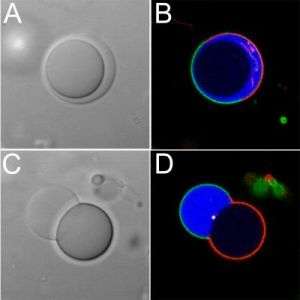
The model cell developed in the lab of Christine D. Keating at Penn State uses as the cytoplasm a solution of two different polymers, PEG and dextran (Panel A). The image in Panel B is the image in Panel A highlighted with fluorescent dyes. The blue region is PEG, which is concentrated in the outer polymer solution; the green area is the portion of the membrane that contains PEG groups, which interact with the contents of the cell; and the red area is the portion of the membrane with fewer PEG groups, which interact with the contents of the cell to a lesser extent. After exposure to a concentrated solution of sugar, the cell converted to a budded form (Panel C). A dextran-rich mixture filled the bud, while a PEG-rich mixture remained inside the body of the cell. Panel D shows the image in Panel C highlighted with fluorescent dyes. The blue area is the PEG-rich region. This new structure exhibits polarity both in the membrane and in the aqueous interior of the model cell. Credit: Christine D. Keating lab, Penn State

A team of Penn State researchers has developed a simple artificial cell with which to investigate the organization and function of two of the most basic cell components: the cell membrane and the cytoplasm--the gelatinous fluid that surrounds the structures in living cells. The work could lead to the creation of new drugs that take advantage of properties of cell organization to prevent the development of diseases. The team's findings will be published later this month (late May 2008) in the Journal of the American Chemical Society.

"Many scientists are trying to understand cells by turning off genes, one at a time, and are observing the effects on cell function, but we're doing the opposite," said Associate Professor of Chemistry Christine D. Keating, who led the research. "We're starting from scratch, adding in components to find out what is needed to simulate the most basic cell functions. Our goal is to find out how much complexity can be observed in very simple collections of molecules."

Building on previous work that was published in the 16 January 2008 issue of Journal of the American Chemical Society, Keating and her colleagues built a model cell using as the cytoplasm a solution of two different polymers: polyethyleneglycol (PEG) and dextran. The researchers encapsulated this polymer solution inside a cell membrane and, because the two polymers do not mix, one of the phases surrounded the other like the white of an egg around a yolk. The team then exposed the cell to a concentrated solution of sugar. Through a process known as osmosis--in which water diffuses across a cell membrane from a region of higher water concentration to a region of lower water concentration--water traveled from the relatively diluted polymer solution inside the cell to the more concentrated sugar solution outside the cell. As a result, the volume of the polymer solution inside the membrane was reduced.

With a cell membrane that was now too large and also unconstrained by its spherical shape, the cell converted to a budded form. A dextran-rich mixture filled the bud while a PEG-rich mixture remained inside the body of the cell. This new structure exhibited the type of complexity that the team had been looking for; it exhibited polarity. "Polarity is critical to development," said Keating. "It is an important first step in the development of a complex multi-cellular organism, like a human being, in which different cells perform different functions."

In previous work, the team created a membrane that was entirely uniform, but in their most recent paper, they describe an asymmetric membrane containing a mixture of lipid molecules. Some of these lipid molecules contained tiny pieces of PEG, which interacted with the PEG in the cytoplasm, thus generating polarity in the model cell. "Our work demonstrated the interrelationship of the cytoplasm and the cell membrane," said Keating.

The team's next step is to create a cascade in polarity. "By creating a model cytoplasm with different compositions, we demonstrated that we can control the behavior of cell membranes," said Keating. "Now we want to find out what will happen if, for example, we add an enzyme whose activity depends on the compositions of the cytoplasm and cell membrane."

Although Keating and her colleagues plan to continue adding components to their model cell, they don't expect to make a real cell. "We aren't trying to generate life here. Rather, we want to understand the physical principles that govern biological systems," said Keating. "For me the big picture is trying to understand how the staggering complexity observed in biological systems might have arisen from seemingly simple chemical and physical principles."

Source: Penn State


print this article email this article download pdf blog this article bookmark this article     Digg this Stumble it share on Facebook share on Reddit add to delicious save to Yahoo! bookmarks
4.8/5 after 5 votes

Rank Filter

Move the slider to adjust rank threshold, so that you can hide some of the comments.


Display comments: newest first

  • E_L_Earnhardt - May 16, 2008
    • Rank: not rated yet
    GOOD WORK! Add mitochondria and the whole thing may begin to function! See "Plant Biologists Discover Unexpected Proteins -" (PHYSORG.COM May 15)

May 15th, 2008 all stories
Chemistry /

Comments: 1
Rank: 4.8/5 after 5 votes

  • Stumble this up

  • Digg this

  • Share it:
  • share on Facebook
  • share on MySpace
  • share on Slashdot
  • rss-newsfeed
  • share on Google
  • share on Reddit
  • add to delicious
  • save to Yahoo! bookmarks
  • share on Windows Live
  • Add to Mixx!
Rating: 4.8/5 after 5 votes


Tags


  • Physicists Demonstrate Quantum Memory with Matter Qubits
    Physicists Demonstrate Quantum Memory with Matter Qubits
    Physics / General Physics
    created Jul 03, 2009 | popularity 4.4 / 5 (17) | comments 1
  • 'Holey' Nanosheets for Wastewater Dye Removal
    Nanotechnology / Nanomaterials
    created Jul 01, 2009 | popularity 5 / 5 (5) | comments 1
  • Jellyfish Robot Swims Like its Biological Counterpart
    Jellyfish Robot Swims Like its Biological Counterpart
    Electronics / Robotics
    created Jun 26, 2009 | popularity 4.4 / 5 (8) | comments 1
  • Could Maxwell's Demon Exist in Nanoscale Systems?
    Could Maxwell's Demon Exist in Nanoscale Systems?
    Physics / General Physics
    created Jun 24, 2009 | popularity 4.4 / 5 (18) | comments 29
  • Living Safely with Robots, Beyond Asimov's Laws
    Living Safely with Robots, Beyond Asimov's Laws
    Electronics / Robotics
    created Jun 22, 2009 | popularity 4.6 / 5 (52) | comments 40
  • Other News

    Scientists find molecule that regulates heart size by using zebrafish screening model

    Chemistry / Biochemistry

    created 2 hours ago | popularity not rated yet | comments 0

    Using zebrafish, researchers at the University of Pittsburgh have identified and described an enzyme inhibitor that allows them to increase the number of cardiac progenitor cells and therefore influence the size of the developing ...


    urine

    Producing hydrogen from urine

    Chemistry / Analytical Chemistry

    created Jul 03, 2009 | popularity 4.6 / 5 (32) | comments 17

    (PhysOrg.com) -- You do two things at motorway services: fill up one tank and empty another. US chemists have combined refuelling your car and relieving yourself by creating a new catalyst that can extract ...


    Scientists find a biological 'fountain of youth' in new world bat caves

    Chemistry / Biochemistry

    created Jun 30, 2009 | popularity 3.8 / 5 (25) | comments 28

    Scientists from Texas are batty over a new discovery which could lead to the single most important medical breakthrough in human history -- significantly longer lifespans. The discovery, featured on the cover of the July ...


    Stanford researchers find a quicker, cheaper way to sort isotopes

    Researchers find quicker, cheaper way to sort isotopes

    Chemistry / Analytical Chemistry

    created Jun 29, 2009 | popularity 5 / 5 (2) | comments 3

    (PhysOrg.com) -- Whether it's the summer grass that tickles your feet or the red Bordeaux smacking on your palette, nearly every part of the world around you carries special chemical markers. These markers, ...


    Oxygen key to 'cut and paste' of genes

    Oxygen key to 'cut and paste' of genes

    Chemistry / Biochemistry

    created Jul 03, 2009 | popularity 4.5 / 5 (4) | comments 0

    (PhysOrg.com) -- An oxygen-sensitive enzyme has been found to play a key role in how genes create the many different proteins that make up our bodies.