Self-repairing aircraft could revolutionize aviation safety
May 19th, 2008 Self-repairing aircraft could revolutionize aviation safety

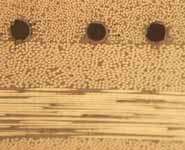
No hollow achievement: hollow glass fibres embedded in carbon fibre reinforced plastic could be the key to safer flying. Photo by EPSRC

A new technique that mimics healing processes found in nature could enable damaged aircraft to mend themselves automatically, even during a flight.

As well as the obvious safety benefits, this breakthrough could make it possible to design lighter aeroplanes in future. This would lead to fuel savings, cutting costs for airlines and passengers and reducing carbon emissions too.

The technique works like this. If a tiny hole/crack appears in the aircraft (e.g. due to wear and tear, fatigue, a stone striking the plane etc), epoxy resin would ‘bleed’ from embedded vessels near the hole/crack and quickly seal it up, restoring structural integrity. By mixing dye into the resin, any ‘self-mends’ could be made to show as coloured patches that could easily be pinpointed during subsequent ground inspections, and a full repair carried out if necessary.

This simple but ingenious technique, similar to the bruising and bleeding/healing processes we see after we cut ourselves, has been developed by aerospace engineers at Bristol University, with funding from the Engineering and Physical Sciences Research Council (EPSRC). It has potential to be applied wherever fibre-reinforced polymer (FRP) composites are used. These lightweight, high-performance materials are proving increasingly popular not only in aircraft but also in car, wind turbine and even spacecraft manufacture. The new self-repair system could therefore have an impact in all these fields.

The technique’s innovative aspect involves filling the hollow glass fibres contained in FRP composites with resin and hardener. If the fibres break, the resin and hardener ooze out, enabling the composite to recover up to 80-90% of its original strength – comfortably allowing a plane to function at its normal operational load.

“This approach can deal with small-scale damage that’s not obvious to the naked eye but which might lead to serious failures in structural integrity if it escapes attention,” says Dr Ian Bond, who has led the project. “It’s intended to complement rather than replace conventional inspection and maintenance routines, which can readily pick up larger-scale damage, caused by a bird strike, for example.”

By further improving the already excellent safety characteristics of FRP composites, the self-healing system could encourage even more rapid uptake of these materials in the aerospace sector. A key benefit would be that aircraft designs including more FRP composites would be significantly lighter than the primarily aluminium-based models currently in service. Even a small reduction in weight equates to substantial fuel savings over an aircraft’s lifetime.

“This project represents just the first step”, says Ian Bond. “We’re also developing systems where the healing agent isn’t contained in individual glass fibres but actually moves around as part of a fully integrated vascular network, just like the circulatory systems found in animals and plants. Such a system could have its healing agent refilled or replaced and could repeatedly heal a structure throughout its lifetime. Furthermore, it offers potential for developing other biological-type functions in man-made structures, such as controlling temperature or distributing energy sources.”

The new self-repair technique developed by the current EPSRC-funded project could be available for commercial use within around four years.

Source: Engineering and Physical Sciences Research Council


print this article email this article download pdf blog this article bookmark this article     Digg this Stumble it share on Facebook share on Reddit add to delicious save to Yahoo! bookmarks
4.6/5 after 54 votes

Rank Filter

Move the slider to adjust rank threshold, so that you can hide some of the comments.


Display comments: newest first

  • Mercury_01 - May 19, 2008
    • Rank: 3 / 5 (1)
    Brilliant!
  • h0dges - May 19, 2008
    • Rank: 4 / 5 (1)
    This technique was talked about on BBC Radio 4's Material World programme on 24/01/2008 with Ian Bond from the Department Aerospace Engineering at Bristol University and Frank Jones from the Department of Engineering Materials at Sheffield University.

    Link: http://www.bbc.co...24.shtml

    You can listen here: http://www.bbc.co...0124.ram

    My lecturer is on it! :-)
  • CWFlink - May 19, 2008
    • Rank: 4 / 5 (1)
    How much does the resin and hardener impact the weight of the material? One of the reasons fiberglass is used is precisely because it weights less due to the hollow fibers. If they are filled, doesn't that bring the weight up significantly? At what point does this heavy, self-healing fiberglass become no more cost effective than an equivalently strong, but much harder material to damage (e.g. thin stainless steel or titanium?)
  • Eco_R1 - May 20, 2008
    • Rank: 3 / 5 (1)
    That%u2019s okay for anything stationary but when the resin would start oozing out the fuselage of a plane traveling at 500mph, it would not fill the tear/gap the way it should due to extreme friction from the air.
  • Mercury_01 - May 21, 2008
    • Rank: 4 / 5 (1)
    First off, fiberglass normally used in aircraft construction isnt hollow. Second, it wouldnt be any heavyer. think about it. the resin inside the fibers is displacing the cured resin around it. if the part is the same size, it would have uncured resin in the fibers, and less cured resin outside the fibers, therefore it remains the same weight, provided that the resin inside the fibers has the same material density.
    As for the comment about the wind force above, dont be retarded. the skin of the airplane is of no concern. it never breaks, and if it does, its because the support structures have failed. spars and ribs would be the main application for this technology. furthermore, if there was a crack in the structure, there wouldnt be any gap to fill, more like an area of stressed fibers that would soak up the resin through capilary action. if there was ever a gap in an airframe, you can bet on catastrophic failure.

    (designing engineer in the industry)

May 19th, 2008 all stories
Technology / Engineering

Comments: 5
Rank: 4.6/5 after 54 votes

  • Stumble this up

  • Digg this

  • Share it:
  • share on Facebook
  • share on MySpace
  • share on Slashdot
  • rss-newsfeed
  • share on Google
  • share on Reddit
  • add to delicious
  • save to Yahoo! bookmarks
  • share on Windows Live
  • Add to Mixx!
Rating: 4.6/5 after 54 votes

  • Related Stories

  • Composites for energy
    created Jun 30, 2009 | popularity not rated yet | comments 0
  • GE to open advanced tech center in Michigan
    created Jun 26, 2009 | popularity not rated yet | comments 0
  • Highly conductive nanocomposites: Inexpensive plastic used in CDs could improve electronics
    created May 15, 2009 | popularity not rated yet | comments 0
  • Fitter frames: Nanotubes boost structural integrity of composites
    created Mar 26, 2009 | popularity not rated yet | comments 0
  • 'Nanostitching' could strengthen airplane skins, more
    created Mar 04, 2009 | popularity not rated yet | comments 0

Tags


  • Physicists Demonstrate Quantum Memory with Matter Qubits
    Physicists Demonstrate Quantum Memory with Matter Qubits
    Physics / General Physics
    created Jul 03, 2009 | popularity 4.4 / 5 (17) | comments 1
  • 'Holey' Nanosheets for Wastewater Dye Removal
    Nanotechnology / Nanomaterials
    created Jul 01, 2009 | popularity 5 / 5 (5) | comments 1
  • Jellyfish Robot Swims Like its Biological Counterpart
    Jellyfish Robot Swims Like its Biological Counterpart
    Electronics / Robotics
    created Jun 26, 2009 | popularity 4.4 / 5 (8) | comments 1
  • Could Maxwell's Demon Exist in Nanoscale Systems?
    Could Maxwell's Demon Exist in Nanoscale Systems?
    Physics / General Physics
    created Jun 24, 2009 | popularity 4.4 / 5 (18) | comments 29
  • Living Safely with Robots, Beyond Asimov's Laws
    Living Safely with Robots, Beyond Asimov's Laws
    Electronics / Robotics
    created Jun 22, 2009 | popularity 4.6 / 5 (52) | comments 40
  • Other News

    Geeks double as scourges and sages at media summit

    Technology / Business

    created 4 hours ago | popularity not rated yet | comments 0

    (AP) -- The media moguls attending an annual powwow staged by investment bank Allen & Co. used to be able to rest comfortably in the Idaho mountains as they mulled their next moves.


    Japan demands 119 million dlrs in tax from Amazon: report

    Technology / Business

    created 7 hours ago | popularity 3 / 5 (1) | comments 0

    Japanese authorities told a sales affiliate of US retail giant Amazon.com to pay about 119 million dollars in tax for unreported income over a three-year period, a newspaper said Sunday.


    Iconic skyscrapers find new luster by going green (AP)

    Iconic skyscrapers find new luster by going green

    Technology / Energy

    created 8 hours ago | popularity 1 / 5 (1) | comments 0

    (AP) -- When owners of the Empire State Building decided to blanket its towering facade this year with thousands of insulating windows, they were only partly interested in saving energy. They also needed ...


    Downturn dating: Hearts flutter as markets stutter (AP)

    Downturn dating: Hearts flutter as markets stutter

    Technology / Internet

    created 8 hours ago | popularity not rated yet | comments 0

    (AP) -- Credit the recession for "staycations" and bringing us more game-night parties at home. But also give it a shout for spurring more first dates.


    UK spy chief's family details posted on Facebook

    Technology / Internet

    created 8 hours ago | popularity not rated yet | comments 0

    (AP) -- He's the spy who came in from the beach.