The mouse that roared: pipsqueak star unleashes monster flare
May 19, 2008
The mouse that roared: pipsqueak star unleashes monster flare

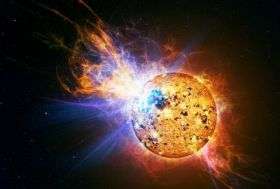
An artist depiction of the incredibly powerful flare that erupted from the red dwarf star EV Lacertae. Credit: Casey Reed/NASA

On April 25, NASA’s Swift satellite picked up the brightest flare ever seen from a normal star other than our Sun. The flare, an explosive release of energy from a star, packed the power of thousands of solar flares. It would have been visible to the naked eye if the star had been easily observable in the night sky at the time.

The star, known as EV Lacertae, isn’t much to write home about. It’s a run-of-the-mill red dwarf, by far the most common type of star in the universe. It shines with only one percent of the Sun’s light, and contains only a third of the Sun’s mass. At a distance of only 16 light-years, EV Lacertae is one of our closest stellar neighbors. But with its feeble light output, its faint magnitude-10 glow is far below naked-eye visibility.

"Here’s a small, cool star that shot off a monster flare. This star has a record of producing flares, but this one takes the cake," says Rachel Osten, a Hubble Fellow at the University of Maryland, College Park and NASA’s Goddard Space Flight Center in Greenbelt, Md. "Flares like this would deplete the atmospheres of life-bearing planets, sterilizing their surfaces."

The flare was first seen by the Russian-built Konus instrument on NASA’s Wind satellite in the early morning hours of April 25. Swift’s X-ray Telescope caught the flare less than two minutes later, and quickly slewed to point toward EV Lacertae. When Swift tried to observe the star with its Ultraviolet/Optical Telescope, the flare was so bright that the instrument shut itself down for safety reasons. The star remained bright in X-rays for 8 hours before settling back to normal.

EV Lacertae can be likened to an unruly child that throws frequent temper tantrums. The star is relatively young, with an estimated age of a few hundred million years. The star rotates once every four days, which is much faster than the sun, which rotates once every four weeks. EV Lacertae’s fast rotation generates strong localized magnetic fields, making it more than 100 times as magnetically powerful as the Sun’s field. The energy stored in its magnetic field powers these giant flares.

EV Lacertae’s constellation, Lacerta, is visible in the spring for only a few hours each night in the Northern Hemisphere. But if the star had been more easily visible, the flare probably would have been bright enough that the star could have been seen with the naked eye for one to two hours.

The flare’s incredible brightness enabled Swift to make detailed measurements. "This gives us a golden opportunity to study a stellar flare on a second-by-second basis to see how it evolved," says Stephen Drake of NASA Goddard.

Since EV Lacertae is 15 times younger than our Sun, it gives us a window into our solar system’s early history. Younger stars rotate faster and generate more powerful flares, so in its first billion years the sun must have let loose millions of energetic flares that would have profoundly affected Earth and the other planets.

Flares release energy across the electromagnetic spectrum, but the extremely high gas temperatures produced by flares can only be studied with high-energy telescopes like those on Swift. Swift's wide field and rapid repointing capabilities, designed to study gamma-ray bursts, make it ideal for studying stellar flares. Most other X-ray observatories have studied this star and others like it, but they have to be extremely lucky to catch and study powerful flares due to their much smaller fields of view.

Says Eric Feigelson of Penn State University in University Park, Pa., "I find it remarkable that a satellite designed to detect the explosive birth of black holes in distant galaxies can also detect explosions on stars in the immediate neighborhood of our Sun."

Source: NASA's Goddard Space Flight Center

4.6 /5 (36 votes)  

Filter


Move the slider to adjust rank threshold, so that you can hide some of the comments.


Display comments: newest first

brant
May 19, 2008

Rank: 2 / 5 (2)
"I find it remarkable that a satellite designed to detect the explosive birth of black holes in distant galaxies can also detect explosions on stars in the immediate neighborhood of our Sun."

You gotta be kidding me.....
Rank 4.6 /5 (36 votes)
Tags

Relevant PhysicsForums posts
  • Scale of the Universe
    created8 hours ago
  • Titan's lack of impact craters
    createdFeb 09, 2012
  • Real pictures of black hole eating a star?
    createdFeb 08, 2012
  • Hypothetical way to travel faster than light, but not technically exceed lightspeed
    createdFeb 06, 2012
  • How do scientists monitor the Sun's activity?
    createdFeb 05, 2012
  • Search patterns in observational studies
    createdFeb 05, 2012
  • More from Physics Forums - General Astronomy

More news stories

Humans may have helped the decline of African rainforests 3000 years ago

(PhysOrg.com) -- Large areas of rainforests in Central Africa mysteriously disappeared over three thousand years ago, to be replaced by savannas. The prevailing theory has been that the cause was a change ...

Space & Earth / Environment

created 19 hours ago | popularity 4.3 / 5 (11) | comments 12 | with audio podcast report

Could Venus be shifting gear?

(PhysOrg.com) -- ESA’s Venus Express spacecraft has discovered that our cloud-covered neighbour spins a little slower than previously measured. Peering through the dense atmosphere in the infrared, the ...

Space & Earth / Space Exploration

created 15 hours ago | popularity 5 / 5 (7) | comments 7 | with audio podcast

NASA budget will axe Mars deal with Europe: scientists

US President Barack Obama's budget proposal to be submitted next week for 2013 will cut NASA's budget by 20 percent and eliminate a major partnership with Europe on Mars exploration, scientists said Thursday.

Space & Earth / Space Exploration

created 18 hours ago | popularity 5 / 5 (2) | comments 18

Mars Science Laboratory computer issue resolved

(PhysOrg.com) -- Engineers have found the root cause of a computer reset that occurred two months ago on NASA's Mars Science Laboratory and have determined how to correct it.

Space & Earth / Space Exploration

created 16 hours ago | popularity 4.7 / 5 (6) | comments 3 | with audio podcast

Two new moons for Jupiter

Advances in technology have lead to the discovery of new planets outside of our Solar System, and now even new moons in our own backyard.

Space & Earth / Space Exploration

created 15 hours ago | popularity 4 / 5 (1) | comments 7


Google users warned of threat to smartphone wallets

Users of Google smartphone wallets were being warned on Friday that there is a way to crack pass codes intended to thwart thieves from going on illicit shopping sprees.

Anonymous knocks CIA website offline (Update)

The website of the Central Intelligence Agency was inaccessible on Friday after the hacker group Anonymous claimed to have knocked it offline.

New error-correcting codes guarantee the fastest possible rate of data transmission

Error-correcting codes are one of the triumphs of the digital age. They’re a way of encoding information so that it can be transmitted across a communication channel — such as an optical fiber o ...

New power source discovered

(PhysOrg.com) -- Researchers at the Massachusetts Institute of Technology (MIT) and RMIT University have made a breakthrough in energy storage and power generation.

Complex wiring of the nervous system may rely on a just a handful of genes and proteins

Researchers at the Salk Institute have discovered a startling feature of early brain development that helps to explain how complex neuron wiring patterns are programmed using just a handful of critical genes. ...

The power of estrogen -- male snakes attract other males

A new study has shown that boosting the estrogen levels of male garter snakes causes them to secrete the same pheromones that females use to attract suitors, and turned the males into just about the sexiest ...