Antennae Galaxies

May 19, 2008 Antennae Galaxies

Image Credit: NASA, ESA, and the Hubble Heritage Team (STScI/AURA)-ESA/Hubble Collaboration

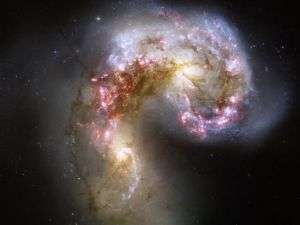
This image of the Antennae galaxies is the sharpest yet of this merging pair of galaxies. During the course of the collision, billions of stars will be formed. The brightest and most compact of these star birth regions are called super star clusters.

The two spiral galaxies started to interact a few hundred million years ago, making the Antennae galaxies one of the nearest and youngest examples of a pair of colliding galaxies.

Nearly half of the faint objects in the Antennae image are young clusters containing tens of thousands of stars. The orange blobs to the left and right of image center are the two cores of the original galaxies and consist mainly of old stars criss-crossed by filaments of dust, which appears brown in the image. The two galaxies are dotted with brilliant blue star-forming regions surrounded by glowing hydrogen gas, appearing in the image in pink.

The new image allows astronomers to better distinguish between the stars and super star clusters created in the collision of two spiral galaxies. By age dating the clusters in the image, astronomers find that only about 10 percent of the newly formed super star clusters in the Antennae will survive beyond the first 10 million years.

The vast majority of the super star clusters formed during this interaction will disperse, with the individual stars becoming part of the smooth background of the galaxy. It is however believed that about a hundred of the most massive clusters will survive to form regular globular clusters, similar to the globular clusters found in our own Milky Way galaxy.

The Antennae galaxies take their name from the long antenna-like "arms" extending far out from the nuclei of the two galaxies, best seen by ground-based telescopes. These "tidal tails" were formed during the initial encounter of the galaxies some 200 to 300 million years ago. They give us a preview of what may happen when our Milky Way galaxy collides with the neighboring Andromeda galaxy in several billion years.

Source: NASA


print this article email this article download pdf blog this article bookmark this article     Stumble it Digg this share on Facebook retweet share on Reddit add to delicious
Rate this story - 4.7 /5 (18 votes)


May 19, 2008 all stories

Comments: 0

4.7 /5 (18 votes)
  • Stumble this up

  • Digg this

  • share this

  • hide
  • Related Stories


  • hide
  • Relevant PhysicsForums posts

  • Consistency of Meteor Shower Dates (i.e. the peak of Perseids always on Aug 13th)
    created 10 hours ago
  • Favourite Astronomy Book?
    created Nov 10, 2009
  • dark energy
    created Nov 10, 2009
  • The shape of our solar system's orbits.
    created Nov 07, 2009
  • More from Physics Forums - General Astronomy

Other News

Reducing greenhouse gases may not be enough to slow climate change

Space & Earth / Environment

created 1hour ago | popularity 5 / 5 (1) | comments 0

Georgia Tech City and Regional Planning Professor Brian Stone publishes a paper in the December edition of Environmental Science and Technology that suggests policymakers need to address the influence of global deforestation ...


Rapid star formation spotted in 'stellar nurseries' of infant galaxies

Rapid star formation spotted in 'stellar nurseries' of infant galaxies

Space & Earth / Astronomy

created 1hour ago | popularity not rated yet | comments 0

The Universe's infant galaxies enjoyed rapid growth spurts forming stars like our sun at a rate of up to 50 stars a year, according to scientists at Durham University.


Controversial new climate change results

Controversial new climate change results

Space & Earth / Environment

created 23 hours ago | popularity 4.2 / 5 (24) | comments 22

(PhysOrg.com) -- New data show that the balance between the airborne and the absorbed fraction of CO2 has stayed approximately constant since 1850, despite emissions of CO2 having risen from about 2 billion ...


The Stars My Destination

The Stars My Destination

Space & Earth / Space Exploration

created 14 hours ago | popularity 5 / 5 (15) | comments 0

The Voyager spacecraft are now in the outermost layer of the heliosphere, traveling toward interstellar space - the first man-made spacecraft to travel such a vast distance from Earth.


Earth

Atomic Particles Help Solve Planetary Puzzle

Space & Earth / Earth Sciences

created 13 hours ago | popularity 4.6 / 5 (8) | comments 0

(PhysOrg.com) -- A University of Arkansas professor and his colleagues have shown that the Earth's mantle contains the same isotopic signatures from magnesium as meteorites do, suggesting that the planet formed ...