University of Chicago launches first archaeological dig at site of 1893 World's Fair
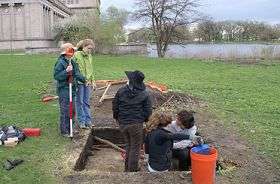
A group of undergraduates at the University of Chicago has come in touch with the 1893 World's Columbian Exposition, launching the first archaeological dig of the famed Chicago fair site in Jackson Park.
"When I came to Chicago, I didn't know much about the fair, but this has been a really interesting way to find out more about it," said John Mullen, a fourth-year student and part of a 20-member class on urban archaeology. "The fair had a huge impact, not only on Chicago, but also on the world, with all the new things that were introduced.
"Now, with Chicago vying for the Olympics, it's like Chicago is trying again to get that kind of prominence," he said as he sifted small clods of dirt through a wire-mesh screen while looking for artifacts.
Some interesting items have quickly appeared through the careful eyes of the student archaeologists and their teachers. As Mullen sifted through the dirt reclaimed from a nearby pit, or excavation unit, he found pieces of white plaster that may have covered the walls of the Michigan or Ohio state buildings, one of the structures that probably sat where he and a student team were digging.
The plaster could be evidence of the White City, whose memory largely remains otherwise preserved in photographs and chronicles. A highly corroded nail is among the other debris found so far in the excavation.
Students in the College of the University of Chicago are conducting the dig, which began in early April as part of the new Chicago Studies Program in the College. They are taking a class from Rebecca Graff, a graduate student specializing in American urban archaeology who is writing her dissertation on 19th-century American habits of tourism and consumption based on the Columbian Exposition.
Although it probably won’t uncover any spectacular artifacts as it probes the grounds, the class is uncovering material that could provide new clues about life in late 19th-century Chicago. Besides nails and plaster, students have found bricks, pieces of ceramic and shards of glass that could have been from soda or beer bottles.
“The glass pieces are really thick,” said Mullen. “It was probably because carbonation had just been invented and bottlers weren’t sure how much pressure the process would create.”
At the site of the Wisconsin building, another piece of evidence is emerging and may show how the state pavilions were built. In the sandy subsoil, about 3 feet deep, a team found an intriguing streak of black soil running directly east and west.
“This could have been the base of a foundation for the building. We know they would put down a plank and then build the foundation on top of it. Over time, the plank may have decayed and turned into black organic matter,” said teaching assistant Mary Leighton.
The artifacts have been taken to a lab at the University, where they will be further examined, along with field notes and measurements from the dig. Graff will try to determine what actually may have been from the fair and what debris was left at other times.
The work will add another layer of information to the record of the fair. “We have the plans for the fair, for instance, but we don’t have a map that shows exactly where the buildings were, Graff said. “This will give us some idea where they were actually built.
“Many of the more mundane, everyday aspects of the fair were not included in any of the other accounts of the fair. This is a way to fill in some information about the visitors,” she said.
Graff has a personal connection with the fair, as her great-grandfather, Morris Graff, also stirred dirt for the fair. He was on a crew that dug ditches for the exposition.
“He was an immigrant and an Orthodox Jew. Most of the other jobs he could find required that he work on Saturday. He took the job at the fair because there were different shifts and not all required he work on the Sabbath,” she said.
“It’s funny to have found out about this family connection. I was interested in the fair before I knew this, but it is certainly adds to the experience for me,” she said. “Although my father’s family is from Chicago, I grew up in Los Angeles, so learning about my great-grandfather’s job at the World’s Columbian Exposition has made me feel more connected to the site.”
Source: University of Chicago


