Hubble Survey Finds Missing Matter, Probes Intergalactic Web
May 20, 2008 Hubble Looks for Missing Matter

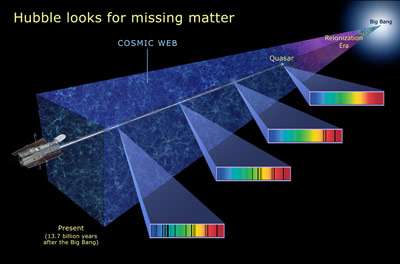
This illustration shows how the Hubble Space Telescope searches for missing ordinary matter, called baryons, by looking at the light from quasars several billion light-years away. Imprinted on that light are the spectral fingerprints of the missing ordinary matter that absorbs the light at specific frequencies (shown in the colorful spectra at right). The missing baryonic matter helps trace out the structure of intergalactic space, called the "cosmic web." Credit: NASA, ESA, and A. Feild (STScI)

Although the universe contains billions of galaxies, only a small amount of its matter is locked up in these behemoths. Most of the universe's matter that was created during and just after the Big Bang must be found elsewhere.

Now, in an extensive search of the local universe, astronomers say they have definitively found about half of the missing normal matter, called baryons, in the spaces between the galaxies. This important component of the universe is known as the "intergalactic medium," or IGM, and it extends essentially throughout all of space, from just outside our Milky Way galaxy to the most distant regions of space observed by astronomers.

The questions "where have the local baryons gone, and what are their properties?" are being answered with greater certainty than ever before.

"We think we are seeing the strands of a web-like structure that forms the backbone of the universe," Mike Shull of the University of Colorado explained. "What we are confirming in detail is that intergalactic space, which intuitively might seem to be empty, is in fact the reservoir for most of the normal, baryonic matter in the universe."

Hubble observations made nearly a decade ago by Todd Tripp and colleagues first reported finding the hottest portion of this missing matter in the local universe. That study utilized spectroscopic observations of one quasar to look for absorbing intergalactic gas along the path to the quasar.

In the May 20 issue of The Astrophysical Journal, Charles Danforth and Shull report on observations taken along sight-lines to 28 quasars. Their analysis represents the most detailed observations to date of how the IGM looks within about four billion light-years of Earth.

Baryons are protons, neutrons, and other subatomic particles that make up ordinary matter such as hydrogen, helium, and heavier elements. Baryonic matter forms stars, planets, moons, and even the interstellar gas and dust from which new stars are born.

Astronomers caution that the missing baryonic matter is not to be confused with "dark matter," a mysterious and exotic form of matter that is only detected via its gravitational pull.

Danforth and Shull, of the Department of Astrophysical and Planetary Sciences at the University of Colorado in Boulder, looked for the missing baryonic matter by using the light from distant quasars (the bright cores of galaxies with active black holes) to probe spider-web-like structure that permeates the seemingly invisible space between galaxies, like shining a flashlight through fog.

Using the Space Telescope Imaging Spectrograph (STIS) aboard NASA's Hubble Space Telescope and NASA's Far Ultraviolet Spectroscopic Explorer (FUSE), the astronomers found hot gas, mostly oxygen and hydrogen, which provide a three-dimensional probe of intergalactic space. STIS and FUSE found the spectral "fingerprints" of intervening oxygen and hydrogen superimposed on the quasars' light.

The bright quasar light was measured to penetrate more than 650 filaments of hydrogen in the cosmic web. Eighty-three filaments were found laced with highly ionized oxygen in which five electrons have been stripped away.

The presence of highly ionized oxygen (and other elements) between the galaxies is believed to trace large quantities of invisible, hot, ionized hydrogen in the universe. These vast reservoirs of hydrogen have largely escaped detection because they are too hot to be seen in visible light, yet too cool to be seen in X-rays.

The oxygen "tracer" was probably created when exploding stars in galaxies spewed the oxygen back into intergalactic space where it mixed with the pre-existing hydrogen via a shockwave which heated the oxygen to very high temperatures.

The team also found that about 20 percent of the baryons reside in the voids between the web-like filaments. Within these voids could be faint dwarf galaxies or wisps of matter that could turn into stars and galaxies in billions of years.

Probing this vast cosmic web will be a key goal for the Cosmic Origins Spectrograph (COS), a new science instrument that astronauts plan to install on Hubble during Servicing Mission 4 later this year.

"COS will allow us to make more robust and more detailed core samples of the cosmic web," Shull said. "We predict that COS will find considerably more of the missing baryonic matter."

"Our goal is to confirm the existence of the cosmic web by mapping its structure, measuring the amount of heavy metals found in it, and measuring its temperature. Studying the cosmic web gives us information on how galaxies built up over time."

The COS team hopes to observe 100 additional quasars and build up a survey of more than 10,000 hydrogen filaments in the cosmic web, many laced with heavy elements from early stars.

Source: Hubble Center


print this article email this article download pdf blog this article bookmark this article     Stumble it Digg this share on Facebook retweet share on Reddit add to delicious
Rate this story - 4.6 /5 (49 votes)

Rank Filter

Move the slider to adjust rank threshold, so that you can hide some of the comments.


Display comments: newest first

  • agg - May 20, 2008
    • Rank: 3.6 / 5 (9)
    "Astronomers caution that the missing baryonic matter is not to be confused with "dark matter," a mysterious and exotic form of matter that is only detected via its gravitational pull."
    Maybe dark matter is an artifact of bad science?
  • davesmith_au - May 20, 2008
    • Rank: 2.1 / 5 (9)
    Maybe these guys should Google Plasma Cosmology instead of banging on about stuff they're not trained in. "Ionized oxygen", "hot, ionized hydrogen", "filaments" are all properties of plasma and predicted by plasma cosmology. And yes agg, dark matter is an artifact of bad science perpetuated by dogma.

    Cheers, Dave Smith.
  • NeilFarbstein - May 20, 2008
    • Rank: 2.4 / 5 (11)
    I expected this all along. Dark matter is unnecessary to explain the structure of the universe.
  • MikeMarianiMD,FAAP - May 20, 2008
    • Rank: 2.8 / 5 (5)
    Like agg I found the instruction not to confuse unobserved baryonic matter with dark matter to be gratuitous. Indeed, I find it hard to tell to whom the writing in this article is addressed--i.e. complex jargon mixed with trivial explanations.
    The fact, however, that normal (baryonic) matter such as that we are made of permeates the universe is fascinating. Thank you for the information. Please take a secondary school English class.
  • Gripe - May 20, 2008
    • Rank: 3.5 / 5 (4)
    Since when has the term 'dark matter' meant anything other than "stuff we know must be there but we aren't really very sure about yet"? I don't see why giving it a term to be referred as is bad science. If you are in desperate need of bad science, I'm sure global warming advocates can provide you with plenty.
  • ezezz - May 21, 2008
    • Rank: 4 / 5 (1)
    Gripe, I think it's one of those primate instincts to throw poo at the alpha males. It makes people feel good to think they're better at science than scientists, on top of which railing on dark matter theories is very much in fashion.
  • Tissa_Perera - Jun 05, 2008
    • Rank: 1.7 / 5 (3)
    Dark matter is just a shadow of the real matter.
    This is my hypothesis and I prove the concept.
    For a hint, see my website cosmicdarkmatter.com
    /K. Tissa Perera
  • nilbud - Jul 09, 2008
    • Rank: 1 / 5 (1)
    The Jews cause all the dark matter.

May 20, 2008 all stories

Comments: 8

4.6 /5 (49 votes)
  • Stumble this up

  • Digg this

  • share this

  • hide
  • Related Stories

  • Rapid supernova could be new class of exploding star
    created Nov 05, 2009 | popularity not rated yet | comments 0
  • Stars Fueled by Dark Matter Could Hold Secrets to the Universe
    created Nov 03, 2009 | popularity not rated yet | comments 0
  • Dark Matter in a Galaxy
    created Oct 30, 2009 | popularity not rated yet | comments 0
  • First light for BOSS -- a new kind of search for dark energy
    created Oct 01, 2009 | popularity not rated yet | comments 0
  • NGC 4945: The Milky Way's not-so-distant Cousin
    created Sep 02, 2009 | popularity not rated yet | comments 0


  • hide
  • Relevant PhysicsForums posts

  • Sideral question
    created 18 hours ago
  • Doppler shifted blackbody spectrum
    created 21 hours ago
  • Earth v. Moon
    created 23 hours ago
  • help me with coordinates and orbits
    created 23 hours ago
  • basic 'our universe' question..
    created Nov 20, 2009
  • deriving keplers law
    created Nov 19, 2009
  • More from Physics Forums - General Astronomy

Other News

Astronauts finish another spacewalk, still no baby (AP)

Astronauts finish another spacewalk, still no baby

Space & Earth / Space Exploration

created 10 hours ago | popularity 3 / 5 (2) | comments 0

(AP) -- A spacewalking astronaut put aside the impending birth of his daughter and blazed through his first-ever venture outside the International Space Station on Saturday.


Unseasonably hot and dry weather combined with strong winds to fan scores of blazes in the country's southeastern states

Australia issues 'catastrophic' alerts as fires rage

Space & Earth / Environment

created 16 hours ago | popularity 4 / 5 (3) | comments 0

Australia has issued "catastrophic" alerts after record-breaking temperatures and wild lightning storms sparked more than 100 fires across the country, officials said Saturday.


Commuters wait on the platform shrouded by fog in London

Climate change not man-made, say majority of Britons: poll

Space & Earth / Environment

created Nov 15, 2009 | popularity 3.3 / 5 (15) | comments 46

Less than half of Britons believes that human activity is to blame for global warming, according to a poll carried out for The Times newspaper and published on Saturday.


Mysteriously warm times in Antarctica

Mysteriously warm times in Antarctica

Space & Earth / Earth Sciences

created Nov 18, 2009 | popularity 4.2 / 5 (21) | comments 28

(PhysOrg.com) -- A new study of Antarctica's past climate reveals that temperatures during the warm periods between ice ages (interglacials) may have been higher than previously thought. The latest analysis ...


UN: Fight climate change with free condoms (AP)

UN: Fight climate change with free condoms

Space & Earth / Environment

created Nov 18, 2009 | popularity 3.1 / 5 (11) | comments 24

(AP) -- The battle against global warming could be helped if the world slowed population growth by making free condoms and family planning advice more widely available, the U.N. Population Fund said Wednesday.