Scientists find first dinosaur tracks on Arabian Peninsula
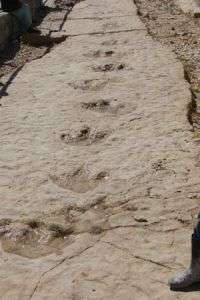
Scientists have discovered the first dinosaur tracks on the Arabian Peninsula. In the May 21 issue of the journal PLoS ONE, they report evidence of a large ornithopod dinosaur, as well as a herd of 11 sauropods walking along a Mesozoic coastal mudflat in what is now the Republic of Yemen.
“No dinosaur trackways had been found in this area previously. It’s really a blank spot on the map,” said Anne Schulp of the Maastricht Museum of Natural History in The Netherlands. He conducted the study with Ohio University paleontologist Nancy Stevens and Mohammed Al-Wosabi of Sana’a University in Yemen.
The finding also is an excellent example of dinosaur herding behavior, the researchers report. The site preserved footprints of 11 small and large sauropods — long-necked, herbivorous dinosaurs that lived in the Jurassic and Cretaceous periods — traveling together at the same speed.
“It’s rare to see such a big example of a dinosaur herd,” Schulp said. “This is interesting social behavior for reptiles.”
A Yemeni journalist spotted one of the trackways in 2003, about 50 kilometers north of the capital of Sana’a in the village of Madar. Stevens, Al-Wosabi and Schulp identified it as the footprint of an ornithopod, a large, common plant-eater sometimes referred to as the “cow of the Mesozoic,” Schulp said. It walked on its hind legs.
Only a few dinosaur fossils have been reported so far from the Arabian Peninsula, including isolated bones from the Sultanate of Oman, which Schulp has studied, and possible fragments of a long-necked dinosaur from Yemen.
In late 2006, the research team conducted further field work at the Madar site. By taking measurements on the shape and angle of the different digits, they were able to identify the bipedal dinosaur as an ornithopod. The size, shape and spacing of the quadrupedal prints were used to identify the body size, travel speed and other distinguishing features of the animals in the sauropod herd, Stevens said.
The rocks in which the dinosaur tracks are preserved are likely Late Jurassic in age, some 150 million years old, according to Al-Wosabi. The tracks probably went unnoticed for so long, Schulp explained, because they were too big to be spotted by the untrained eye and were partially covered by rubble and debris. “It isn’t a surprise that they were overlooked,” he said.
Though ornithopods and sauropods overlapped in time, it’s a bit unusual to find evidence of such a big ornithopod in the late Jurassic, the researchers noted.
“We really want to learn when did which dinosaurs live where, and why was that?” Schulp said. “How did the distribution change over time, why did one replace another and move from one place to another?”
The researchers agreed that discoveries from Yemen could yield more answers to those questions.
“This international collaboration provides an exciting new window into evolutionary history from a critically undersampled region,” said Stevens, an assistant professor in Ohio University’s College of Osteopathic Medicine. “These trackways help us to assemble a more detailed picture of what was happening on the southern landmasses. It’s exciting to see new paleontological data coming out of Yemen – and I think there is a lot more to discover.”
The Yemen Geological Survey has implemented protective measures to preserve the trackways and to improve their accessibility to tourists, the researchers report.
Source: Ohio University


