RNA toxicity contributes to neurodegenerative disease, scientists say
May 21, 2008
RNA toxicity contributes to neurodegenerative disease, scientists say

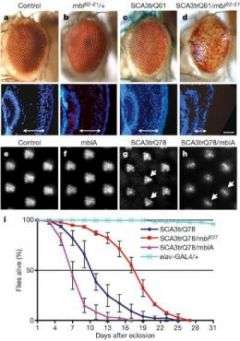
a–d, External (top) and internal (bottom) retinal cryosections of eyes of 1-day-old flies. a, Flies expressing gmr-GAL4 alone or b with mblB2–E1 have normal eye morphology. c, Flies expressing SCA3trQ61 have a mild loss of pigmentation, and slightly disrupted internal retinal morphology. d, Flies expressing SCA3trQ61 with mblB2–E1 show severe external degeneration and collapse of the retina. Genotypes w;gmr-GAL4 UAS-SCA3trQ61 in trans to c w or d mblB2–E1. Scale bar in d, 5 mum for retinal sections. e–h, Retinal pseudopupils of 1-day-old flies. e, Flies expressing elav-GAL4 alone or f with MblA have a normal pattern of seven photoreceptors per ommatidium. g, Flies expressing SCA3trQ78 show mild loss of retinal integrity (arrows), with 5.8 plusminus 0.4 s.d. photoreceptors per ommatidium (n = 200 ommatidia). Genotype elav-GAL4/+;UAS-SCA3trQ78/+. h, Co-expression of MblA with SCA3trQ78 enhances photoreceptor loss to 3.0 plusminus 0.5 s.d. (n = 200 ommatidia; significant difference from g, P < 0.0001 (two-tailed unpaired Student's t-test)). Genotype elav-GAL4/+;UAS-mblA/+;UAS-SCA3trQ78/+. i, Neuronal toxicity by lifespan analysis. Upregulation of MblA further shortened the lifespan of SCA3trQ78 flies, whereas downregulation of mbl (flies heterozygous for allele mblE27) extended lifespan (P < 0.001, SCA3trQ78 and SCA3trQ78/mblE27, SCA3trQ78 and SCA3trQ78/mblA, log-rank analysis). Mean plusminus s.d.; n = 170–220 flies for each genotype. Genotypes for SCA3trQ78 and SCA3trQ78/mblA are the same as g and h, SCA3trQ78/mblE27 is elav-GAL4/+;mblE27/+;UAS-SCA3trQ78/+. Credit: Ling-Bo Li, Nature

Expanding on prior research performed at the University of Pennsylvania, Penn biologists have determined that faulty RNA, the blueprint that creates mutated, toxic proteins, contributes to a family of neurodegenerative disorders in humans.

Nancy Bonini, professor in the Department of Biology at Penn and an investigator of the Howard Hughes Medical Institute, and her team previously showed that the gene that codes for the ataxin-3 protein, responsible for the inherited neurodegenerative disorder Spinocerebellar ataxia type 3, or SCA3, can cause the disease in the model organism Drosophila. SCA3 is one of a class of human diseases known as polyglutamine repeat diseases, which includes Huntington's disease. Previous studies had suggested that the disease is caused largely by the toxic polyglutamine protein encoded by the gene.

The current study, which appears in the journal Nature, demonstrates that faulty RNA, the blueprint for the toxic polyglutamine protein, also assists in the onset and progression of disease in fruit fly models.

“The challenge for many researchers is coupling the power of a simple genetic model, in this case the fruit fly, to the enormous problem of human neurodegenerative disease,” Bonini said. “By recreating in the fly various human diseases, we have found that, while the mutated protein is a toxic entity, toxicity is also going on at the RNA level to contribute to the disease.”

To identify potential contributors to ataxin-3 pathogenesis, Bonini and her team performed a genetic screen with the fruit fly model of ataxin-3 to find genes that could change the toxicity. The study produced one new gene that dramatically enhanced neurodegeneration. Molecular analysis showed that the gene affected was muscleblind, a gene previously implicated as a modifier of toxicity in a different class of human disease due to a toxic RNA. These results suggested the possibility that RNA toxicity may also occur in the polyglutamine disease situation.

The findings indicated that an RNA containing a long CAG repeat, which encodes the polyglutamine stretch in the toxic polyglutamine protein, may contribute to neurodegeneration beyond being the blueprint for that protein. This raised the possibility that expression of the RNA alone may be damaging.

Long CAG repeat sequences can bind together to form hairpins, dangerous molecular shapes. The researchers therefore tested the role of the RNA by altering the CAG repeat sequence to be an interrupted CAACAG repeat that could no longer form a hairpin. Such an RNA strand, however, would still be a blueprint for an identical protein. The researchers found that this altered gene caused dramatically reduced neurodegeneration, indicating that altering the RNA structure mitigated toxicity.

To further implicate the RNA in the disease progression, the researchers then expressed just a toxic RNA alone, one that was unable to code for a protein at all. This also caused neuronal degeneration. These findings revealed a toxic role for the RNA in polyglutamine disease, highlighting common components between different types of human triplet repeat expansion diseases. Such diseases include not only the polyglutamine diseases but also diseases like myotonic dystrophy and fragile X.

The family of diseases called polyglutamine repeat disorders arise when the genetic code of a CAG repeat for the amino acid glutamine stutters like a broken record within the gene, becoming very long. This leads to an RNA — the blueprint for the protein — with a similar long run of CAG. During protein synthesis, the long run of CAG repeats are translated into a long uninterrupted run of glutamine residues, forming what is known as a polyglutamine tract. The expanded polyglutamine tract causes the errant protein to fold improperly, leading to a glut of misfolded protein collecting in cells of the nervous system, much like what occurs in Alzheimer's and Parkinson's diseases.

Polyglutamine disorders are genetically inherited ataxias, neurodegenerative disorders marked by a gradual decay of muscle coordination, typically appearing in adulthood. They are progressive diseases, with a correlation between the number of CAG repeats within the gene, the severity of disease and age at onset.

Source: University of Pennsylvania

4.4 /5 (10 votes)  

Rank 4.4 /5 (10 votes)
Tags

Relevant PhysicsForums posts

More news stories

A mitosis mystery solved: How chromosomes align perfectly in a dividing cell

Although the process of mitotic cell division has been studied intensely for more than 50 years, Whitehead Institute researchers have only now solved the mystery of how cells correctly align their chromosomes during symmetric ...

Biology / Cell & Microbiology

created 1 hour ago | popularity 5 / 5 (2) | comments 0 | with audio podcast

The proteins ensuring genome protection

Researchers from the University of Geneva (UNIGE), Switzerland, have discovered the crucial role of two proteins in developing a cell 'anti-enzyme shield'. This protection system, which operates at the level of molecular ...

Biology / Cell & Microbiology

created 1 hour ago | popularity 5 / 5 (2) | comments 0 | with audio podcast

Researchers find extensive RNA editing in human transcriptome

In a new study published online in Nature Biotechnology, researchers from BGI, the world's largest genomics organization, reported the evidence of extensive RNA editing in a human cell line by analysis of RNA-seq data, demons ...

Biology / Biotechnology

created 1 hour ago | popularity 5 / 5 (3) | comments 0 | with audio podcast

Entire genome of extinct human decoded from fossil

(PhysOrg.com) -- In 2010, Svante Pääbo and his colleagues presented a draft version of the genome from a small fragment of a human finger bone discovered in Denisova Cave in southern Siberia. The ...

Biology / Biotechnology

created Feb 07, 2012 | popularity 4.7 / 5 (58) | comments 48 | with audio podcast

Why are there so few fish in the Earth's oceans?

(PhysOrg.com) -- A Stony Brook University researcher has found that, contrary to popular belief, there are not plenty of fish in the sea.

Biology / Plants & Animals

created Feb 08, 2012 | popularity 4.3 / 5 (17) | comments 27 | with audio podcast


Lab study raises questions over nano-particle impact

Tests involving chickens have raised questions about the impact on health from engineered nano-particles, the ultra-fine grains commonly used in drugs and processed foods, scientists said on Sunday.

Iran blocks email, restricts net access: reports

Iran has further restricted access to the Internet and blocked popular email services for the past few days, in a move a top lawmaker said could "cost the regime dearly," media reports said on Sunday.

Salvage workers begin pumping fuel from Italian shipwreck

Salvage workers Sunday began pumping fuel from the shipwrecked Italian cruise liner Costa Concordia, a day ahead of schedule, officials said.

Scientists discover molecular secrets of 2,000-year-old Chinese herbal remedy

For roughly two thousand years, Chinese herbalists have treated Malaria using a root extract, commonly known as Chang Shan, from a type of hydrangea that grows in Tibet and Nepal. More recent studies suggest that halofuginone, ...

New method to examine batteries -- MRI from the inside

There is an ever-increasing need for advanced batteries for portable electronics, such as phones, cameras, and music players, but also to power electric vehicles and to facilitate the distribution and storage of energy derived ...

Starve a virus, feed a cure? Findings show how some cells protect themselves against HIV

A protein that protects some of our immune cells from the most common and virulent form of HIV works by starving the virus of the molecular building blocks that it needs to replicate, according to research published online ...