A missing link settles debate over the origin of frogs and salamanders
May 21, 2008 A missing link settles debate over the origin of frogs and salamanders

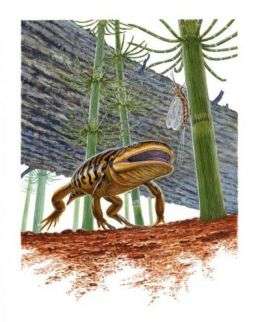
An Early Permian landscape, with Gerobatrachus hottoni lunging at the mayfly Protoreisma between stands of Calamites and under a fallen Walchia conifer. Credit: Michael Skrepnick

The description of an ancient amphibian that millions of years ago swam in quiet pools and caught mayflies on the surrounding land in Texas has set to rest one of the greatest current controversies in vertebrate evolution. The discovery was made by a research team led by scientists at the University of Calgary.

The examination and detailed description of the fossil, Gerobatrachus hottoni (meaning Hotton’s elder frog), proves the previously disputed fact that some modern amphibians, frogs and salamanders evolved from one ancient amphibian group called temnospondyls.

The discovery is described for the first time in the prestigious international research journal Nature.

“The dispute arose because of a lack of transitional forms. This fossil seals the gap,” says Jason Anderson, assistant professor, University of Calgary Faculty of Veterinary Medicine and lead scientist in the study.

The Gerobatrachus fossil provides a much fuller understanding of the origin and evolution of modern amphibians. The skull, backbone and teeth of Gerobatrachus have a mixture of frog and salamander features—the fossil has two fused bones in the ankle, which is normally only seen in salamanders, and a very large tympanic ear (ear drum). It also has a lightly built and wide skull similar to that of a frog. Its backbone is exactly intermediate in number between the modern frogs and salamanders and more primitive amphibians.

The new fossil also addresses a controversy over molecular clock estimates, or the general time salamanders and frogs evolved into two distinct groups.

“With this new data our best estimate indicates that frogs and salamanders separated from each other sometime between 240 and 275 million years ago, much more recently than previous molecular data had suggested,” says Robert Reisz, professor, University of Toronto Mississauga and second author on the paper.

Gerobatrachus was originally discovered in Texas in 1995 by a field party from the Smithsonian Institution that included the late Nicholas Hotton, for whom the fossil is named. It remained unstudied until it was “rediscovered” by Anderson’s team. It took countless hours of work on the small, extremely delicate fossil to remove the overlying layers of rock and uncover the bones to reveal the anatomy of the spectacular looking skeleton.

“It is bittersweet to learn about frog origins in this Year of the Frog, dedicated to informing the public about the current global amphibian decline,” continues Anderson. “Hopefully we won’t ever learn about their extinction.”

Source: University of Calgary


print this article email this article download pdf blog this article bookmark this article     Stumble it Digg this share on Facebook retweet share on Reddit add to delicious
Rate this story - 4.8 /5 (28 votes)

Rank Filter

Move the slider to adjust rank threshold, so that you can hide some of the comments.


Display comments: newest first

  • nano999 - May 21, 2008
    • Rank: 4.2 / 5 (6)
    Go Evolution!
  • Going - May 22, 2008
    • Rank: not rated yet
    Is this likey to have been a common ancestor with us naked apes?

May 21, 2008 all stories

Comments: 2

4.8 /5 (28 votes)
  • Stumble this up

  • Digg this

  • share this

  • hide
  • Related Stories

  • Reptiles stood upright after mass extinction
    created Sep 15, 2009 | popularity not rated yet | comments 0
  • Flying frog among 353 new Himalayan species: WWF
    created Aug 10, 2009 | popularity not rated yet | comments 0
  • Naming evolution's winners and losers
    created Jul 29, 2009 | popularity not rated yet | comments 0
  • Forgotten evolutionist lives in Darwin's shadow
    created Jun 28, 2009 | popularity not rated yet | comments 0
  • Amazonian amphibian diversity traced to Andes
    created Mar 10, 2009 | popularity not rated yet | comments 0


  • hide
  • Relevant PhysicsForums posts

Other News

Growth in secular attitudes leaves Americans room for belief in God

Other Sciences / Social Sciences

created Oct 31, 2009 | popularity 4 / 5 (6) | comments 118

(PhysOrg.com) -- The nature of the American religious experience is changing as a rising number of people report having no formal religious affiliation, even though the number of Americans who say they pray is increasing, ...


Forest clearances sealed ancient civilisation's downfall

Forest clearances sealed ancient civilisation's downfall

Other Sciences / Archaeology & Fossils

created Nov 02, 2009 | popularity 4.9 / 5 (9) | comments 5

(PhysOrg.com) -- An ancient South American civilisation which disappeared around 1,500 years ago helped to cause its own demise by damaging the fragile ecosystem that held it in place, a study has found. ...


Oscar Pistorius

New study further disputes notion that amputee runners gain advantage from protheses

Other Sciences / Other

created Nov 04, 2009 | popularity 5 / 5 (4) | comments 5

A study by six researchers, including a University of Colorado at Boulder associate professor and his former doctoral student, shows that amputees who use running-specific prosthetic legs have no performance ...


New theory on fairness in economics targets CEO pay

Other Sciences / Economics

created Nov 03, 2009 | popularity 4.3 / 5 (11) | comments 2

(PhysOrg.com) -- Chief executives in 35 of the top Fortune 500 companies were overpaid by about 129 times their "ideal salaries" in 2008, according to a new type of theoretical analysis proposed by a Purdue University researcher ...


Racial segregation key factor in subprime lending

Other Sciences / Economics

created Nov 06, 2009 | popularity 3 / 5 (2) | comments 2

(PhysOrg.com) -- New study examines impact of segregation on the prevalence of high-cost loans in U.S. metro areas. Subprime loans disproportionately located in segregated areas.