Swift satellite catches first 'normal' supernova in the act of exploding
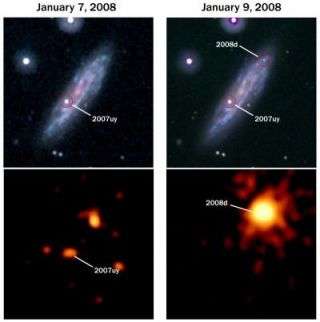
Thanks to a fortunate observation with NASA's Swift satellite, astronomers, for the first time, have caught a normal supernova at the moment of its birth--the first instant when an exploding star begins spewing its energy into space, transforming into a supernova that during its brief lifetime will shine brighter than billions of stars combined.
Until this discovery, the only supernovae glimpsed during their first moments were the more rare kind--the ones whose birth cries are drowned out by a blindingly bright gamma-ray burst, which sometimes forms in the space surrounding a massive exploding star but is not part of the star itself. This new supernova, named SN2008D, intrigues scientists because it is closer to Earth than any type of supernova ever observed in the act of exploding and because its gamma-ray-free radiation gives them the clearest picture ever of a star at the moment its explosive death transforms it into a supernova. The discovery will be described in a paper to be published in the 22 May 2008 issue of the journal Nature.
"This discovery is giving us unique insights into how a supernova-producing star explodes," said David Burrows, a senior scientist and professor of astronomy and astrophysics at Penn State University and a co-author of the paper to be published in Nature.
"This explosion seems to be characteristic of the vast majority of supernovae -- those that do not contain gamma rays. All the data we are collecting, beginning with the initial shock wave, will help us to more fully understand why some supernovae make gamma rays and others do not," said Burrows, who is the lead scientist for Swift's X-ray telescope (XRT), which detected the first signals from the new supernova and has continued to observe its evolution. The Swift satellite is controlled by Penn State from its Mission Operations Center at University Park.
"We were in the right place, at the right time, with the right telescopes, and witnessed history," says Alicia Soderberg of Princeton University and Carnegie observatories, who is leading the group studying this explosion. Astronomers previously had observed thousands of such "normal" supernova explosions, but not until days or weeks after the supernova's first moment of birth, after the expanding shell of debris becomes energized by the decay of radioactive elements forged in the initial explosion. "This newly born supernova is going to be the Rosetta stone of supernova studies for years to come," Soderberg said.
A typical supernova occurs when the core of a massive star runs out of nuclear fuel and collapses under its own gravity to form an ultradense object known as a neutron star. The newborn neutron star compresses and then rebounds, triggering a shock wave that plows through the star’s gaseous outer layers and blows the star to smithereens. The new observations of the first "shock break-out" in X-rays are important because they provide a direct view of the exploding star in the last minutes of its life.
Soderberg's discovery of the supernova's shock breakout began on 9 January 2008, when Soderberg and Edo Berger, also a Princeton/CarnegieFellow, were using Swift to observe a supernova known as SN 2007uy in the spiral galaxy NGC 2770, located 90-million light years from Earth in the constellation Lynx. At 9:33 a.m. EST they spotted an extremely bright X-ray outburst that lasted for 5 minutes, and they quickly recognized that they were witnessing a new and unprecedented phenomenon that was occurring in that same galaxy. In the paper to be published in Nature, Soderberg and 38 colleagues show that the energy and pattern of the X-ray outburst is consistent with a shock wave bursting through the surface of an exploding star, which gave birth to the supernova now known as SN 2008D.
The astronomers were making these observations with Swift, which is well equipped to study such an event because of its multiple instruments observing in gamma rays, X-rays, ultraviolet light, and optical light. The X-ray observations were captured by Swift's X-ray telescope, the XRT, which was developed and built by an international team led by Penn State's Burrows, who directs the continuing operation of the XRT instrument and the analysis of the data it collects. The principal analyses of the X rays from the new supernova were done by members of the XRT instrument team led by Burrows, including Kim Page and Andy Beardmore at the University of Leicester in the United Kingdom and Judy Racusin, a graduate student at Penn State.
Due to the significance of the X-ray observations, Soderberg immediately mounted an international observing campaign to study SN 2008D. Astronomers rushed to observe the new supernova with major telescopes such as the Hubble Space Telescope, the Chandra X-ray Observatory, the Very Large Array in New Mexico, the Gemini North telescope in Hawaii, the Keck I telescope in Hawaii, the 200-inch and 60-inch telescopes at the Palomar Observatory in California, and the 3.5-meter telescope at the Apache Point Observatory in New Mexico. Chandra's ACIS X-ray camera was conceived and developed for NASA by Penn State and the Massachusetts Institute of Technology under the leadership of Gordon Garmire, Evan Pugh Professor of Astronomy and Astrophysics at Penn State. "Data from NASA's Chandra X-ray Observatory turned out to be crucial for interpreting some of the Swift XRT telescope's follow-up observations of this supernova's evolution," Burrows said. The combined observations helped Soderberg and her colleagues to pin down the energy of the initial X-ray outburst, which is helping theorists to better understand supernovae.
"A fascinating conclusion from the theoretical modeling of this outburst is that a thin outer layer must have been ejected at velocities up to about 70-percent the speed of light. This speed is much higher than previously known for the bulk of the stellar envelope, which moves at only up to 10-percent the speed of light," said Peter Meszaros, Holder of the Eberly Family Chair in Astronomy and Astrophysics and Professor of Physics at Penn State and leader of the theory team for Swift. "The relatively higher-energy X-rays observed can now be understood as the usual optical photons emitted by the supernova being boosted up to X-ray energies as they are batted back and forth between the slower envelope and the faster outer shell," Meszaros explained. In addition to Meszaros, other members of Swift's theory team include XiangYu Wang, a former Penn State postdoctoral fellow now at Nanjing University in China; and Eli Waxman, of the Weizman Institute of Science in Israel.
Penn State graduate student Peter Brown is involved in follow-up observations in ultraviolet and optical wavelengths with Swift's Ultraviolet/Optical Telescope (UVOT), which was developed, built, and is operated by international teams led by Penn State. Penn State graduate student Antonino Cucchiara and his advisor Derek Fox, assistant professor of astronomy and astrophysics at Penn State, have been working on the team's effort to study the evolving optical light of the supernova using the Gemini-North and Hobby-Eberly Telescopes. "We are getting new data every other day that we quickly share with astronomers worldwide," says Cucchiara. "Our observations are giving us a deeper understanding about not only this supernova, but also about a dynamical evolution that may be characteristic of most supernovae."
"It was a gift of nature for Swift to be observing that patch of sky when the supernova exploded. But thanks to Swift's flexibility, we have been able to trace its evolution in detail every day since," commented Swift lead scientist Neil Gehrels of NASA's Goddard Space Flight Center in Greenbelt, Maryland.
Source: Penn State


