Mathematicians Reveal Secrets of the Ancient and Universal Art of Symmetry
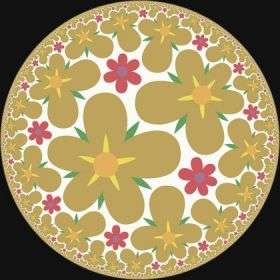
Humans have used symmetrical patterns for thousands of years in both functional and decorative ways. Now, a new book by three mathematicians offers both math experts and enthusiasts a new way to understand symmetry and a fresh way to see the world.
In The Symmetries of Things, eminent Princeton mathematician John H. Conway teams up with Chaim Goodman-Strauss of the University of Arkansas and Heidi Burgiel of Bridgewater State College to present a comprehensive mathematical theory of symmetry in a richly illustrated volume. The book is designed to speak to those with an interest in math, artists, working mathematicians and researchers.
“Symmetry and pattern are fundamentally human preoccupations in the same way that language and rhythm are. Any culture that is making anything has ornament and is preoccupied with this visual rhythm,” Goodman-Strauss said. “There are actually Neolithic examples of many of these patterns. The fish-scale pattern, for example, is 22,000 years old and shows up all over the world in all kinds of contexts.”
Symmetrical objects and patterns are everywhere. In nature, there are flowers composed of repeating shapes that rotate around a central point. Architects trim buildings with friezes that repeat design elements over and over.
Mathematicians, according to Goodman-Strauss, are latecomers to the human fascination with pattern. While mathematicians bring their own particular concerns, “we’re also able to say things that other people might not be able to say.”
Symmetries of Things contributes a new system of notation or descriptive categories for symmetrical patterns and a host of new proofs. The first section of the book is written to be accessible to a general reader with an interest in the subject. Sections two and three are aimed at mathematicians and experts in the field. The entire book, Goodman-Strauss said, “is meant to be engaging and reveal itself visually as well.”
To explain the significance within mathematics of understanding symmetry, Goodman-Strauss began by talking about mathematics in general:
“Mathematicians above anything else study structure, structure for its own sake, mental structure, not necessarily physical structure. That’s why mathematics is so good at describing the world. What more fundamental kind of structure could you consider than the way patterns can be laid out in a plane?”
While mathematics may be called “a descriptive art,” Goodman-Strauss noted that mathematicians are not simply trying to describe. Rather, he said, “We’re trying to understand what inherently can be described in a quantitative, analytical way.”
For about a hundred years, mathematicians have used a system developed by crystallographers to describe symmetries, a system that didn’t easily generalize to other situations. Conway developed a notational system that is more useful for mathematicians, a flexible, intuitive system that is “much more than a naming system,” according to Goodman-Strauss.
“Conway is one of the best notation-makers in the world,” Goodman-Strauss said. “A good notation is amazing because it’s not just a way of naming things. It’s a way of making the structure of things transparent and simultaneously providing a way of enumerating them, classifying them and proving that’s what the classification is – all at once. That’s really the big exciting thing.”
The second section of the book discusses the orbifold, which is a tool for understanding symmetries. As the researchers write in the book’s introduction, Goodman-Strauss “had been preaching the gospel of the orbifold signature on his own, and was known for his gorgeous illustrations.”
Orbifolds are formed when symmetrical patterns on a surface are folded or rolled so that every distinct feature, every point on a pattern, is brought together with its corresponding point. The result is a geometrical shape, such as a sphere, a cone or a cylinder, that shows one example of the design element that was repeated to make the symmetrical pattern.
As a tool, the orbifold pattern provides an efficient way to understand patterns. Goodman-Strauss uses the example of the ancient and universal fish-scale pattern.
“Why would the fish scale pattern be so compelling and so interesting and be the basis for all kinds of other patterns? It’s very easy – because it has a very simple orbital,” Goodman-Strauss explained. “You want to get to a simple pattern on an orbifold. When you do that, then the pattern is strong and dynamic.”
Source: University of Arkansas


