Twinkle, twinkle, any star - Sun not so special
May 21, 2008 The Sun

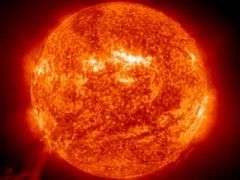
ANU astronomers have found there is nothing special about the Sun after conducting the most comprehensive comparison of it with other stars – adding weight to the idea that life could be common in the universe.

Scientists have long argued about whether or not the Earth has some special characteristics that led to the evolution of life. PhD researcher Jose Robles and Dr Charley Lineweaver from the Planetary Science Institute at ANU contend that this is a difficult question to answer because we don’t have information about other Earth-like planets.

“Yet the question ‘How special is the Sun?’ is easier to address because we do have observations of thousands of other Sun-like stars,” explains Dr Lineweaver.

Rather than guess what properties a star should have to enable life, the researchers decided to compare the Sun – which already hosts a life-bearing planet – to other stars.

“Our research goes further than previous work which only looked at single properties such as mass or iron content,” says Robles, who is the lead author on the research paper. “We looked at 11 properties that could plausibly be connected with life and did an analysis of these properties: The upshot is that there doesn’t seem to be anything special about the Sun. It seems to be a random star that was blindly pulled out of the bag of all stars.”

The researchers found that the Sun’s mass is the most anomalous of its properties; the Sun is more massive than 95 per cent of stars. The Sun’s orbit around the centre of the galaxy is also more circular than the orbits of 93 per cent of its peers. “But when analysing the 11 properties together, the Sun shows up as a star selected at random, rather than one selected for some life-enhancing property,” Robles says.

The research is part of the ongoing scientific understanding of our place in the universe. “Those who are searching for justification for their beliefs that terrestrial life and humanity in particular are special, will probably interpret this result as a humiliating dethronement,” says Dr Lineweaver. “Those who believe we are the scum of the universe may find our non-special status uplifting.”

The research paper A comprehensive comparison of the Sun to other stars: searching for self-selection effects, is a collaborative work between ANU, UNSW and European astronomers. It has just been accepted for publication in the Astrophysical Journal and is available online at http://www.mso.anu.edu.au/~josan/astrophysics.html

Source: Australian National University


print this article email this article download pdf blog this article bookmark this article     Stumble it Digg this share on Facebook retweet share on Reddit add to delicious
Rate this story - 4.2 /5 (10 votes)

Rank Filter

Move the slider to adjust rank threshold, so that you can hide some of the comments.


Display comments: newest first

  • barakn - May 21, 2008
    • Rank: 3 / 5 (2)
    That's an odd way to interpret their findings. What they may have discovered is that not all 11 of the properties they tested are important factors for life. Leaving them in makes the result seem more random than it really is.

May 21, 2008 all stories

Comments: 1

4.2 /5 (10 votes)
  • Stumble this up

  • Digg this

  • share this

  • hide
  • Related Stories

  • Paradigm shift: How Galileo's spy glass upended science
    created Oct 23, 2009 | popularity not rated yet | comments 0
  • Astronomers do it Again: Find Organic Molecules Around Gas Planet (w/ Video)
    created Oct 20, 2009 | popularity not rated yet | comments 0
  • Natural Fusion: Solar-powered home designed for 'realities of life'
    created Sep 23, 2009 | popularity not rated yet | comments 0
  • First Solid Evidence for a Rocky Exoplanet (w/ Video)
    created Sep 16, 2009 | popularity not rated yet | comments 0
  • New findings on the birth of the solar system
    created Jul 20, 2009 | popularity not rated yet | comments 0


  • hide
  • Relevant PhysicsForums posts

  • The shape of our solar system's orbits.
    created Nov 07, 2009
  • Above or Below the Line of Nodes
    created Nov 07, 2009
  • Supernova vs. Nova?
    created Nov 07, 2009
  • Supernova's Gamma Rays and Comets
    created Nov 06, 2009
  • More from Physics Forums - General Astronomy

Other News

Making Climate Forecasts More Useful to Farmers

Making Climate Forecasts More Useful to Farmers

Space & Earth / Environment

created 29 minutes ago | popularity not rated yet | comments 0

(PhysOrg.com) -- Climate forecasts are becoming more useful to farmers and ranchers, thanks to research by Agricultural Research Service (ARS) scientists and their cooperators.


Antarctica glacier retreat creates new carbon dioxide store

Antarctica glacier retreat creates new carbon dioxide store

Space & Earth / Earth Sciences

created 7 hours ago | popularity 4.3 / 5 (3) | comments 0

Large blooms of tiny marine plants called phytoplankton are flourishing in areas of open water left exposed by the recent and rapid melting of ice shelves and glaciers around the Antarctic Peninsula. This ...


L-R: Chiwetel Ejiofor, Amanda Peet and John Cusack at the premiere of "2012"

NASA on crusade to debunk 2012 apocalypse myths

Space & Earth / Space Exploration

created 2 hours ago | popularity not rated yet | comments 0

The world is not coming to an end on December 21, 2012, the US space agency insisted Monday in a rare campaign to dispel widespread rumors fueled by the Internet and a new Hollywood movie.


NASA satellites make a movie and get rainfall, wind info on Ida

NASA satellites make a movie and get rainfall, wind info on Ida (w/ Video)

Space & Earth / Earth Sciences

created 2 hours ago | popularity not rated yet | comments 0

NASA satellites are amazing examples of technology. The TRMM satellite peers into tropical cyclones and can tell how much rain is falling per hour and where. QuikScat uses microwave technology to measure Ida's ...


NASA's TRMM Satellite sees most of Ida's heaviest rain stayed off coasts

NASA's TRMM Satellite sees most of Ida's heaviest rain stayed off coasts

Space & Earth / Earth Sciences

created 3 hours ago | popularity not rated yet | comments 0

NASA and the Japanese Space Agency's Tropical Rainfall Measuring Mission (TRMM) satellite flew over Ida and captured her rainfall when she passed by Nicaragua, Honduras and Belize this weekend. TRMM data revealed ...