Relocation of endangered Chinese turtle may save species
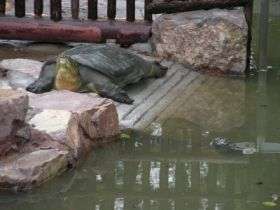
There are only four specimens of the Yangtze giant softshell turtle left on Earth—one in the wild and three in captivity. In order to save this species from extinction, conservation partners from the Wildlife Conservation Society (WCS) and the Turtle Survival Alliance (TSA), working in conjunction with partners from two Chinese zoos and the China Zoo Society, recently paired two of them.
A still reproductive, more than 80-year-old, female, living in China’s Changsha Zoo has been introduced to the only known male in China, a more than 100-year-old living more than 600 miles away at the Suzhou Zoo.
The Bronx Zoo-based WCS and the Fort Worth Zoo-based TSA coordinated the critically important move; TSA provided much of the funding, animal reproduction and technical expertise while WCS provided veterinary and logistical support and coordination with wildlife partners in China and New York. Other project partners include Ocean Park and Kadoorie Farm and Botanic Garden, both in Hong Kong.
On Monday, May 5, turtle biologists, veterinarians, and zoo staff from partner organizations convened at the Changsha Zoo to collect and transport the female to the Suzhou Zoo where she joined her new mate to potentially save their entire species. The move was coordinated to coincide with the female’s reproductive cycle.
“This is a story of hope for a species truly on the brink,” said Colin Poole, Director of the Wildlife Conservation Society’s Asia Programs. “We are extremely grateful to our conservation partners both in China and here in the U.S. who made this historic move possible. Now that the turtles are together, we are optimistic that they will successfully breed.”
"I hate to call this a desperation move, but it really was. With only one female known worldwide, and given that we have lost three captive specimens over the past two years, what choice did we have" The risks related to moving her were certainly there, but doing nothing was much riskier," said Rick Hudson, TSA co-chair and Fort Worth Zoo conservation biologist.
Listed at the top of the World Conservation Union’s Red List, the Yangtze giant softshell turtle is the most critically endangered turtle in the world. Its status in the wild has long been recognized as grim, but extinction risk now is believed higher than ever. Much of its demise has been attributed to pollution, over-harvesting for Asian food markets and habitat alteration. Biologists saw no other alternative but to save the species by any means necessary. Still, the risks were high—relocating an animal this age can be highly stressful for it and research shows that breeding attempts by males can become aggressive. However, since the female has arrived safely and is settling well into her new habitat at the Suzhou Zoo, biologists are optimistic for breeding success.
Source: Wildlife Conservation Society


