UW scientists join hunt for 'God' particle to complete 'theory of everything'
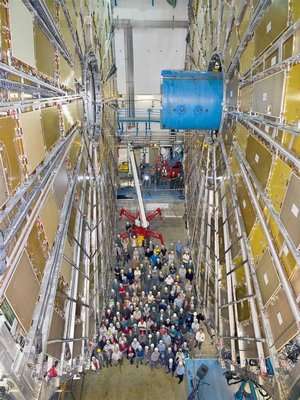
When the world's most powerful subatomic particle collider begins gathering data this summer, it will be a major milestone for a number of University of Washington scientists.
The UW, led by professors Henry Lubatti in physics and Colin Daly in mechanical engineering, played a central role in designing and fabricating nearly 90,000 tubes that are key to the workings of the Atlas detector. Atlast is one of six particle physics experiments that are part of the Large Hadron Collider at the European Organization for Nuclear Research, known as CERN, near Geneva, Switzerland.
Physicists the world over are hoping that Atlas will help unlock some deep scientific mysteries and perhaps even lead to discovery of the Higgs boson, sometimes called "the God particle" because it is believed its discovery will refine the understanding of exactly how the universe came to be and how it functions, and how mass came to be in the first place.
UW researchers are primarily involved with an Atlas subsystem that detects subatomic particles called muons. These particles have little interaction with each other or with other matter and are formed as a byproduct of the collisions between protons, the nuclei of hydrogen atoms. The collider will provide far too much data for scientists to log all of it, so the first appearance of muons can be a signal that scientists need to record information on collisions taking place at that time.
"They are like little messengers that tell us a potentially interesting event may have occurred, a signal that we should look more closely at that event," Lubatti said.
Potentially that could lead to direct evidence of the elusive Higgs boson.
"That's just one example of the detector's value," Lubatti added. "There are many other interactions that produce high-energy muons, so it is very important to be able to observe these."
The scientists are looking for other information that will help them to fill gaps in what they call the Standard Model of particle physics, a framework that explains the fundamental forces of nature. The Standard Model explains the way particle interactions create the strong nuclear force, the electroweak force and electromagnetism, and how those forces work with each other, but aspects of those interactions still are not well understood. The Large Hadron Collider also could lead to better understanding of the fourth fundamental force – gravity – in terms of particle interactions, and help solve the puzzle of why gravity, while perhaps most recognizable to a lay observer, is the weakest of the fundamental forces.
The collider is a successor of sorts to the Superconducting Supercollider, a high-energy collider that was to have been built in Texas. The supercollider was first proposed in 1983 and construction began in 1991, but escalating cost estimates and other factors created controversy and Congress cancelled the project in 1993, after about $2 billion had been spent.
UW scientists including Lubatti, who initially worked on the Superconducting Supercollider, began working on aspects of the Large Hadron Collider in the mid 1990s. The collider, which is to begin test operations in late May or early June, will send hydrogen protons racing at nearly the speed of light in opposite directions through parallel underground cylinders that form a large circle about 16.5 miles in circumference straddling the Swiss-French border. The cylinders intersect at various points, allowing proton collisions that produce subatomic particles that can be observed by one of the six detectors, each positioned at one of the intersections.
The Atlas detector contains more than 430 chambers filled with aluminum tubes that range in length from about 5 feet to 10 feet, each resembling a fluorescent light tube. From the early 2000s to 2007, some 30,000 of the tubes were made at the UW and fitted into 80 chambers that were then packed into cargo containers and shipped to Geneva. It cost about $50,000 to ship each chamber, and all arrived undamaged. Another 60,000 tubes made with UW methods and specifications were packed into chambers at two other U.S. sites.
Once in Geneva, the chambers were mounted into 32 sections shaped like giant pie wedges, which fit together into two rings at either end of the main detector. The last segment of the world's largest general-purpose particle detector was lowered into place on leap day this year.
The tubes, critical to the detector's work, have a skin just 1/64th of an inch thick. Each has a gold-plated tungsten wire just half the width of a human hair strung tautly through the center that will detect what happens when subatomic particles collide at nearly the speed of light.
The manufacture required great precision, in some cases with tolerances of less than one-thousandth of an inch, a tall order for instrument makers and machinists in the UW Physics Department. A major part of their success was designing and making the equipment that could replicate such precision. Threading the tiny wires was another great challenge.
"Maintaining that kind of precision can be very difficult when you're working on scales of more than 9 feet, but we were able to do it," Daly said. "We found that students with good eyes were able to thread the wires very easily. If I tried to do it, I couldn't even see the wire."
Source: University of Washington


