New study finds most North Pacific humpback whale populations rebounding
May 21st, 2008 Scientists Study Humpback Whales

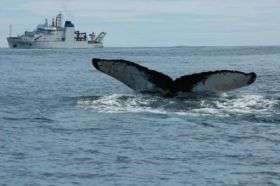
NOAA ship Oscar Dyson stands watch as researchers gather information from humpback whales. Humpback whale flukes, like the one shown here, are unique to each animal just like a fingerprint. This whale could be identified thousands of miles away by its distinctive markings. Credit: NOAA

The number of humpback whales in the North Pacific Ocean has increased since international and federal protections were enacted in the 1960s and 70s, according to a new study funded primarily by NOAA and conducted by more than 400 whale researchers throughout the Pacific region.

However, some isolated populations of humpbacks, especially those in the Western Pacific Ocean, have not recovered at the same rate and still suffer low numbers.

The new research reveals that the overall population of humpbacks has rebounded to approximately 18,000 to 20,000 animals. The population of humpback whales in the North Pacific, at least half of whom migrate between Alaska and Hawaii, numbered less than 1,500 in 1966 when international whaling for this species was banned. In the 1970s, federal laws including the Marine Mammal Protection Act and the Endangered Species Act provided additional protection.

“NOAA is proud to have played a key role in initiating and funding this study,” said retired Navy Vice Adm. Conrad C. Lautenbacher, Ph.D., under secretary of commerce for oceans and atmosphere and NOAA administrator. “It is only through this type of international cooperation that we can gauge our success and measure what additional work needs to be accomplished to protect highly migratory marine mammals.”

The results of this new report come from SPLASH (Structure of Populations, Levels of Abundance and Status of Humpbacks), an international effort involving more than 50 organizations. Launched in 2004, the project determined whale migratory patterns and estimated population sizes by using a library of 18,000 photographs of whale flukes to identify 8,000 individual whales.

Cascadia Research in Olympia, Wash., the central coordinator for the SPLASH project, matched photographs from six different feeding and breeding areas. By matching whale flukes photographed in their feeding areas with those photographed in the wintering areas, researchers were able to determine the patterns of individual whale movements, as well as estimate the sizes of different populations.

In addition to whale fluke photographs, SPLASH researchers collected more than 6,000 biopsy samples for studies of genetics and pollutants, along with thousands of additional photographs to determine how levels of scarring from line entanglement and ship strikes vary among regions. The samples, which are yet to be analyzed, will provide valuable insights into the complex population structure and current threats to further recovery.

Source: NOAA National Marine Fisheries Service


print this article email this article download pdf blog this article bookmark this article     Digg this Stumble it share on Facebook share on Reddit add to delicious save to Yahoo! bookmarks
4.7/5 after 6 votes


May 21st, 2008 all stories
Space & Earth / Environment

Comments: 0
Rank: 4.7/5 after 6 votes

  • Stumble this up

  • Digg this

  • Share it:
  • share on Facebook
  • share on MySpace
  • share on Slashdot
  • rss-newsfeed
  • share on Google
  • share on Reddit
  • add to delicious
  • save to Yahoo! bookmarks
  • share on Windows Live
  • Add to Mixx!
Rating: 4.7/5 after 6 votes

  • Related Stories

  • Endangered right whales found where presumed extinct
    created May 20, 2009 | popularity not rated yet | comments 0
  • Scientists identify world's largest leatherback turtle population
    created May 18, 2009 | popularity not rated yet | comments 0
  • Blue whales returning to former Alaska waters
    created May 18, 2009 | popularity not rated yet | comments 0
  • Biologists use DNA to study migration of threatened whale sharks
    created Apr 07, 2009 | popularity not rated yet | comments 0
  • Study: False killer whales declining off Hawaii
    created Apr 03, 2009 | popularity not rated yet | comments 0

Tags


  • Physicists Demonstrate Quantum Memory with Matter Qubits
    Physicists Demonstrate Quantum Memory with Matter Qubits
    Physics / General Physics
    created Jul 03, 2009 | popularity 4.4 / 5 (16) | comments 1
  • 'Holey' Nanosheets for Wastewater Dye Removal
    Nanotechnology / Nanomaterials
    created Jul 01, 2009 | popularity 5 / 5 (5) | comments 1
  • Jellyfish Robot Swims Like its Biological Counterpart
    Jellyfish Robot Swims Like its Biological Counterpart
    Electronics / Robotics
    created Jun 26, 2009 | popularity 4.4 / 5 (7) | comments 1
  • Could Maxwell's Demon Exist in Nanoscale Systems?
    Could Maxwell's Demon Exist in Nanoscale Systems?
    Physics / General Physics
    created Jun 24, 2009 | popularity 4.4 / 5 (18) | comments 29
  • Living Safely with Robots, Beyond Asimov's Laws
    Living Safely with Robots, Beyond Asimov's Laws
    Electronics / Robotics
    created Jun 22, 2009 | popularity 4.6 / 5 (52) | comments 40
  • Other News

    Forty years ago man first walked on the moon

    Space & Earth / Space Exploration

    created 2 hours ago | popularity 5 / 5 (2) | comments 0

    Forty years ago on July 20, 1969, American astronaut Neil Armstrong realized the oldest dream of human civilizations when he became the first man to walk on the moon.


    The least sea ice in 800 years

    The least sea ice in 800 years

    Space & Earth / Earth Sciences

    created Jul 01, 2009 | popularity 4.3 / 5 (59) | comments 52

    New research, which reconstructs the extent of ice in the sea between Greenland and Svalbard from the 13th century to the present indicates that there has never been so little sea ice as there is now. The ...


    Gas around young galaxy

    Intense heat killed the Universe's would-be galaxies, researchers say

    Space & Earth / Astronomy

    created Jul 01, 2009 | popularity 3.2 / 5 (19) | comments 25

    (PhysOrg.com) -- Our Milky Way galaxy only survived because it was already immersed in a large clump of dark matter which trapped gases inside it, scientists led by Durham University's Institute for Computational ...


    Scientists' Drill Hits Magma: Only Third Time on Record

    Scientists' Drill Hits Magma: Only Third Time on Record

    Space & Earth / Earth Sciences

    created Jun 29, 2009 | popularity 4.7 / 5 (20) | comments 19

    (PhysOrg.com) -- Scientists drilling a borehole deep into Iceland’s rocky crust to explore new methods of using geothermal energy hit a major roadblock on Thursday: Their drill ran into molten rock at a depth ...


    NASA manager pitches a cheaper return-to-moon plan

    Space & Earth / Space Exploration

    created Jun 30, 2009 | popularity 4 / 5 (7) | comments 18

    (AP) -- Like a car salesman pushing a luxury vehicle that the customer no longer can afford, NASA has pulled out of its back pocket a deal for a cheaper ride to the moon.