Quitting Smoking Helps Social Life
May 22, 2008
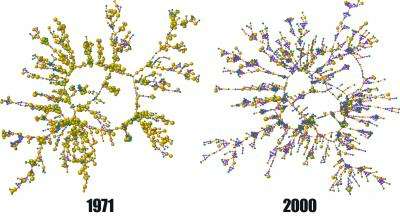
A random sample of 1000 subjects in 1971 and 2000. Yellow nodes are smokers (with the node size proportional to number of cigarettes consumed); green nodes are nonsmokers. Orange arrows denote friendship or marital ties; purple arrows, family ties. In 1971, there are many more smokers and they are dispersed throughout the social network. By 2000, there are not only fewer people smoking, but they have also been pushed to the outside of their social groups. Courtesy James Fowler, UC San Diego
Putting down cigarettes for good can have unexpected social benefits, according to new research from Harvard and the University of California, San Diego. Smoking is bad, it turns out, not only for your physical wellbeing but for your social health, too – with smokers increasingly edged out to the margins of social circles.
Another significant finding of the study, published in the May 22 issue of the New England Journal of Medicine, is that the decision to quit appears to be taken up almost communally, with whole clusters of spouses, friends, siblings and co-workers giving up the habit at about the same time.
The researchers – Nicholas Christakis of Harvard Medical School and James Fowler of UC San Diego – analyzed changes in smoking behavior from 1971 to 2003 in a large social network of 12,067 densely interconnected people.
The study follows up on research by Fowler and Christakis published last summer, also in the New England Journal of Medicine, finding that obesity is “socially contagious” – spreading from person to person in a social network so that if one becomes obese those closely connected to them have a greater chance of becoming obese themselves.
Using data from the same Framingham Heart Study (which, among other things, was the first to identify the link between smoking and cardiovascular disease), the researchers observed that smoking behaviors are subject to similar social-network effects, at two and three degrees of separation. Except that quitting smoking, they found, spread through the network not only like one domino knocking down the next, which in turn knocks down another, but also like a house of cards collapsing.
Christakis and Fowler note that their findings speak both to the power of relationships and to the efficacy of public-health campaigns to reduce smoking. While smoking remains a leading cause of preventable death, rates in the U.S. have decreased substantially.
“When you look at the entire network over this 30-year period, you see that the average size of each particular cluster of smokers remains roughly the same,” Fowler said. “It’s just that there are fewer and fewer of these clusters as time goes on.”
Observing that “entire pockets of people who might not know each other all quit smoking at once,” said Christakis, points to a cultural shift or a change in the zeitgeist. “What appears to happen is that people quit in droves.”
Generally, the researchers found, the closer the relationship between contacts, the greater the influence when one person quit smoking. When one spouse quit, for example, the other spouse’s chances of continuing to smoke decreased by 67 percent. Among friends, the effect was 36 percent. Among co-workers in small firms, 34 percent. Among siblings, the effect was 25 percent. Neighbors did not seem to be influenced by one another’s smoking habits.
Education played a role: Among friends who both had at least one year of college, the effect was 61 percent. The paper concludes that the educated are not only more influential, but also that they are also more easily influenced.
Surprisingly, people quit roughly in tandem, with whole groups becoming nonsmokers. Those who continued to smoke, meanwhile, formed their own “cliques” that, over time, shifted from the center of the social network to the periphery.
“In the early 1970s,” said Fowler, “it was completely irrelevant if you smoked. You could be central in your circle and be connected to lots of other people who were similarly central. You could be popular, in other words. By the 2000s, it had become highly relevant: If you smoked, you would, in some sense, be shunned.”
The reverse was also true: Once you quit, you tended to move back to a more central position among your contacts.
“We show,” Fowler said, “that this not coincidental – there seems to be a causal relationship at work.”
All of which points to possible policies for addressing other public-health concerns – like the researchers’ previous study case, obesity.
“Network phenomena,” they write, “might be exploited to spread positive health behaviors,” and targeting groups, not just individuals, might be more effective.
Yet, cautions Fowler, effective doesn’t necessarily equate with good. “Stigmatization is effective,” he said. “But is it always advisable? Social pressure comes with a cost. We see here that we have stigmatized not only smoking but smokers too. Huddling in a corner with your smoking friends is going to make it that much harder for you to stop. And we also know from other research that social isolation is detrimental to your physical health on several other levels as well.”
Source: University of California - San Diego
-
Poorest smokers face toughest odds for kicking the habit
Jan 20, 2012 |
5 / 5 (1) |
0
-
Setting a good example? Smoking amongst key occupational groups
Jan 18, 2012 |
not rated yet |
0
-
If you plan, then you'll do... but it helps to have a friend
Jan 04, 2012 |
not rated yet |
0
-
People don't just think with their guts; logic plays a role too
Dec 29, 2011 |
4.8 / 5 (5) |
0
-
Tobacco industry dying? Not so fast, says Stanford expert
Dec 13, 2011 |
not rated yet |
4
-
Engineers build first sub-10-nm carbon nanotube transistor
Feb 01, 2012 |
4.9 / 5 (31) |
30
-
Something old, something new: Evolution and the structural divergence of duplicate genes
Jan 31, 2012 |
4.6 / 5 (7) |
1
-
The hidden nanoworld of ice crystals: Revealing the dynamic behavior of quasi-liquid layers
Jan 30, 2012 |
5 / 5 (3) |
1
-
Stock market network reveals investor clustering
Jan 27, 2012 |
3.9 / 5 (23) |
8
-
Of microchemistry and molecules: Electronic microfluidic device synthesizes biocompatible probes
Jan 26, 2012 |
5 / 5 (1) |
0
-
Classical and Quantum Mechanics via Lie algebras
Apr 15, 2011
- More from Physics Forums - Independent Research
More news stories
Study finds that anti-diabetic medication can prevent the long-term effects of maternal obesity
In a study to be presented today at the Society for Maternal-Fetal Medicine's annual meeting, The Pregnancy Meeting, in Dallas, Texas, researchers will report findings that show that short therapy with the anti-diabetic medication ...
21 hours ago |
5 / 5 (1) |
1
FDA-approved drug rapidly clears amyloid from the brain, reverses Alzheimer's symptoms in mice
Neuroscientists at Case Western Reserve University School of Medicine have made a dramatic breakthrough in their efforts to find a cure for Alzheimer's disease. The researchers' findings, published in the journal Science, show t ...
Medicine & Health / Neuroscience
Feb 09, 2012 |
4.9 / 5 (53) |
20
|
Teen school drop-outs three times as likely to be on benefits in later life
Teen school drop-outs are almost three times as likely to be on benefits in later life as their peers who complete their schooling, indicates research published online in the Journal of Epidemiology and Community Health.
Feb 06, 2012 |
not rated yet |
11
Green tea found to reduce disability in the elderly
(Medical Xpress) -- A lot of research has been done over the past several years looking into the health benefits of green tea. As a result, scientists have found that regular consumption of the beverage leads ...
Amateur football players not always keen on returning to play after ACL injuries
Despite the known success rates of reconstructive Anterior Cruciate Ligament (ACL) surgery, the number of high school and collegiate football players returning to play may not be as high as anticipated, say researchers presenting ...
21 hours ago |
not rated yet |
0
Google might launch Drive for cloud storage soon
(PhysOrg.com) -- Google's next big move, according to the Wall Street Journal, is a cloud storage service called Drive. Hardly first to the plate, Google is simply catching up to introducing its cloud reposi ...
Latin America mining boom clashes with conservation
Latin America is experiencing a mining boom as prices rise fuelled by a hike in global demand, but the region is also being hit by a wave of violent protests, strikes and rallies by environmentalists.
Love a click away in Indonesia's Twitter Republic
He was a geeky kid from Yogyakarta, she a glamorous city girl in Jakarta. In a country with one of the world's most vibrant social networking scenes they fell in love on Twitter.
Walney offshore wind farm is world's biggest (for now)
(PhysOrg.com) -- The Walney wind farm on the Irish Sea--characterized by high tides, waves and windy weather--officially opened this week. The farm is treated in the press as a very big deal as the Walney ...
GPS court ruling leaves US phone tracking unclear
A US Supreme Court decision requiring a warrant to place a GPS device on the car of a criminal suspect leaves unresolved the bigger issue of police tracking using mobile phones, legal experts say.
Europeans protest controversial Internet pact
Tens of thousands of people marched in protests in more than a dozen European cities Saturday against a controversial anti-online piracy pact that critics say could curtail Internet freedom.
May 22, 2008
Rank: 4 / 5 (1)