Dutch robot Flame walks like a human
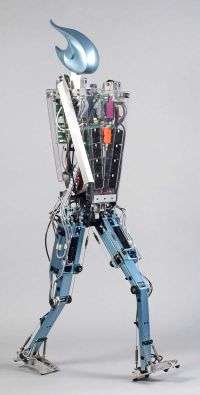
Researcher Daan Hobbelen of TU Delft has developed a new, highly-advanced walking robot: Flame. This type of research, for which Hobbelen will receive his PhD on Friday 30 May, is important as it provides insight into how people walk. This can in turn help people with walking difficulties through improved diagnoses, training and rehabilitation equipment.
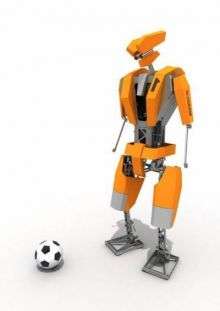
If you try to teach a robot to walk, you will discover just how complex an activity it is. Walking robots have been around since the seventies. The applied strategies can roughly be divided into two types.
The first derives from the world of industrial robots, in which everything is fixed in routines, as is the case with factory robots. This approach can, where sufficient time and money are invested, produce excellent results, but there are major restrictions with regard to cost, energy consumption and flexibility.
TU Delft is a pioneer of the other method used for constructing walking robots, based on the way humans walk. This is really very similar to falling forward in a controlled fashion. Adopting this method replaces the cautious, rigid way in which robots walk with the more fluid, energy-efficient movement used by humans.
PhD student Daan Hobbelen has demonstrated for the first time that a robot can be both energy-efficient and highly stable. His breakthrough came in inventing a suitable method for measuring the stability of the way people walk for the first time. This is remarkable, as ‘falling forward’ is traditionally viewed as an unstable movement.
To watch Flame in action click here (WMV, 5.25MB).
Next he built a new robot with which he was able to demonstrate the improved performance: Flame. Flame contains seven motors, an organ of balance and various algorithms which ensure its high level of stability.
For instance, the robot can apply the information provided by its organ of balance to place its feet slightly further apart in order to prevent a potential fall. According to Hobbelen, Flame is the most advanced walking robot in the world, at least in the category of robots which apply the human method of walking as a starting principle.
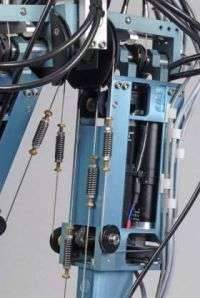
Modelling the walking process allows researchers to construct two-legged robots which walk more naturally. More insight into the walking process can in turn help people with walking difficulties, for example through improved diagnoses, training and rehabilitation equipment. TU Delft is working on this together with motion scientists at VU University Amsterdam.
Hobbelen cites ankles as an example. These joints are a type of spring which can be used to define the best level of elasticity. Research conducted by Hobbelen into Flame’s ankles has provided motion scientists with more insight into this topic.
Source: Delft University of Technology


