A Test of the Copernican Principle
May 22, 2008 By Lisa Zyga
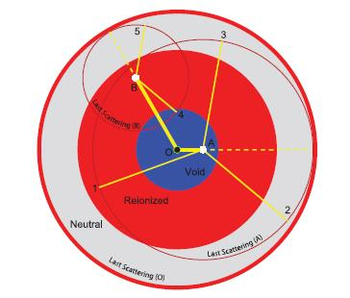
This image shows a cross-section of a void universe with an observer (O) in the center, in violation of the Copernican principle. CMB photons (yellow lines) can scatter off reionized gas, and some may lead to CMB distortions. Credit: Caldwell, R. R. and Stebbins, A. ©2008 APS.
The Copernican principle states that the Earth is not the center of the universe, and that, as observers, we don’t occupy a special place. First stated by Copernicus in the 16th century, today the idea is wholly accepted by scientists, and is an assumed concept in many astronomical theories.
However, as physicists Robert Caldwell of Dartmouth College in Hanover, New Hampshire, and Albert Stebbins of Fermilab in Batavia, Illinois, point out, the Copernican principle has never been confirmed as a whole. In a recent paper published in Physical Review Letters called “A Test of the Copernican Principle,” the two researchers set out to prove the 500-year-old principle using observations of the cosmic microwave background (CMB).
“The Copernican principle is a cornerstone of most of astronomy, it is assumed without question, and plays an important role in many statistical tests for the viability of cosmological models,” Stebbins told PhysOrg.com. “It is also a necessary consequence of the stronger assumption of the Cosmological Principle: namely, that not only do we not live in a special part of the universe, but there are no special parts of the universe – everything is the same everywhere (up to statistical variation).
“It is a very handy principle, since it implies that here and now is the same as there and now, and here and then is the same as there and then. We do not have to look back in time at our current location to see how the universe was in our past – we can just look very far away, and given the large light travel time, we are looking at a distant part of the universe in the distant past. Given the Cosmological Principle, their past is the same as our past.”
Cosmic Distortion
When the universe was just 400,000 years old, matter and radiation decoupled and left a remnant radiation that still pervades the entire universe today. By measuring the tiny temperature fluctuations of this CMB radiation, scientists can learn things about the universe such as its shape, size, and rate of expansion. In the latter case, the observations show that the universe is expanding at an ever-accelerating rate, leading scientists to speculate about the existence of dark energy, new laws of gravity, and other possible – and often exotic – theories.
But what if the universe’s accelerating expansion is just an illusion? As Caldwell and Stebbins explained, this scenario is entirely plausible if the Copernican principle is loosened a bit. If, instead of the universe being homogenous and isotropic as the Cosmological Principle states, there is rather “a peculiar distribution of matter centered upon our location,” then the universe would be centered on a low-density, matter-dominated void. Such a universe would be non-accelerating, and there would be no need for dark energy or other similar theories.
That’s why it’s important to know if the Copernican principle is correct: it will ensure that CMB observations haven’t been misinterpreted to indicate cosmic acceleration when there is none. To test the principle, Caldwell and Stebbins developed a “CMB-distortion test”: they looked for deviations of the CMB spectrum from a perfect blackbody as might have been caused by a large, local void. A void or other “non-Copernican structure” would cause ionized gas to move relative to the CMB, and the Doppler-shifted CMB scattered toward us could contain detectable deviations from a blackbody.
“In essence, we use the reionized Universe as a mirror to look at ourselves in CMB light,” the researchers explained. “If we see ourselves in the mirror, it is because ours is a privileged location. If we see nothing [i.e. no peculiar distortions] in the mirror, then the Copernican principle is upheld.”
The Hubble Bubble
As an initial test, Caldwell and Stebbins focused on a universe model consisting of a simple, spherically symmetric void, which is also known as a “Hubble bubble.” This void universe resembles an open (low-density) universe embedded inside a flat (medium-density) universe. The size of the void depends on how gas is distributed throughout the universe. Basically, gas can exist in three zones – neutral, reflection, and Doppler – depending on its redshift. Depending on how these three zones overlap, the void can come in five sizes, from small to “superhorizon,” where the void encompasses the entire observable universe.
Using their CMB-distortion test, the researchers calculated that only the smaller void models could lead to the type of distortion associated with a violation of the Copernican principle. Then, by analyzing data for the CMB spectrum, they were able to rule out nearly all of these non-Copernican Hubble bubble void universes – meaning the Copernican principle passed this first test. However, Caldwell and Stebbins also noted that other models – such as those with a higher density or smaller radius – may still exist that evade this test.
The researchers added that this is not the first time that bits of the Copernican principle have been tested, but it is one of the first tests of the remaining radial inhomogeneity on very large scales. Caldwell explained that, in 1995, physicist Jeremy Goodman of Princeton proposed a similar test of spectral distortions. Goodman’s implementation resulted in a weaker constraint, or test, of the Copernican principle.
“This [large-scale testing] is not easy to do because, when we look far away, we are looking back in time, and it is difficult to say whether what we see is due to changes with time, which does not violate the Copernican principle, or changes with distance, which does,” Stebbins explained. “Thus, it is a hard question to answer, which is why it has not been done.”
More Tests
In the future, the scientists plan to further pinpoint the CMB distortions that could be caused by a local non-Copernican structure, and also apply the test to other more general universe models. These tests should be useful in potentially ruling out alternative hypotheses for dark energy, as Caldwell explained. More fundamentally, the tests could either verify the foundation of centuries of astronomical work, or – and the chance is slim – suggest that the Copernican principle may not be as certain as we think.
“If our test of the Copernican principle were to fail, it would probably not be believed, and a variety of other observations would be required to test it,” Stebbins said. “If all these further tests confirmed the large void, then we would have to rethink our ideas about dark energy, or, namely, unthink them.
“I think the scientific community would not be too unhappy with the idea of a large under-dense region – it is not hard to think of ideas of how they might come to be, even in the context of a hot big bang model. What is hard to understand is why we would be so close to the center of one. No doubt someone would come up with an ‘anthropic’ argument for it – but I've thought a bit about that, and don't really think there is a salable anthropic explanation. (By the way, I don't think there is a salable intelligent design reason, either.) In the end, we might have to live with the Walter Cronkite explanation ‘... and that's the way it is .... ’”
More information: Caldwell, R. R. and Stebbins, A. “A Test of the Copernican Principle.” Physical Review Letters 100, 191302 (2008).
Copyright 2008 PhysOrg.com.
All rights reserved. This material may not be published, broadcast, rewritten or redistributed in whole or part without the express written permission of PhysOrg.com.


Perhaps you are referring to the missing mass that was used to produce the photons? Only 0.7% of the original mass in stellar fusion is lost in the chemical process. I can guarantee you astronomers have factored this in to cosmology theory :)
This is sort of basic...
No particle travelling at the speed of light can have mass as that would take an infinite amount of energy.
For most average objects, momentum is truly mass x velocity. When motion gets close to the speed of light, we find that the momentum relation p=mv is only an approximation. It is only correct when speed (v) is much smaller than the speed of light (c). The relation that works for all speeds is E^2 = p^2c^2 m^2c^4. It is much less convenient to use, and doesn't help figure anything out until you reach speeds of perhaps thirty million meters per second. For a particle with no mass, the relation reduces to E=pc. This works for a photon. For very small speeds, the system reduces to E=mc^2 (1/2)mv^2, and p=mv. This leads to relations with kinetic energy and momentum: much more convenient to work with and just as accurate until you reach speeds close to the speed of light.
The problem we face is that what we observe is not explained under the theories we currently have. I see theories starting with dark (unobservable matter)matter and now dark (unobservable) energy. Our mathmatical system starts suffering irregularities when we hit/approach zero. Is it possible that the photon having freqency and spin maintains some neglible mass in singular but signigicant in vast quantity???
Alternatively suppose in space (excluding the mass from the trace gasses and stray atoms you were to instantainesouly enclose one cubic meter (or kilometer for that matter) with a perfectly absorbtive sphere such that all photons with in the space were perfectly absorbed such that we harvested all the energy contained in that space E=mc^2. Even at a trace amount there is alot of cubic volume to concider so thats alot of matter I assume? Does this mass exert gravitational attraction when converted to energy?
:) I know this is where I should have shut my mouth and only be thought a fool instead of proving it :)
The wikipedia article, "Mass in special relativity", is very revealing - http://en.wikiped...lativity
Here's a quote:
"The term mass in special relativity usually refers to the rest mass of the object, which is the Newtonian mass as measured by an observer moving along with the object. The invariant mass is another name for the rest mass, but it is usually reserved for systems which consist of widely separated particles.
The term relativistic mass is also used, and this is the total quantity of energy in a body (divided by c2). The relativistic mass includes a contribution from the kinetic energy of the body, and is bigger the faster the body moves, so unlike the invariant mass, the relativistic mass depends on the observer's frame of reference.
Because the relativistic mass is just another name for the energy, it has gradually fallen into disuse."
I always understood the M in Einstein's relativity was the same as in E=MC^2 which suggests to me that photons, by virtue of their energy, have relativistic mass, and hence warp space... i.e. interact with gravity.
Does only "rest mass" warp space?
The original question by PaulLove asked if cosmologists have considered if the dark energy/mass that is "missing" is simply that contained in the starlight.
I've re-read above posts and still have not seen the answer. I agree the rest mass of the photon is zero, but none of the sunlight protons are at rest relative to us or the stars behind them.
Please... help us out here.
Ontheinternets quotes the definition of relativistic mass as including the kinetic energy of the object. This suggests that a hot earth distorts space a little more than a cold earth, giving the appearance of attracting a satellite a little stronger... the kinetic energy contributing to the relativistic mass.
Is this correct? Is this something that has been taken into account?
I'll quit with one more thought: Black Holes are suppose to be so gravitationally strong, photons cannot escape. This implies that photons indeed respond to gravity... and thus do have mass in that sense.
Well... maybe one more thought: as the photon escapes from an "almost" black hole, it travels at the speed of light, but as it climbs out of the energy well, it shifts from being an x-ray photon to being an infrared photon. Is this true? ...consider the gedanken experiment: as a massive red giant collapses into a black hole, what happens to the last few photons that escape? I've always imagined they turn deeper and deeper red, they become radio waves, then are snuffed out entirely. Is this correct?
I suspect the cosmologists have taken into account the mass of all the starlight... and the "red shift" due to gravity effects... and still have to to conjecture an expanding universe to explain the magnitude of the red shift and still have to conjecture "dark matter" to explain the changes in the rate of expansion.
This means that the relative angular motion of galaxies involves the skipping of space-frames defined by light at their centers with respect to their peripheries, which at the limit results in black holes. There is a hole in the fabric of space-time because there is no light. Light can not bridge the quantum jumps in position associated with relative angular motions so some frames must be skipped at the center. It is this that curves the integrated fabric of space-time. Light travelling through this fabric must necessarily bend with it.
One can see how this works from the historic coordinates on the website mentioned above. There is an obvious derivation of the Lorentz Transformations from these coordinates that shows two complementary aspects to them and how gravity works accordingly.
Current approaches based on the assumed spacetime continuum as an independent "thing" that curves according to mass which is embedded in it are necessarily flawed. This discussion is about these contradictory assumptions in general relativity. If there really was a continuum then Zeno's arrow would never reach the target. Space and time are quantized in discrete increments and they are not infinitely divisible. There is a minimum limit to the differential in the calculus associated with the uncertainty principle. Exact position is known in a single frame. Momentum by its nature requires a succession of frames. Both can't be known accurately at once.
Planck's constant is a universal quantum of action associated with the projection of discrete space frames. Light comes to us as a series of pulses in each discret space frame. It takes a while for this to sink in.
The Void by its nature is spatially indeterminate and so defies detection on the space-frame side. The Void is orthogonal to the integrated fabric of space-time. Each particulate atom has a conjugate quantum energy equivalent in the Void, and since the Void is timeless the space frames close ranks to present the appearance of continuity. The Void thus has certain characteristics of the ether.
Nevertheless there are irrational holes in space-time associated with the quantization of discrete frames of space-time. Particulate matter oscillates between space and quantum frames such that each oscillation defines one primary interval of time.
Matter is a wave and a particle at the same time. But its wave motion is only detectable at high relative motions attainable with subatomic particles. The Schroedinger wave equation requires a complex conjugate energy equivalent in order to correctly solve the equation when the wave function is said to collapse. It collapses into one final space-frame state that specifies specific conditions at that point in time. This state must take into account qunatum energy equivalents on the quantum side because they accumulate due to relative space frame skipping that accounts for relativistic efects.
The primary interval of time is confirmed by the fact that the orbital angular momentum of the electron in the first orbit of hydrogen is Zero. This means that the electron synchronously recurrs in the same place relative to the proton in each successive projection of the atomic space-frame. The primary interval is thus defined as 1.519x10^-16 seconds.
This being the case in a discontinuous universe the Copernican assumption is too simplistic. The gravitational mass of the earth is synchronous with that of stellar population of the galaxy as a whole and yet its rotational inertial velocity is completely independent from its gravitational mass.
Uh, why do you think they call it "Heavy Metal" music? Duh!
CWFlink - As far as I'm aware, current models (and there is more than just one model out there that reasonably matches observations) hold that gravitational fields are generated proportional to relativistic mass. So yes, a hot body would exert greater gravitational attraction than a similar colder body (however, the difference would likely be very slim -- I hope and trust that many physicists have bothered to calculate this, but it would never hurt for others to do it again).
Back to photons- I'm not a physicist, but I believe that the gravitational effect of a photon has never been measured/verified in a lab because current equipment is insufficiently sensitive. It's hard enough to detect the gravitational effect of a small mass (say, less than 1g), and the relativistic energy possessed by a passing photon is considerably less.
It's a bit embarrassing that most educated people will stubbornly hold that a photon does or does not possess mass - as if trying to prove exposure to the authoritative answer on the matter and/or win a trivia contest - rather than be concerned about what a photon does in the real world under various circumstances.
Paradoxically the interpretations available generally accept either implicitly or explicitly the spacetime continuum as fundamental. There is currently no interpretation generally recognized that explores all the ramifications of a discontinuous universe that at the same stroke explores the structural requirements implicit in the concept of universal wholeness.
Meaning derives from the integration of experience and physics seeks a unified theory. Every culture has had a theory of everything. We need a universal worldview to relate to. So there must be such a thing as universal wholeness, unless we are all hopelessly lost forever. But infinitesimal strings or probability waves don't offer much pragmatic direction to the human spirit in the challenges we face in just living.
The thing about a discontinuous universe is that it remarries the practice and interpretation of physics. It requires direct confirmation in phenomenal experience and it can expand the horizons of physics as well as the biological and social sciences. Unlike interpretations divorced from practice it offers a universal methodology that can complement traditional approaches to science in very practical ways.
So this alternative approach is not taken into consideration with the article's investigation of the Copernican Principle. Whatever these researchers find or conclude will be based upon a spacetime continuum that itself has not been confirmed in phenomenal experience and never can be.
As for the photon there are several aspects to consider in a discontinuous universe. Photons examined in experiments are distinct phenomena from the ubiquitous light that saturates our surroundings even in darkness and that defines space in the vast interstellar reaches as well as in our dark cellars. EM radiation reaches everywhere and it is quantized by the discontinuous but synchronous projection of the cosmic movie.
So specific photons produced by a source for experimental study are superimposed on this background. They are emitted in some way from within atoms, by some manipulation of atomic or sub-atomic processes. Within atoms photons define the spherical inner space of the atom in discrete levels consistent with de Broglies wave equation, so light that is emitted is always quantized accordingly across the whole range of the EM spectrum.
The point here is that it is light that implicitly defines mass within the atom, not vice-versa. It is the intimate internal relationship between photon, electron and proton within the atom as well as in the conjugate quantum frame that specifies what mass, space and time are. This is clear in a discontinuous universe and it is directly confirmed by our most fundamental laws which derive naturally from this interpretation.
This interpretation does allow of confirmation in phenomenal experience and no mass for a photon has ever been detected. Light energy is essentially matter in reflux through the space frame side of the movie, but on the space-frame side it does not manifest as mass, only as energy. Nevertheless in a discontinuous universe the neutrino produced in decay processes is essentially a photon remnant in particle form. There is speculation that it may have a very small mass.
One is entitled to have intuitive hunches about anything of course but they should not become blind beliefs as the current interpretations so often are. They must find confirmation in phenomenal experience in either the public or private domain. The advantage of the approach taken at www.cosmic-mindreach.com is that it exhausts all possible structural varieties to phenomenal experience. In this way it can provide valuable intuitive guidance regardless of the circumstance.
"Photons" do not exist as particles. Neither the particle theory nor the wave theory of light is accurate.
A "Photon" is actually more an event than a particle, since you can never actually observe a photon "in motion". When a WAVE of light leaves point A strikes a surface at point B, a "photon" is said to strike the surface, but no such particle actually exists between point A and point B.
A solar sail works because, when a wave strikes the surface of the sail and experiences total reflection, Newton's laws state that conservation of momentum must be maintained. The wave of light then imparts its own momentum to the sail, and to balance this, it is reflected in exactly opposite direction with double the electromagnetic frequency. This causes the wave to have momentum double its original momentum and in the opposite direction, and the sail gains momentum equal to the light wave's original momentum, conservation is maintained. Theoretically anyway.
That should be E^2 = c^2p^2 m^2c^4
Hmm. actualy, I think I have it backwards. The sail gains twice the the reflected waves original momentum in order to conserve the total momentum of the system (wave sail).
If sail is at rest and wave strikes it, the systems momentum before the collision is "p".
Now p must remain the same at all times.
Before the collision, the wave has all of the momentum, so the momentum of the wave is w = p.
The momentum of the sail is s = 0.
Once again, the system's momentum p must remain the same at all times. that is:
p = s w
and
p' = s' w'
in this case, "w'" has sign opposite "w".
In the case of total reflection, the wave's entire momentum is transferred to the sail, causing the sail to gain momentum "after" the collision equal to twice that of the original wave.
p = w s
s = 0
so
p = w (if the sail started at rest)
then
s' = 2w
w' = -w
p' = s' w'
so
p' = 2w - w
p' = w = p
Ok, so i had it reversed. Sorry about this. The wave leaves with the same frequency and the sail gains double the momentum of the original wave.
2-1 = 1 so momentum is conserved.
That is total reflection.
------------------
Anything less than total reflection from the normal angle becomes inefficient.
I didn't look at the equations too closely, but that seems more plausible (it matches my experience of mirrors - which are an example of something that we are still familiar with through everyday experience :)).
You say that the wave leaves with the same frequency. I think that is nearly correct. However, since the sail moves a bit, I would expect Doppler shift to slightly affect the reflected wave (decreasing frequency slightly). This would be part of ensuring that energy is conserved.
Imagine two mirrors opposite one another, and light bouncing back and forth between them -- As the light pushes the mirrors apart, energy has got to be lost somewhere, or else we would potentially have a perpetual motion device. I believe the loss would be in the energy of the photons via Doppler shift.
Thanks for the explanation Quantum, I think you hit it on the head. As other commenters have noted, light has momentum but not mass. The equation E^2 = c^2p^2 m^2c^4 implies that for E to equal mc^2, then c^2p^2 must equal 1. Thus p is quite small but not zero.