COROT's exoplanet hunt update
May 22, 2008 COROT's exoplanet hunt update

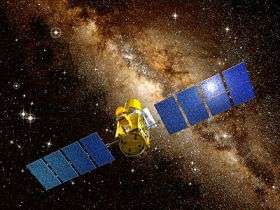
This artist's view shows the COROT satellite, consisting of a 30-centimetre space telescope launched on 27 December 2006. Credits: CNES/D. Ducros

Two new exoplanets and an unknown celestial object are the latest findings of the COROT mission. These discoveries mean that the mission has now found a total of four new exoplanets.

These results were presented this week at the IAU symposium 253 in Massachusetts, USA.

COROT has now been operating for 510 days, and the mission started observations of its sixth star field at the beginning of May this year. During this observation phase, which will last 5 months, the spacecraft will simultaneously observe 12 000 stars.

The two new planets are gas giants of the hot Jupiter type, which orbit very close to their parent star and tend to have extensive atmospheres because heat from the nearby star gives them energy to expand.

In addition, an oddity dubbed ‘COROT-exo-3b’ has raised particular interest among astronomers. It appears to be something between a brown dwarf, a sub-stellar object without nuclear fusion at its core but with some stellar characteristics, and a planet. Its radius is too small for it to be a super-planet.

If it is a star, it would be among the smallest ever detected. Follow-up observations from the ground have pinned it at 20 Jupiter massses. This makes it twice as dense as the metal Platinum.

Scientists suspect that with the detection of COROT-exo-3b, they might just have discovered the missing link between stars and planets.

COROT has also detected extremely faint signals that, if confirmed, could indicate the existence of another exoplanet, as small as 1.7 times Earth’s radius.

This is an encouraging sign in the delicate and difficult search for small, rocky exoplanets that COROT has been designed for.

COROT was launched atop the Soyuz from the Baikonour cosmodrome in Kazakhstan on 27 December 2006. Settled in its almost-circular polar orbit ranging between 895 and 906 km above Earth's surface, the spacecraft was first powered on 2 January 2007 and started its science observations on 3 February of the same year.

Source: ESA


print this article email this article download pdf blog this article bookmark this article     Stumble it Digg this share on Facebook retweet share on Reddit add to delicious
Rate this story - 4.5 /5 (14 votes)


May 22, 2008 all stories

Comments: 0

4.5 /5 (14 votes)
  • Stumble this up

  • Digg this

  • share this

  • hide
  • Related Stories

  • The CoRoT space mission: Early results
    created Oct 22, 2009 | popularity not rated yet | comments 0
  • First Solid Evidence for a Rocky Exoplanet (w/ Video)
    created Sep 16, 2009 | popularity not rated yet | comments 0
  • Missing planets attest to destructive power of stars' tides
    created Apr 27, 2009 | popularity not rated yet | comments 0
  • Mass Loss Leaves Close-In Exoplanets Exposed to the Core
    created Apr 21, 2009 | popularity not rated yet | comments 0
  • Team finds smallest transiting extrasolar planet ever
    created Feb 03, 2009 | popularity not rated yet | comments 0


  • hide
  • Relevant PhysicsForums posts

  • The shape of our solar system's orbits.
    created Nov 07, 2009
  • Above or Below the Line of Nodes
    created Nov 07, 2009
  • Supernova vs. Nova?
    created Nov 07, 2009
  • Supernova's Gamma Rays and Comets
    created Nov 06, 2009
  • More from Physics Forums - General Astronomy

Other News

Planetary Society plans new 'solar sail'

Space & Earth / Space Exploration

created 7 hours ago | popularity 4.5 / 5 (2) | comments 0

(AP) -- Four years after its first solar sail ended up in the ocean instead of orbit, The Planetary Society announced Monday that by the end of 2010 it will try again to launch a spacecraft that will be propelled by the ...


Antarctica glacier retreat creates new carbon dioxide store

Antarctica glacier retreat creates new carbon dioxide store

Space & Earth / Earth Sciences

created 17 hours ago | popularity 3.8 / 5 (5) | comments 0

Large blooms of tiny marine plants called phytoplankton are flourishing in areas of open water left exposed by the recent and rapid melting of ice shelves and glaciers around the Antarctic Peninsula. This ...


L-R: Chiwetel Ejiofor, Amanda Peet and John Cusack at the premiere of "2012"

NASA on crusade to debunk 2012 apocalypse myths

Space & Earth / Space Exploration

created 12 hours ago | popularity 4 / 5 (1) | comments 1

The world is not coming to an end on December 21, 2012, the US space agency insisted Monday in a rare campaign to dispel widespread rumors fueled by the Internet and a new Hollywood movie.


Australian scientists call for urgent 'global cooling' to save coral reefs

Space & Earth / Environment

created 7 hours ago | popularity 3 / 5 (2) | comments 0

(PhysOrg.com) -- Australian marine scientists have issued an urgent call for massive and rapid worldwide cuts in carbon emissions, deep enough to prevent atmospheric CO2 levels rising to 450 parts per million (ppm).


NASA satellites make a movie and get rainfall, wind info on Ida

NASA satellites make a movie and get rainfall, wind info on Ida (w/ Video)

Space & Earth / Earth Sciences

created 12 hours ago | popularity not rated yet | comments 0

NASA satellites are amazing examples of technology. The TRMM satellite peers into tropical cyclones and can tell how much rain is falling per hour and where. QuikScat uses microwave technology to measure Ida's ...