Scientists reveal the lifestyle evolution of wild marine bacteria
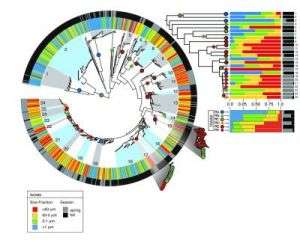
May 22nd, 2008 Eco-Phylogenetic Tree

This figure shows the likely habitats of vibrio bacteria populations mapped onto a phylogenetic tree for all strains found in the samples taken from the Atlantic Ocean near Plum Island, Mass. Dot colors indicate the predicted habitat of the bacteria (red are believed to attach to zooplankton, yellow to large organic particles, green to small organic particles, and finally blue are free-floating). The outer ring indicates the microbe’s preference for warm weather (gray) or cold (black). The inner ring shows where the microbes were found (attached or free-floating). The 25 shaded bands within show the ecological populations based on habitat and genetic similarity, all of which originated from a common ancestor hundreds of millions of years ago. Populations 9 through 25 are all called V. splendidus, even though they have distinct habitat preferences and genetic lineage distributions. Two of those (15 and 17) appear to be in the process of radiating into a different habitat. Credit: Lawrence David and Dana Hunt, MIT

Marine bacteria in the wild organize into professions or lifestyle groups that partition many resources rather than competing for them, so that microbes with one lifestyle, such as free-floating cells, flourish in proximity with closely related microbes that may spend life attached to zooplankton or algae.

This new information about microbial groups and the methodology behind it could change the way scientists approach the classification of microbes by making it possible to determine on a large scale, relatively speaking, the genetic basis for ecological niches. Microbes drive almost all chemical reactions in the ocean; it’s important to identify the specific professions held by different groups.

“This is the first method to accurately differentiate the ecological niche or profession among large groups of microbes in the ocean,” said Professor Martin Polz, a microbiologist in MIT’s Department of Civil and Environmental Engineering. He and colleague Professor Eric Alm, a computational biologist, published a paper describing their research in the May 23 issue of Science.

The nature of reproduction in microbes makes it impossible to define populations based on the ability of individuals within a species to share genes, as we do with larger animals. It’s only by determining bacteria’s ecological niche that scientists can classify them into populations. But microbes don’t live in natural population groups when cultured in a lab. So scientists must catch bacteria in the wild, then examine them genetically to determine their lifestyle.

“Most methods in use either over or underestimate greatly the number of microbial populations in a sample, leading either to a confusing array of populations, or a few large, but extremely diverse groups,” said Polz. “Eric’s method takes genetic information and groups the microbes into genetically distinct populations based on their preference for different habitats. Although this sounds like a simple problem, it is exceedingly difficult with microbes, because we have no species concept that would allow us to identify the genetic structure expected for populations. Microbial habitats differ on such small scales that they are invisible to us.”

Polz and former graduate student Dana Hunt, now a postdoctoral researcher at the University of Hawaii, created a large and accurate genetic data set by isolating and identifying over 1,000 strains of vibrio bacteria from a sample of eight liters of seawater gathered near Plum Island, Mass., in the spring and fall. To achieve accuracy in their identification of strains, they selected a gene whose molecular clock—the rate at which a gene accumulates random mutations over time—was well-suited to the task.

“The trick in many ways is choosing a gene that has a molecular clock that ticks at the right rate,” said Polz. “In particular, if it’s too slow, you might lump organisms into a single group that you would actually like to differentiate. We chose a gene that accumulates mutations fairly fast and thus allowed us to differentiate closely related groups of individuals and map the ecological data we collected onto their family tree.”

Alm and graduate student Lawrence David wrote an algorithm to make a conservative estimate of the minimum number of different habitats occupied by the vibrios (whether they live on small or large particles and thrive in the cool or warm months, etc.). They then combined information about habitat with phylogeny (the evolutionary history of groups of genes), and apportioned the original strains into 25 distinct populations and mapped their habitats back to a common ancestor, showing when and how each group diverged from the ancestral lifestyle.

“What is really new about our approach is that we were able to combine both molecular data (DNA sequences) with ecological data in a single mathematical framework,” said Alm. “This allowed us to solve the inverse problem of taking samples of organisms from different environments and figuring out their underlying habitats. In essence, we modeled the evolution of a microbe’s lifestyle over millions of years.”

One splendid example of the difficulty of applying the term “species” to a single-celled creature: 17 of those 25 populations are called V. splendidus, a name that was previously assigned to them based on classical taxonomic techniques. Alm and Polz can see now that V. splendidus has differentiated into several ecological populations.

Alm and Polz believe they caught at least one of those V. splendidus populations in the act of switching from one ecological niche (thriving on zooplankton) toward a new niche (attaching to small organic particles). Of course, this process takes millions of years, so the current population of scientists may never know for certain.

Source: Massachusetts Institute of Technology


print this article email this article download pdf blog this article bookmark this article     Digg this Stumble it share on Facebook share on Reddit add to delicious save to Yahoo! bookmarks
4.2/5 after 10 votes


May 22nd, 2008 all stories
Biology /

Comments: 0
Rank: 4.2/5 after 10 votes

  • Stumble this up

  • Digg this

  • Share it:
  • share on Facebook
  • share on MySpace
  • share on Slashdot
  • rss-newsfeed
  • share on Google
  • share on Reddit
  • add to delicious
  • save to Yahoo! bookmarks
  • share on Windows Live
  • Add to Mixx!
Rating: 4.2/5 after 10 votes

  • Related Stories

  • Our microbes, ourselves
    created Jan 19, 2009 | popularity not rated yet | comments 0
  • Tiny ecosystem may shed light on climate change
    created Dec 15, 2008 | popularity not rated yet | comments 0
  • After the first decade of metagenomics -- adolescent growth spurt anticipated
    created Sep 25, 2008 | popularity not rated yet | comments 0
  • Insect attack may have finished off dinosaurs
    created Jan 03, 2008 | popularity not rated yet | comments 0
  • Midge keeps invasive mosquito in check, aiding native mosquitoes (w/Podcast)
    created Jun 04, 2009 | popularity not rated yet | comments 0

Tags


  • Physicists Demonstrate Quantum Memory with Matter Qubits
    Physicists Demonstrate Quantum Memory with Matter Qubits
    Physics / General Physics
    created Jul 03, 2009 | popularity 4.4 / 5 (17) | comments 1
  • 'Holey' Nanosheets for Wastewater Dye Removal
    Nanotechnology / Nanomaterials
    created Jul 01, 2009 | popularity 5 / 5 (5) | comments 1
  • Jellyfish Robot Swims Like its Biological Counterpart
    Jellyfish Robot Swims Like its Biological Counterpart
    Electronics / Robotics
    created Jun 26, 2009 | popularity 4.4 / 5 (8) | comments 1
  • Could Maxwell's Demon Exist in Nanoscale Systems?
    Could Maxwell's Demon Exist in Nanoscale Systems?
    Physics / General Physics
    created Jun 24, 2009 | popularity 4.4 / 5 (18) | comments 29
  • Living Safely with Robots, Beyond Asimov's Laws
    Living Safely with Robots, Beyond Asimov's Laws
    Electronics / Robotics
    created Jun 22, 2009 | popularity 4.6 / 5 (52) | comments 40
  • Other News

    Researchers uncover the potential for super-sized abalone

    Biology / Microbiology

    created 1hour ago | popularity not rated yet | comments 0

    (PhysOrg.com) -- Designer abalone could be an option in the foreseeable future, thanks to a project conducted at UQ's Heron Island Research Station and the St Lucia campus.


    Scientists 'rebuild' giant moa using ancient DNA

    Biology / Plants & Animals

    created Jul 01, 2009 | popularity 5 / 5 (10) | comments 12

    (PhysOrg.com) -- Scientists have performed the first DNA-based reconstruction of the giant extinct moa bird, using prehistoric feathers recovered from caves and rock shelters in New Zealand.


    Pacific Giant Salamander (Dicamptodon tenebrosus)

    Salamanders, regenerative wonders, heal like mammals, people

    Biology / Microbiology

    created Jul 01, 2009 | popularity 5 / 5 (20) | comments 11

    The salamander is a superhero of regeneration, able to replace lost limbs, damaged lungs, sliced spinal cord -- even bits of lopped-off brain. But it turns out that remarkable ability isn't so mysterious after ...


    California water plan aims to save Puget Sound orcas

    Biology / Ecology

    created 17 hours ago | popularity not rated yet | comments 0

    A plan to restore salmon runs on California's Sacramento River also could help revive killer whale populations 700 miles to the north in Puget Sound, as federal scientists struggle to protect endangered species in a complex ...


    Genetically modified trees

    Anti-biotech groups obstruct forest biotechnology

    Biology / Biotechnology

    created Jun 30, 2009 | popularity 3.7 / 5 (7) | comments 5

    The potential of forest biotechnology to help address significant social and environmental issues is being "strangled at birth" by the rigid opposition of some groups and regulations that effectively preclude ...