Profits for publishers in making books accessible to all
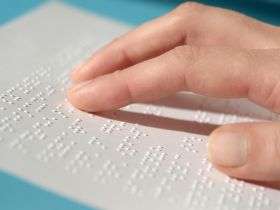
Many people have no access to most published books. European researchers are trying to remedy this by adapting new technologies to provide accessibility on demand for the visually impaired.
The dream is to make all new publications simultaneously available in formats such as Braille, large print and audio. This will mean the blind, the partially sighted and those suffering from reading disabilities such as dyslexia have the same access rights to information as the rest of society.
While the driving force behind the research is helping the ‘print impaired’, who make up between 6-8% of all Europeans, a substantial and hence profitable new mainstream market is also being created.
The EU-funded EUAIN project and its successors have brought together the publishing industry in Europe with accessibility organisations for the first time, and a whole new type of publishing is in the process of being created as a result.
Project co-ordinator David Crombie says while there are plenty of accessibility projects for the Internet, this one is different in that it deals with allowing access to documents in any digital format.
The researchers also viewed accessibility as a being part of a process rather than as a product.
“At key points in the process of creating a digital document, you have to put in accessibility,” he says. “The sooner in the process you add accessibility the better and cheaper it is.”
Important to start at the beginning
He compares built in accessibility in publishing with that in a building.
“When you build, you make sure there is wheelchair access, disabled toilets and other features for the disabled in the building blueprints,” he says. “If you have to go back once the building is completed and retrofit, then it will cost a fortune.”
The same principle applies to publishing. Page make-up and mark-up instructions are included in the original formatting of a digital document, and form the publishing equivalent of an architect’s plan.
These instructions not only provide publishers with information they need for a standard print run, but also for Braille, large-print and even audio versions of the book.
“Printing on demand is a relatively new technology which is just now starting to become mainstream,” Crombie says.
With many of the intermediate steps between receipt of the manuscript and printing of a book now made redundant by digital technologies, a file containing the words and formatting instructions goes straight to the printing press.
The partners in EUAIN have been working on demonstrating to publishers that it is in their best interests, as well as in the interests of the print impaired, to include different sets of formatting instructions from the start of the process.
In the US a commercial start has already been made in this respect with large-print books, the most popular format after standard print. Online shoppers at Amazon.com can order books in either standard or large-print format, and these are then printed on demand.
In European countries a number of book accessibility initiatives have been started over the years, but most of them have been conducted in isolation from each other.
Third-party organisations, rather than the publishers in each country, are responsible for producing books in accessible formats, but only in relation to a small number of selected ones.
Carrots not sticks for publishers
What the EUAIN team has done is to bring all the accessibility organisations in the different countries together to pool their knowledge. The team then put them together with the pan-European publishing industry to explore mutually-beneficial ways to work together.
“It’s no longer a question of publishers being told ‘You must give us this’, but of everybody sitting around a table and talking about markets and how to best serve them while ensuring a profit for the publishers,” Crombie says.
One field in particular where there is likely to be a major crossover, and a whole new mainstream market created, is in synthesised print and audio titles.
Advances in publishing have made well-structured digital audio versions of books extremely flexible, with listeners able to jump from page to page, chapter to chapter or even paragraph to paragraph and easily conduct word searches.
Synthesising the printed text and audio, using a speech synthesiser on the computer reading instructions from the electronic book file, produces a whole new experience for users.
A trial of the methods was recently conducted at a university with a course book. When other students saw how well this worked they started demanding that their course books also be synchronised, Crombie says.
“This is a new and interesting way of interacting with the information which many people will find useful,” he says.
Although EUAIN itself wound up last year, there is a still a long way to go before all publishers make all books accessible on demand. But the EUAIN team has laid the building blocks in the form of a new association, and spin-off projects such as one to set up standards and industry guidelines and produce training materials and courses.
The partners from the project are also trying to set up a new entity that will use the Open Document Format to provide publishers with the ability to electronically plug in to the system and get their books automatically formatted for accessibility.
Two hundred years after the first Braille book was published, there is now a real hope that all books will one day be available in that and other accessible formats.
The EUAIN project received funding from the EU's Sixth Framework Programme for research.
Source: ICT Results


