Sticky business – researchers devise new way of mapping the viscosity of cells
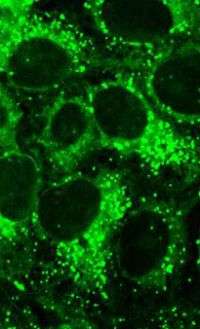
A fluorescent dye can be used to map how viscous, or 'gloopy', different parts of a cell are, according to new research published in the Journal of the American Chemical Society this month.
Changes in viscosity have been linked to disease and malfunction in human cells. For example, changes in the viscosity of the membranes of red blood cells have been observed in diabetes patients. Knowing more about these changes could lead to a greater understanding of how some diseases affect the human body.
Now a team of scientists from Imperial in collaboration with Kings College London has demonstrated that a fluorescent dye can be used to show how viscous different parts of a cell are, compared to one another.
The dye is made of a molecule which has a component that can freely rotate or naturally spin, like a molecular rotor. The researchers demonstrated that the speed of rotation of this molecule can be used to monitor local viscosity.
One of the lead authors on the paper, Dr Gokhan Yahioglu from Imperial's Department of Chemistry and the Imperial spin-out company PhotoBiotics Ltd explains: "We have taken a molecule often used as a fluorescent marker in cells and used it as a true molecular rotor where the intensity and duration of the molecule's fluorescence is strongly linked to the viscosity of the cell into which it is introduced. This means we have developed a sensitive and versatile method for measuring the local micro-viscosity in biological systems."
When a light is shone on fluorescent dyes they emit some of the light back which currently enables these kind of dyes to be used by scientists as markers in cells. However, in the dye used by Dr Yahioglu and his colleagues, some of this light is lost as it is taken up by the molecule as energy to fuel its spinning motion.
The researchers realised that if they placed the dye molecule in a very viscous material, its rotational speed reduced significantly. When it is spinning slower, less energy is being used to fuel its rotation, so the dye emits a much brighter light for a longer period of time.
Conversely, when placed in a less viscous material, the molecule spins much faster, taking up more energy, resulting in the emission of a much dimmer light for a shorter period of time.
When they introduced the dye into a cell, the researchers used imaging techniques to measure the brightness of the dye's fluorescence and for how long it fluoresced, to produce a precise map of the different levels of viscosity in different parts of the cell.
This means researchers have a clearer picture than ever before about how viscosity varies throughout a cell. The new technique could be used to monitor changes in cells' 'stickiness' when they become diseased.
Dr Yahioglu added: "Creating these 'viscosity maps' of the inside of a cell will give us greater insight into the fundamental properties of cells, and could also help us analyse how cells change when they become distressed or diseased."
The paper by Dr Yahioglu and collaborators has been selected as a research highlight by the newly-created journal Nature Chemistry. The Nature Chemistry article about Dr Yahioglu's work can be read in full here: www.nature.com/nchem/reshigh/2 … 8/full/nchem.10.html
The paper entitled "Molecular rotor measures viscosity of live cells via fluorescence lifetime imaging" is available to download in full from the Journal of the American Chemical Society's website: pubs.acs.org/cgi- bin/abstract.cgi/jacsat/asap/abs/ja800570d.html
Source: Imperial College London


