New grants to create fabrics that render toxic chemicals harmless
May 23, 2008 New grants to create fabrics that render toxic chemicals harmless

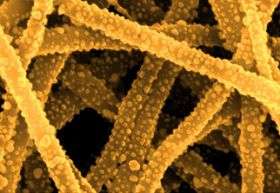
Nylon nanofibers coated with metal nanoparticles. These functional nanofibers have potential applications as active air filtration media as well as flexible antibacterial surfaces such as wipes, carpets and upholstery.

Cornell fiber scientist Juan Hinestroza is working with the U.S. government to create fabrics made of functional nanofibers that would decompose toxic industrial chemicals into harmless byproducts.

Potential applications include safety gear for U.S. soldiers and filtration systems for buildings and vehicles.

Hinestroza, assistant professor of fiber science in the College of Human Ecology, is a member of two teams that secured more than $2.2 million from the U.S. Department of Defense; about $875,000 will go directly to Hinestoza's work. Both grants are multi-university collaborative efforts funded through the U.S. Defense Threat Reduction Agency.

"These nanostructures could be used in creating advanced air filtration and personal protection systems against airborne chemical threats and can find many applications in buildings, airplanes as well as personal respirators," Hinestroza said.

The first project, in collaboration with North Carolina State University, is aimed at understanding how very small electrical charges present in fibers and nanofibers can help in capturing nanoparticles, bacteria and viruses.

"Understanding how these charges are injected into the fibers and how they are dissipated under different environmental conditions can open an avenue to significant improvements in air filtration technology," Hinestroza said.

The position and distribution of the electrical charges on the nanofibers will be fed into computerized fluid dynamics algorithms developed by Andrey Kutznetsov of NC State to predict the trajectory of the nanoparticles challenging the filter. Hinestroza and NC State's Warren Jasper pioneered work in this area a couple of years ago.

The second project, in collaboration with the University of California-Los Angeles (UCLA), will study the incorporation of a new type of molecules -- called metal organic polyhedra and metal organic frameworks -- onto polymeric nanofibers to trap dangerous gases as toxic industrial chemicals and chemical warfare agents, then decompose them into substances that are less harmful to humans and capture them for further decontamination. The synthesis of these molecules was pioneered by Omar Yaghi of UCLA.

This project will also look into the potential toxicity of these nanofiber-nanoparticle systems to humans in collaboration with Andre Nel from UCLA Medical School.

Hinestroza's research group specializes in understanding and manipulating nanoscale phenomena in fiber and polymer science.

Source: Cornell University


print this article email this article download pdf blog this article bookmark this article     Stumble it Digg this share on Facebook retweet share on Reddit add to delicious
Rate this story - 4.5 /5 (6 votes)


May 23, 2008 all stories

Comments: 0

4.5 /5 (6 votes)
  • Stumble this up

  • Digg this

  • share this

  • hide
  • Related Stories


  • hide
  • Relevant PhysicsForums posts

  • Distortion of Zr2Cu crystal structures?
    created 2 hours ago
  • Poynting Effect, more than one meaning?
    created 12 hours ago
  • Pipeline Drying
    created 14 hours ago
  • Polymer Properties Question
    created Nov 08, 2009
  • More from Physics Forums - Materials & Chemical Engineering

Other News

Research helps overcome barrier for organic electronics

Research helps overcome barrier for organic electronics

Nanotechnology / Nanomaterials

created 5 hours ago | popularity 4.8 / 5 (4) | comments 0

(PhysOrg.com) -- Electronic devices can't work well unless all of the transistors, or switches, within them allow electrical current to flow easily when they are turned on. A team of engineers has determined ...


Scientists develop DNA origami nanoscale breadboards for carbon nanotube circuits

Scientists develop DNA origami nanoscale breadboards for carbon nanotube circuits

Nanotechnology / Nanomaterials

created 13 hours ago | popularity 5 / 5 (6) | comments 0

In work that someday may lead to the development of novel types of nanoscale electronic devices, an interdisciplinary team of researchers at the California Institute of Technology has combined DNA's talent ...


Argonne 'homegrown' hybrid solar cell aims for low-cost power

Argonne 'homegrown' hybrid solar cell aims for low-cost power

Nanotechnology / Nanomaterials

created 8 hours ago | popularity 3.8 / 5 (5) | comments 1

(PhysOrg.com) -- Scientists at the U.S. Department of Energy’s (DOE) Argonne National Laboratory have refined a technique to manufacture solar cells by creating tubes of semiconducting material and then "growing" ...


carbon fiber

Ultra-Long Carbon Nanotubes Could Serve as Future Transmission Lines

Nanotechnology / Nanomaterials

created 12 hours ago | popularity 4.9 / 5 (15) | comments 12

(PhysOrg.com) -- When it comes to carbon nanotubes, the majority of research so far has focused on small-scale applications. But now, a team of researchers from Rice University has created carbon nanotubes ...


Researchers invent new method for graphene growth

Researchers invent new method for graphene growth

Nanotechnology / Nanomaterials

created 16 hours ago | popularity 4.9 / 5 (18) | comments 0

(PhysOrg.com) -- A Cornell research team has invented a simple way to make graphene electrical devices by growing the graphene directly onto a silicon wafer.