Radio Telescopes to Keep Sharp Eye on Mars Lander
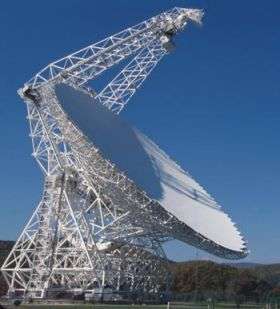
As NASA's Phoenix Mars Lander descends through the Red Planet's atmosphere toward its landing on May 25, its progress will be scrutinized by radio telescopes from the National Radio Astronomy Observatory (NRAO). At NRAO control rooms in Green Bank, West Virginia, and Socorro, New Mexico, scientists, engineers and technicians will be tracking the faint signal from the lander, 171 million miles from Earth.
To make a safe landing, Phoenix must make a risky descent, slowing down from nearly 13,000 mph at the top of the Martian atmosphere to only 5 mph in the final seconds before touchdown. NASA officials point out that fewer than half of all Mars landing missions have been successful, but the scientific rewards of success are worth the risk.
Major events in the spacecraft's atmospheric entry, descent and landing will be marked by changes in the Doppler Shift in the frequency of the vehicle's radio signal. Doppler Shift is the change in frequency caused by relative motion between the transmitter and receiver.
At Green Bank, NRAO and NASA personnel will use the giant Robert C. Byrd Green Bank Telescope (GBT) to follow the Doppler changes and verify that the descent is going as planned. The radio signal from Phoenix is designed to be received by other spacecraft in Mars orbit, then relayed to Earth. However, the GBT, a dish antenna with more than two acres of collecting surface and highly-sensitive receivers, can directly receive the transmissions from Phoenix.
"We'll see the frequency change as Phoenix slows down in the Martian atmosphere, then there will be a big change when the parachute deploys," said NRAO astronomer Frank Ghigo. When the spacecraft's rocket thrusters slow it down for its final, gentle touchdown, its radio frequency will stabilize, Ghigo said.
"We'll have confirmation of these major events through our direct reception several seconds earlier than the controllers at NASA's Jet Propulsion Laboratory will get the relayed information," Ghigo added.
In Socorro, scientists will collect signals from Phoenix with antennas of the continent-wide Very Long Baseline Array (VLBA), which produces the sharpest images of any astronomical instrument in existence. They will use the VLBA's ability to mark the position of objects in the sky with pinpoint precision to reconstruct the craft's location relative to other spacecraft at Mars to within about 100 feet, despite its great distance from Earth.
The VLBA observations will demonstrate NRAO's capability to provide extremely precise measurements of spacecraft positions. This capability may be used to improve the navigational accuracy of future interplanetary missions.
NRAO telescopes have contributed to the success of several previous space missions.
In 1989, the Very Large Array (VLA) received signals from the Voyager 2 spacecraft as it flew by the distant planet Neptune. The combined collecting area of the 27 VLA antennas and their sensitive receivers made possible a higher data-transmission rate from the spacecraft, thus enabling scientists to obtain more images of Neptune, its rings, and its moons.
In 1995, the VLA captured signals from the Galileo spaccraft's probe as the probe dived into the giant planet Jupiter's atmosphere. Like Phoenix, the Galileo probe was designed to send its information to the main spacecraft, which would then relay the signal to Earth. However, the VLA's direct reception of the probe's signal measured the Doppler shift in the signal's frequency and made measurements of Jovian wind speeds 10 times more accurate than they otherwise would have been.
In 2005, the GBT and the VLBA snagged the signal from the Huygens probe as it descended into the atmosphere of Saturn's moon Titan. The Doppler measurements of wind speeds made by NRAO and other radio telescopes provided the only wind data from the mission, because of a malfunction in communication between Huygens and its "mother ship" Cassini.
The National Radio Astronomy Observatory is a facility of the National Science Foundation, operated under cooperative agreement by Associated Universities, Inc.
Source: National Radio Astronomy Observatory


