Researchers demonstrate 'avalanche effect' in solar cells
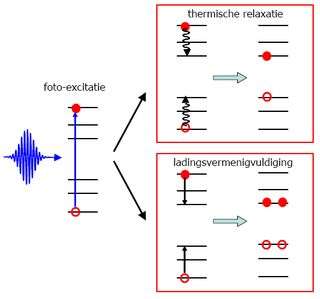
Researchers at TU Delft (Netherlands) and the FOM Foundation for Fundamental Research on Matter have found irrefutable proof that the so-called avalanche effect by electrons occurs in specific, very small semiconducting crystals. This physical effect could pave the way for cheap, high-output solar cells. The findings are to be published in scientific journal Nano Letters this week.
Solar cells provide great opportunities for future large-scale electricity generation. However, there are currently significant limitations, such as the relatively low output of most solar cells (typically fifteen percent) and high manufacturing costs.
One possible improvement could derive from a new type of solar cell made of semiconducting nanocrystals (crystals with dimensions in the nanometre size range). In conventional solar cells, one photon (light particle) can release precisely one electron. The creation of these free electrons ensures that the solar cell works and can provide power. The more electrons released, the higher the output of the solar cell.
In some semiconducting nanocrystals, however, one photon can release two or three electrons, hence the term avalanche effect. This could theoretically lead to a maximum output of 44 percent in a solar cell comprising the correct semiconducting nanocrystals. Moreover, these solar cells can be manufactured relatively cheaply.
The avalanche effect was first measured by researchers at the Los Alamos National Laboratories in 2004. Since then, the scientific world has raised doubts about the value of these measurements. Does the avalanche effect really exist or not?
Within the Joint Solar Programme TU Delft’s Prof. Laurens Siebbeles has now demonstrated that the avalanche effect does indeed occur in lead selenide (PbSe) nanocrystals. It has been established, however, that the effect in this material is smaller than previously assumed. Siebbeles’ results are more reliable than those of other scientists thanks to more careful and more detailed measurement using ultra-fast laser methods.
Siebbeles believes that this research paves the way for further unravelling the secrets of the avalanche effect.
The paper can be found here (requires subscription).
Source: TU Delft


