Geoengineering could slow down the global water cycle
May 27th, 2008 Geoengineering could slow down the global water cycle

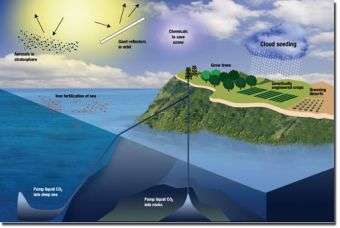
A schematic representation of various geoengineering and carbon storage proposals. Diagram by Kathleen Smith/LLNL

As fossil fuel emissions continue to climb, reducing the amount of sunlight hitting the Earth would definitely have a cooling effect on surface temperatures.

However, a new study from Lawrence Livermore National Laboratory, led by atmospheric scientist Govindasamy Bala, shows that this intentional manipulation of solar radiation also could lead to a less intense global water cycle. Decreasing surface temperatures through “geoengineering” also could mean less rainfall.

The reduction in sunlight can be accomplished by geoengineering schemes. There are two classes: the so-called “sunshade” geoengineering scheme, which would mitigate climate change by intentionally manipulating the solar radiation on the earth's surface; the other category removes atmospheric CO2 and sequesters it into the terrestrial vegetation, oceans or deep geologic formations.

In the new climate modeling study, which appears in the May 27-30 early online edition of the Proceedings of the National Academy of Sciences, Bala and his colleagues Karl Taylor and Philip Duffy demonstrate that the sunshade geoengineering scheme could slow down the global water cycle.

The sunshade schemes include placing reflectors in space, injecting sulfate or other reflective particles into the stratosphere, or enhancing the reflectivity of clouds by injecting cloud condensation nuclei in the troposphere. When CO2 is doubled as predicted in the future, a 2 percent reduction in sunlight is sufficient to counter the surface warming.

This new research investigated the sensitivity of the global mean precipitation to greenhouse and solar forcings separately to help understand the global water cycle in a geoengineered world.

While the surface temperature response is the same for CO2 and solar forcings, the rainfall response can be very different.

“We found that while climate sensitivity can be the same for different forcing mechanisms, the hydrological sensitivity is very different,” Bala said.

The global mean rainfall increased approximately 4 percent for a doubling of CO2 and decreases by 6 percent for a reduction in sunlight in his modeling study.

“Because the global water cycle is more sensitive to changes in solar radiation than to increases in CO2, geoengineering could lead to a decline in the intensity of the global water cycle” Bala said.

A recent study showed that there was a substantial decrease in rainfall over land and a record decrease in runoff and discharge into the ocean following the eruption of Mount Pinatubo in 1991. The ash emitted from Pinatubo masked some of the sunlight reaching the earth and therefore decreased surface temperatures slightly, but it also slowed down the global hydrologic cycle.

“Any research in geoengineering should explore the response of different components of the climate system to forcing mechanisms,” Bala said.

For instance, Bala said, sunshade geoengineering would not limit the amount of CO2 emissions. CO2 effects on ocean chemistry, specifically, could have harmful consequences for marine biota because of ocean acidification, which is not mitigated by geoengineering schemes.

“While geoengineering schemes would mitigate the surface warming, we still have to face the consequences of CO2 emissions on marine life, agriculture and the water cycle,” Bala said.

Source: Lawrence Livermore National Laboratory


print this article email this article download pdf blog this article bookmark this article     Digg this Stumble it share on Facebook share on Reddit add to delicious save to Yahoo! bookmarks
3.3/5 after 23 votes


May 27th, 2008 all stories
Space & Earth / Environment

Comments: 0
Rank: 3.3/5 after 23 votes

  • Stumble this up

  • Digg this

  • Share it:
  • share on Facebook
  • share on MySpace
  • share on Slashdot
  • rss-newsfeed
  • share on Google
  • share on Reddit
  • add to delicious
  • save to Yahoo! bookmarks
  • share on Windows Live
  • Add to Mixx!
Rating: 3.3/5 after 23 votes

  • Related Stories

  • Ocean islands fuel productivity and carbon sequestration through natural iron fertilization
    created Jan 30, 2009 | popularity not rated yet | comments 0
  • Geoengineering could complement mitigation to cool the climate
    created Jan 28, 2009 | popularity not rated yet | comments 0
  • Carbon dioxide already in danger zone, warns study
    created Nov 18, 2008 | popularity not rated yet | comments 0
  • Global warming tactic cools climate but won’t help corals, say researchers
    created Jul 03, 2009 | popularity not rated yet | comments 0
  • Global sunscreen won't save corals
    created Jun 16, 2009 | popularity not rated yet | comments 0

Tags


  • Physicists Demonstrate Quantum Memory with Matter Qubits
    Physicists Demonstrate Quantum Memory with Matter Qubits
    Physics / General Physics
    created Jul 03, 2009 | popularity 4.4 / 5 (17) | comments 1
  • 'Holey' Nanosheets for Wastewater Dye Removal
    Nanotechnology / Nanomaterials
    created Jul 01, 2009 | popularity 5 / 5 (5) | comments 1
  • Jellyfish Robot Swims Like its Biological Counterpart
    Jellyfish Robot Swims Like its Biological Counterpart
    Electronics / Robotics
    created Jun 26, 2009 | popularity 4.4 / 5 (8) | comments 1
  • Could Maxwell's Demon Exist in Nanoscale Systems?
    Could Maxwell's Demon Exist in Nanoscale Systems?
    Physics / General Physics
    created Jun 24, 2009 | popularity 4.4 / 5 (18) | comments 29
  • Living Safely with Robots, Beyond Asimov's Laws
    Living Safely with Robots, Beyond Asimov's Laws
    Electronics / Robotics
    created Jun 22, 2009 | popularity 4.6 / 5 (52) | comments 40
  • Other News

    US ambitions to send astronauts back to the moon as a prelude to missions to Mars have been put in doubt

    Forty years ago man first walked on the moon

    Space & Earth / Space Exploration

    created 21 hours ago | popularity 4.3 / 5 (4) | comments 2

    Forty years ago on July 20, 1969, American astronaut Neil Armstrong realized the oldest dream of human civilizations when he became the first man to walk on the moon.


    The least sea ice in 800 years

    The least sea ice in 800 years

    Space & Earth / Earth Sciences

    created Jul 01, 2009 | popularity 4.1 / 5 (63) | comments 59

    New research, which reconstructs the extent of ice in the sea between Greenland and Svalbard from the 13th century to the present indicates that there has never been so little sea ice as there is now. The ...


    Gas around young galaxy

    Intense heat killed the Universe's would-be galaxies, researchers say

    Space & Earth / Astronomy

    created Jul 01, 2009 | popularity 3.4 / 5 (21) | comments 27

    (PhysOrg.com) -- Our Milky Way galaxy only survived because it was already immersed in a large clump of dark matter which trapped gases inside it, scientists led by Durham University's Institute for Computational ...


    Scientists' Drill Hits Magma: Only Third Time on Record

    Scientists' Drill Hits Magma: Only Third Time on Record

    Space & Earth / Earth Sciences

    created Jun 29, 2009 | popularity 4.7 / 5 (22) | comments 20

    (PhysOrg.com) -- Scientists drilling a borehole deep into Iceland’s rocky crust to explore new methods of using geothermal energy hit a major roadblock on Thursday: Their drill ran into molten rock at a depth ...


    NASA manager pitches a cheaper return-to-moon plan

    Space & Earth / Space Exploration

    created Jun 30, 2009 | popularity 4.1 / 5 (8) | comments 18

    (AP) -- Like a car salesman pushing a luxury vehicle that the customer no longer can afford, NASA has pulled out of its back pocket a deal for a cheaper ride to the moon.