Close-up of a dying heavyweight
May 27, 2008
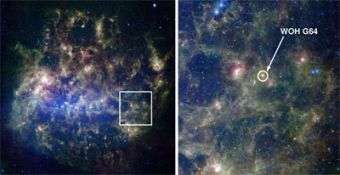
Infrared image of the Large Magellanic Cloud, our next neighbour galaxy at a distance of 160,000 light years, and the star WOH G64. Image: NASA, Spitzer Satellite, SAGE Team
A team of researchers at the Max Planck Institute for Radio Astronomy (MPIfR) in Bonn and European Southern Observatory (ESO) in Garching near Munich have for the first time taken a close-up of an individual dying supergiant star in our neighbouring galaxy, the Large Magellanic Cloud. By combining two 8.2-m telescopes in Chile as an interferometer, they achieved the resolving power of a 60-m telescope.
Geared with such a refined view, they discovered that the dying supergiant star is developing a thick dust torus around it. They estimated that the star had an initial mass of about 25 times the mass of our sun. But now, the star is shedding material so rapidly that it has already lost 10 - 40% of its initial mass and is speeding toward its final fate as a supernova (Astronomy & Astrophysics, DOI 10.1051/000- 6361:200809469).
When a star becomes older, it ejects a huge amount of material and gets embedded in a thick envelope, in which a variety of molecules and dust form. Researchers have been trying for decades to understand how such aging stars lose a considerable amount of their mass before their death.
A straightforward approach to tackle this issue is to take a very close look at the envelope surrounding the stars. However, this is easier said than done because of the great distances to these stars. Even with the world's largest optical telescopes with 8 - 10 m diameters, it is still difficult to take a close-up shot of the envelopes around the aging stars closest to Earth, let alone those outside our own galaxy, the Milky Way.
Using two or more telescopes combined as an "interferometer" provides a way to achieve much higher resolving power than with an individual telescope alone. The ESO's Very Large Telescope Interferometer (VLTI) in Chile is one of the largest interferometers, combining two or three 8.2-m telescopes. A team of researchers at MPIfR and ESO used the VLTI instrument MIDI, operating at mid-infrared wavelengths, which is ideal for observing the thermal radiation from the dust envelope heated by the star.
The resolving power they obtained is so high that it would recognize a tennis ball placed on top of the Brandenburg Gate in Berlin from Bonn. This was powerful enough for the team to zoom in on a dying supergiant star called WOH G64, which does not belong to our Galaxy but to our neighbouring galaxy, the Large Magellanic Cloud, lying some 160,000 light years away.
"For the first time we could take a close-up look at an individual star outside our Galaxy, and this is an important first step to understand how dying stars in other galaxies differ from their counterparts in our Milky Way", says Keiichi Ohnaka at the MPIfR, first author of the publication presenting the result. "We discovered that the dying supergiant star WOH G64 is surrounded by a thick dust torus which sort of looks like a thick bagel by comparing it with detailed theoretical modelling."
The diameter of the supergiant star is as large as the orbit of Saturn in the solar system. The dimensions of the whole torus are considerably larger: the inner edge of the torus is at 120 AU ("Astronomical Units", corresponding to the distance of the Earth from the sun), the total size of the torus reaches almost one light year.
The astronomers could also estimate that when WOH G64 was born several million years ago, its mass was about 25 times larger than that of our Sun. They found out that it has already shed 10 - 40% of its initial mass into the dust torus by means of a violent stellar wind.
What will happen to WOH G64 in future? Some day, in the next few thousand or ten thousand years, it will explode as a supernova like the famous SN1987A, also in the Large Magellanic Cloud. Judging by the mass of WOH G64, it will be as bright as SN1987A and will become visible to the unaided eye in the southern hemisphere. The supernova explosion will blow away most of the mass of WOH G64, which will then be recycled as the building blocks for stars of the next generation.
Citatation: Keiichi Ohnaka, Thomas Driebe, Karl-Heinz Hofmann, Gerd Weigelt, Markus Wittkowski, Spatially resolved dusty torus toward the red supergiant WOH G64 in the Large Magellanic Cloud, Astronomy & Astrophysics, DOI 10.1051/0004-6361:200809469
Source: Max Planck Institute for Radio Astronomy
-
Ovation for a stellar senior
Jun 16, 2011 |
5 / 5 (3) |
1
-
Perspective on: The future of fusion
May 13, 2011 |
3.8 / 5 (6) |
76
-
The Oddball Hosts of Gamma-ray Bursts
Oct 22, 2008 |
4.3 / 5 (12) |
2
-
Integral locates origin of high-energy emission from Crab Nebula
Aug 29, 2008 |
4.1 / 5 (8) |
0
-
The behemoth has a thick belt
May 27, 2008 |
4.7 / 5 (7) |
1
-
Engineers build first sub-10-nm carbon nanotube transistor
Feb 01, 2012 |
4.9 / 5 (33) |
30
-
Something old, something new: Evolution and the structural divergence of duplicate genes
Jan 31, 2012 |
4.6 / 5 (7) |
1
-
The hidden nanoworld of ice crystals: Revealing the dynamic behavior of quasi-liquid layers
Jan 30, 2012 |
5 / 5 (5) |
1
-
Stock market network reveals investor clustering
Jan 27, 2012 |
3.9 / 5 (23) |
8
-
Of microchemistry and molecules: Electronic microfluidic device synthesizes biocompatible probes
Jan 26, 2012 |
5 / 5 (2) |
0
-
Never ending outer space.....
Feb 11, 2012
-
Neutron Star fragments?
Feb 11, 2012
-
stationary or not?
Feb 11, 2012
-
Scale of the Universe
Feb 10, 2012
-
Titan's lack of impact craters
Feb 09, 2012
-
Real pictures of black hole eating a star?
Feb 08, 2012
- More from Physics Forums - General Astronomy
More news stories
Climate change causes harmful algal blooms in North Atlantic: study
Warming oceans and increases in windiness could be causing of an abundance of harmful algal blooms in the North Atlantic Ocean and North Sea, according to new research.
2 hours ago |
not rated yet |
0
New European rocket lifts off on maiden flight
A new lightweight rocket, Vega, lifted off from Europe's space base Monday carrying nine satellites on its inaugural flight, mission control said.
Space & Earth / Space Exploration
55 minutes ago |
5 / 5 (2) |
1
Salvage workers begin pumping fuel from Italian shipwreck
Salvage workers Sunday began pumping fuel from the shipwrecked Italian cruise liner Costa Concordia, a day ahead of schedule, officials said.
17 hours ago |
5 / 5 (2) |
0
NASA budget will axe Mars deal with Europe: scientists
US President Barack Obama's budget proposal to be submitted next week for 2013 will cut NASA's budget by 20 percent and eliminate a major partnership with Europe on Mars exploration, scientists said Thursday.
Space & Earth / Space Exploration
Feb 10, 2012 |
5 / 5 (4) |
59
Humans may have helped the decline of African rainforests 3000 years ago
(PhysOrg.com) -- Large areas of rainforests in Central Africa mysteriously disappeared over three thousand years ago, to be replaced by savannas. The prevailing theory has been that the cause was a change ...
New molecule has potential to help treat genetic diseases and HIV
(PhysOrg.com) -- Chemists at The University of Texas at Austin have created a molecule that's so good at tangling itself inside the double helix of a DNA sequence that it can stay there for up to 16 days before ...
Social psychologist: Lust makes you smarter and evidence that seven deadly sins are good for you
(Medical Xpress) -- Good news for lovers on Valentine’s Day - the seven deadly sins, including Lust, are good for you. University of Melbourne social psychologist Dr Simon Laham uses modern research to make a compelling ...
The joy of cheques
An electronic cheque which eliminates the need for costly processing by banks but preserves the simplicity and ease of a traditional cheque book has been designed by a team of academics in the UK.
Research finds injuries to professional athletes from routine play or practice often reported as 'freak accidents' in me
(Medical Xpress) -- A new report from the Johns Hopkins Center for Injury Research and Policy finds injuries to professional athletes from routine play or practice are often characterized as freak accidents in ...
Researchers' paper wins Best Paper Award for 2011
A paper written by Dr. Paul Gratz and his graduate student, Reena Panda, from the Department of Electrical and Computer Engineering at Texas A&M University was selected as one of the best papers from IEEE Computer Architecture ...
Low levels of amplitude-modulated electromagnetic fields elicit therapeutic responses cancer patients
Ryne Ramaker, a senior UALR Donaghey Scholar and University Science Scholar with a double major in biology and chemistry, is a co-author of a cancer research paper creating excitement among other researchers. The article ...