Family feuds -- why close relatives keep their distance in the animal kingdom
May 28, 2008 Family feuds -- why close relatives keep their distance in the animal kingdom

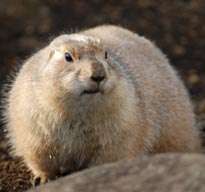
Datasets showed that closely related species of prairie dogs did not live together

Mammals cannot share their habitat with closely related species because the need for the same kind of food and shelter would lead them to compete to the death, according to new research out today in Proceedings of the Royal Society B: Biological Sciences.

The team behind the study says this is important because the retreat of natural habitats like rainforests caused by habitat destruction and climate change could inadvertently force closely-related species to live closer together than before.

Lead author of the study Natalie Cooper, a postgraduate student in Imperial College London’s Department of Life Sciences, explains: “Mammal species that share a recent common ancestor have similar needs in terms of food and other resources. Our study shows that this has naturally resulted in closely related species keeping their distance from each other in the wild. Without this separation, one species outcompetes the other.

“The danger is that if mankind’s reduction of natural habitats throws these close relatives together in small geographical areas they could struggle to survive.”

The new research focused on communities of three different types of mammals: new world monkeys (including marmosets, tamarins and spider monkeys), possums, and ground squirrels (including marmots, prairie dogs and chipmunks).

Ms Cooper and her colleagues compared data from a ‘family tree’ showing the evolution of all mammal species on the planet, with checklists of which mammal species are found where. They discovered that in the case of these monkeys, squirrels and possums, close evolutionary relatives do not tend to live in communities with one another.

For example, in Badlands National Park, South Dakota USA, four species of ground squirrel, including the black tailed prairie dog, live alongside each other and other distantly related squirrels in a community. However, Gunnison’s prairie dog, a close relative of the black-tailed species, was notably absent from the community, although data showed it lived within just 10km of the National Park and in very similar habitats.

This idea that closely related species would be unlikely to be found together because they compete ferociously was first put forward by Charles Darwin in 1859. This study provides the most evidence so far for Darwin’s prediction, thanks to the new complete ‘family tree’ for mammals, developed by Imperial biologists last year, and new comprehensive data on the location and make-up of different mammal communities worldwide.

The research team hope that their findings could help conservationists have a better understanding of the possible problems that mammal species could encounter if their habitats are depleted and they are forced to live in close proximity to their close evolutionary relatives.

Source: Imperial College London


print this article email this article download pdf blog this article bookmark this article     Stumble it Digg this share on Facebook retweet share on Reddit add to delicious
Rate this story - 4.5 /5 (6 votes)


May 28, 2008 all stories

Comments: 0

4.5 /5 (6 votes)
  • Stumble this up

  • Digg this

  • share this

  • hide
  • Related Stories

  • BoarCroc, RatCroc, DogCroc, DuckCroc and PancakeCroc
    created Nov 19, 2009 | popularity not rated yet | comments 0
  • Scientists Unravel Evolution of Highly Toxic Box Jellyfish
    created Nov 18, 2009 | popularity not rated yet | comments 0
  • Ancient high-altitude trees grow faster as temperatures rise
    created Nov 16, 2009 | popularity not rated yet | comments 0
  • Warming drives off Cape Cod's namesake, other fish
    created Nov 12, 2009 | popularity not rated yet | comments 0
  • Can a plant be altruistic?
    created Nov 11, 2009 | popularity not rated yet | comments 0


Other News

A farmer droving his sheep, northwest of Melbourne

Australian scientists aim to reduce sheep burps

Biology / Biotechnology

created 9 hours ago | popularity 2.8 / 5 (4) | comments 3

Australian scientists are working to breed a sheep that belches less, as they look for ways to reduce harmful methane emissions from the country's woolly flocks, a researcher said Sunday.


The six elephants in Sierra Leone were shot and "crudely butchered"

S.Leone elephants 'wiped out' by poachers: official

Biology / Ecology

created Nov 26, 2009 | popularity 5 / 5 (6) | comments 6

Poachers "wiped out" the entire elephant herd in Sierra Leone's only wildlife park, wildlife managers said Thursday after police said they had arrested a gang of 10 poachers.


Hammerhead shark

Wide heads give hammerheads exceptional stereo view

Biology / Plants & Animals

created Nov 27, 2009 | popularity 4.6 / 5 (8) | comments 4

Hammerhead sharks are some of the Ocean's most distinctive residents. 'Everyone wants to understand why they have this strange head shape,' says Michelle McComb from Florida Atlantic University. One possible ...


First-ever blueprint of a minimal cell is more complex than expected

First-ever blueprint of a minimal cell is more complex than expected

Biology / Cell & Microbiology

created Nov 26, 2009 | popularity 4.9 / 5 (19) | comments 4

What are the bare essentials of life, the indispensable ingredients required to produce a cell that can survive on its own? Can we describe the molecular anatomy of a cell, and understand how an entire organism ...


Golden Oldie: Key Role for Ancient Protein in Algae Photosynthesis

Golden Oldie: Key Role for Ancient Protein in Algae Photosynthesis

Biology / Biotechnology

created Nov 27, 2009 | popularity 3 / 5 (2) | comments 2

The discovery that an ancient light harvesting protein plays a pivotal role in the photosynthesis of green algae should help the effort to develop algae as a biofuels feedstock. Researchers with the Lawrence ...