Phoenix Spacecraft Commanded to Unstow Arm
May 28, 2008 Phoenix Spacecraft Commanded to Unstow Arm

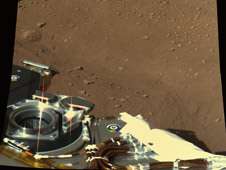
This approximate color (SSI's red, green, and blue filters: 600, 530, and 480 nanometers) view was obtained on sol 2 by the Surface Stereo Imager (SSI) on board the Phoenix lander.

Scientists leading NASA's Phoenix Mars mission from the University of Arizona in Tucson sent commands to unstow its robotic arm and take more images of its landing site early today.

The Phoenix lander sent back new sharp color images from Mars late yesterday. Phoenix imaging scientists made a color mosaic of images taken by the lander's Surface Stereo Imager on landing day, May 25, and the first two full "sols," or Martian days, after landing.

The panorama, now about one-third complete, shows a fish-eye perspective from the camera, a view from the lander itself all the way to the horizon. Phoenix adjusts its color vision with "Caltargets," calibrated color targets on disks mounted on the landing deck. Its color vision isn't quite like human color vision, but close.

"These images are very exciting to the science team," said the Surface Stereo Imager co-investigator Mark Lemmon of Texas A&M University. "We see the polygons we're looking for, and we're very excited to fill in the context with more site pan images that go beyond the workspace." Images to complete the panorama are planned today and tomorrow, Sols 3 and 4, Lemmon said.

"We appear to have landed where we have access to digging down a polygon trough the long way, digging across the trough, and digging into the center of a polygon. We've dedicated this polygon as the first national park system on Mars -- a "keep out" zone until we figure out how best to use this natural Martian resource," Lemmon said.

Phoenix will use its robotic arm to dig first in another area seen in the panorama, an area outside the preserved polygon.

Robotic arm manager Bob Bonitz of NASA's Jet Propulsion Laboratory, Pasadena, Calif., explained how the arm is to be unstowed today. "It's a series of seven moves, beginning with rotating the wrist to release the forearm from its launch restraint. Another series of moves releases the elbow from its launch restraints and moves the elbow from underneath the biobarrier."

The robotic arm is a critical part of the Phoenix Mars mission. It is needed to trench into the icy layers of northern polar Mars and deliver samples to instruments that will analyze what Mars is made of, what its water is like, and whether it is or has ever been a possible habitat for life.

"Phoenix is in perfect health," JPL's Barry Goldstein, Phoenix project manager, said Wednesday morning, May 28.

The robotic arm's first movement was delayed by one day when Tuesday's commands from Earth did not get all the way to the Phoenix lander on Mars. The commands went to NASA's Mars Reconnaissance Orbiter as planned, but the orbiter's Electra UHF radio system for relaying commands to Phoenix temporarily shut off. Without new commands, the lander instead carried out a set of activity commands sent Monday as a backup. Images and other information from those activities were successfully relayed back to Earth by the Mars Reconnaissance Orbiter Tuesday evening.

Wednesday morning's uplink to Phoenix and evening downlink from Phoenix were planned with NASA's Mars Odyssey orbiter as the relay. "We are using Odyssey as our primary link until we have a better understanding of what happened with Electra," Goldstein said.

Source: NASA


print this article email this article download pdf blog this article bookmark this article     Stumble it Digg this share on Facebook retweet share on Reddit add to delicious
Rate this story - 4.8 /5 (6 votes)


May 28, 2008 all stories

Comments: 0

4.8 /5 (6 votes)
  • Stumble this up

  • Digg this

  • share this

  • hide
  • Related Stories

  • Frost-Covered Phoenix Lander Seen in Winter Images
    created Nov 05, 2009 | popularity not rated yet | comments 0
  • Scientists see water ice in fresh meteorite craters on Mars
    created Sep 24, 2009 | popularity not rated yet | comments 0
  • Biosphere 2 Opens Phoenix Mars Lander Exhibit
    created Sep 18, 2009 | popularity not rated yet | comments 0
  • Reconstruct Mars automatically in minutes
    created Sep 18, 2009 | popularity not rated yet | comments 0
  • Telltale tells story of winds at Phoenix landing site
    created Sep 16, 2009 | popularity not rated yet | comments 0


  • hide
  • Relevant PhysicsForums posts

  • The shape of our solar system's orbits.
    created Nov 07, 2009
  • Above or Below the Line of Nodes
    created Nov 07, 2009
  • Supernova vs. Nova?
    created Nov 07, 2009
  • Supernova's Gamma Rays and Comets
    created Nov 06, 2009
  • More from Physics Forums - General Astronomy

Other News

Antarctica glacier retreat creates new carbon dioxide store

Antarctica glacier retreat creates new carbon dioxide store

Space & Earth / Earth Sciences

created 2 hours ago | popularity 5 / 5 (1) | comments 1

Large blooms of tiny marine plants called phytoplankton are flourishing in areas of open water left exposed by the recent and rapid melting of ice shelves and glaciers around the Antarctic Peninsula. This ...


Success in 'space elevator' competition (AP)

Success in 'space elevator' competition (Update 3)

Space & Earth / Space Exploration

created Nov 05, 2009 | popularity 4.3 / 5 (33) | comments 53

(AP) -- A robot powered by a ground-based laser beam climbed a long cable dangling from a helicopter on Wednesday to qualify for prize money in a $2 million competition to test the potential reality of the ...


In a Galaxy Far, Far Away...

In a Galaxy Far, Far Away...

Space & Earth / Astronomy

created Nov 06, 2009 | popularity 4.8 / 5 (5) | comments 15

(PhysOrg.com) -- Astronomers have published the discovery of the farthest known object in the cosmos: a star that exploded when the universe was only 630 million years old -- only 4.6% of its current age. ...


'Dropouts' pinpoint earliest galaxies

'Dropouts' pinpoint earliest galaxies

Space & Earth / Astronomy

created Nov 06, 2009 | popularity 4.2 / 5 (10) | comments 13

Astronomers, conducting the broadest survey to date of galaxies from about 800 million years after the Big Bang, have found 22 early galaxies and confirmed the age of one by its characteristic hydrogen signature ...


Space hotel taking bookings for 2012 opening

Space hotel taking bookings for 2012 opening

Space & Earth / Space Exploration

created Nov 05, 2009 | popularity 4.4 / 5 (21) | comments 11

(PhysOrg.com) -- The first orbiting space hotel is on track to open for its first customers in 2012, but hurry, as bookings are filling fast.