MIT studies robotic training for astronauts
May 29, 2008 MIT studies robotic training for astronauts

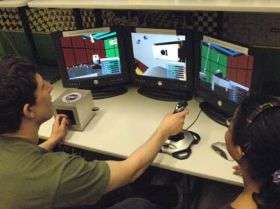
An aeronautics and astronautics project led by MIT researcher Chuck Oman aims to provide better training systems for astronauts to learn how to use robotic arms in space. At left, Joseph Silverman, a sophomore in mechanical engineering, tries his hand with the joysticks that control the robotic arm. At right is graduate student Zakiya Tomlinson, who is running the experiment. Photo / Donna Coveney

The space shuttle's 45-foot robotic arm may look simple and automatic as it gracefully lifts a multi-ton satellite from the cargo bay and lets it drift off into space. Far from it.

Controlling the spindly arm is a delicate process of manipulating multi-axis joysticks with both hands simultaneously - a feat that makes rubbing your stomach while patting your head seem like, well, child's play.

For years, NASA trainers have given astronauts a series of tests before teaching them to control the multi-jointed arm - an enhanced version of which was attached to the International Space Station during an April shuttle mission. But it turns out they've never checked to see how those test scores relate to the training's outcome.

MIT faculty and graduate students have started to remedy that, by doing a systematic evaluation of the effectiveness of the tests in predicting performance. As they continue a four-year project funded by NASA's National Space Biomedical Research Institute, they will see whether other tests could do better.

Andrew Liu, a research scientist in MIT's Man Vehicle Laboratory, has been leading the project, and began by comparing records of test results and actual performance from 40 astronauts, provided by Johnson Space Center and the Astronaut Office of NASA. Zakiya Tomlinson, a graduate student in the aeronautics and astronautics department, has been running simulation training tests here under the supervision of Liu and Charles Oman, director of the Man Vehicle Laboratory.

Liu presented the first report on the research on May 13 at the Aerospace Medical Association meeting in Boston. The results show “they're not good enough for decisions affecting their career path, but just for things like adjusting schedules,” says Tomlinson. “The tests might be suited for selecting training methods, like how many sessions they might need.”

Oman explains that “a lot more has been learned in recent years, about the psychological and physical sides of spatial intelligence. People think differently” about such tasks as mentally rotating a complex shape, but NASA's training has not yet adapted in light of new findings.

In NASA's astronaut training, as well as in actual operation of the robot arm in space, astronauts work in pairs with one operating the controls and another observing. In the next round of MIT tests, the training will simulate the role of the observer, Tomlinson explains.

This might help to determine how much of the ability is related to visual skills in spatial orientation, and how much has to do with manual dexterity in operating the controls. With the “observer” training, manual dexterity no longer makes a difference.

Eventually, the research might also lead to better ways of designing the actual control systems and displays to make the process easier and more intuitive to learn and to use, Tomlinson says.

As part of the research, Tomlinson and other team members spent time in Houston working with the actual system used for astronaut training. After she earns her masters degree, “I would love to go back and actually become a trainer,” she says.

Source: MIT


print this article email this article download pdf blog this article bookmark this article     Stumble it Digg this share on Facebook retweet share on Reddit add to delicious
Rate this story - not rated yet


May 29, 2008 all stories

Comments: 0

not rated yet
  • Stumble this up

  • Digg this

  • share this

  • hide
  • Related Stories

  • FASTSAT instruments shipped for tests and launch preparation
    created Oct 26, 2009 | popularity not rated yet | comments 0
  • Volunteers wanted for simulated 520-day Mars mission
    created Oct 20, 2009 | popularity not rated yet | comments 0
  • A woman in space
    created Oct 06, 2009 | popularity not rated yet | comments 0
  • Augmented reality to help astronauts make sense of space
    created Sep 22, 2009 | popularity not rated yet | comments 0
  • Test of Futuristic X-48C is Historic Wind Tunnel's Swan Song
    created Sep 18, 2009 | popularity not rated yet | comments 0


  • hide
  • Relevant PhysicsForums posts

  • astronomy
    created 19 hours ago
  • mass of molecular clouds versus stars
    created 23 hours ago
  • Astronomy Problems PLEASE HELP! PLEASE PLEASE
    created Nov 30, 2009
  • geographic location determination
    created Nov 29, 2009
  • More from Physics Forums - General Astronomy

Other News

Typhoon Nida's cloud tops dropping as it zigzags in wind shear

Typhoon Nida's cloud tops dropping as it zigzags in wind shear

Space & Earth / Earth Sciences

created 31 minutes ago | popularity not rated yet | comments 0

Nida is battling to keep its typhoon strength in the Western Pacific Ocean as wind shear continues to tear at the storm and weaken it. NASA's CloudSat satellite noticed that Nida's cloud tops are not as high ...


Superior Super Earths

Superior Super Earths

Space & Earth / Space Exploration

created 20 hours ago | popularity 4.8 / 5 (39) | comments 12

Super Earths are named for their size, but these planets - which range from about 2 to 10 Earth masses - could be superior to the Earth when it comes to sustaining life. They could also provide an answer to ...


First comprehensive review of the state of Antarctica's climate

Space & Earth / Earth Sciences

created 7 hours ago | popularity 2.3 / 5 (3) | comments 3

The first comprehensive review of the state of Antarctica's climate and its relationship to the global climate system is published this week by the Scientific Committee on Antarctic Research (SCAR). The review - Antarctic ...


ISS astronauts land safely in Kazakhstan

Space & Earth / Space Exploration

created 7 hours ago | popularity 5 / 5 (1) | comments 0

A space capsule carrying a Belgian, a Canadian and a Russian landed safely in the steppes of Kazakhstan on Tuesday after the trio spent half a year on the International Space Station (ISS).


Winds drive icebergs away from New Zealand

Space & Earth / Earth Sciences

created 7 hours ago | popularity 4 / 5 (2) | comments 0

(AP) -- Strong westerly winds in the southern Pacific Ocean have driven scores of icebergs originally headed toward New Zealand to the east, away from the country, an oceanographer said Tuesday.