Listen to Phoenix descend
May 29, 2008 Phoenix

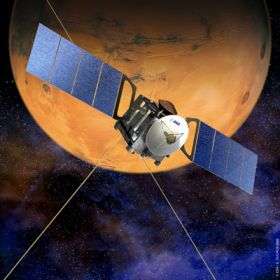
An artist's impression of Mars Express. The spacecraft left Earth for Mars on 2 June 2003. It reached its destination after a 6-month journey, and has been thoroughly investigating the planet since early 2004. Credits: ESA - D. Ducros

With data recorded on board Mars Express, you can hear Phoenix descend on to the surface of the Red Planet. After being processed by the Mars Express Flight Control Team, the sounds of Phoenix descending are audible, loud and clear.

The data from the Mars Express Lander Communication system (MELACOM) that tracked Phoenix was received on Earth soon after the Phoenix landing.

>>> Listen now

As Mars Express flew over

This animation (Mpeg, 9MB) shows the signal of Phoenix’s descent, recorded by MELACOM.

The spike in the animation, between frequencies of 7 and 8 kiloHertz, shows the transmission from Phoenix itself.

The lander can be seen in the animation starting from about 342 s after the start time and disappears at about 1085 s. This shows Mars Express picking up on the Phoenix signal and tracking it while closing in on the lander; the closest Mars Express got to Phoenix was 1550 km.

As Mars Express flew away, the lander deployed its parachute, separated from it and landed, the signal from the lander was cut off.

The shift of the spike seen in the animation, is due to the so-called Doppler effect, which is very similar to what we hear when listening to the whistle of a passing train.

The signal was tracked successfully, even during the expected transmission blackout window of the descent, until the lander was out of Mars Express’s view. The transmission blackout window is caused because of ionisation around the probe, which builds up as the lander descends through the atmosphere and only very weak signals come through.

The rest of the recording, the start and the end, contains background noise generated by Mars Express itself.

Science observations

During the descent, all of the capabilities of Mars Express were focussed on tracking Phoenix with MELACOM. Unfortunately, the science observations carried out during the descent did not lead to the anticipated results.

Apart from these observations, the Planetary Fourier Spectrometer (PFS) on board Mars Express has been collecting relevant data since 8 May this year in anticipation of the Phoenix landing. This includes information on the physical conditions of the Martian atmosphere (temperature, pressure and density) above the expected the landing site. This data was provided to NASA in support of their observations of the physical conditions in the atmosphere prior to landing.

Over the next few days, Mars Express will monitor Phoenix using MELACOM 15 more times; at least one of these will be used to demonstrate and confirm that the ESA spacecraft can be used as a data relay station for NASA, receiving data from the surface and transmitting test commands to the lander.

Detailed information about the descent and landing will be available once the data from all the fly-overs is processed and analysed over the next few weeks.

Source: European Space Agency


print this article email this article download pdf blog this article bookmark this article     Stumble it Digg this share on Facebook retweet share on Reddit add to delicious
Rate this story - 3.5 /5 (4 votes)


May 29, 2008 all stories

Comments: 0

3.5 /5 (4 votes)
  • Stumble this up

  • Digg this

  • share this

  • hide
  • Related Stories

  • Mountain on Mars may answer big question
    created Mar 04, 2009 | popularity not rated yet | comments 0
  • Planets Align for the 4th of July
    created Jul 02, 2008 | popularity not rated yet | comments 0
  • Mars Sample Return: The next step in exploring the Red Planet
    created Jul 02, 2008 | popularity not rated yet | comments 0
  • First images from Phoenix Mars lander
    created May 26, 2008 | popularity not rated yet | comments 0
  • Phoenix probe lands on Mars (Update 4)
    created May 25, 2008 | popularity not rated yet | comments 0


  • hide
  • Relevant PhysicsForums posts

  • The shape of our solar system's orbits.
    created Nov 07, 2009
  • Above or Below the Line of Nodes
    created Nov 07, 2009
  • Supernova vs. Nova?
    created Nov 07, 2009
  • Supernova's Gamma Rays and Comets
    created Nov 06, 2009
  • More from Physics Forums - General Astronomy

Other News

Planetary Society plans new 'solar sail'

Space & Earth / Space Exploration

created 2 hours ago | popularity not rated yet | comments 0

(AP) -- Four years after its first solar sail ended up in the ocean instead of orbit, The Planetary Society announced Monday that by the end of 2010 it will try again to launch a spacecraft that will be propelled by the ...


L-R: Chiwetel Ejiofor, Amanda Peet and John Cusack at the premiere of "2012"

NASA on crusade to debunk 2012 apocalypse myths

Space & Earth / Space Exploration

created 7 hours ago | popularity 4 / 5 (1) | comments 1

The world is not coming to an end on December 21, 2012, the US space agency insisted Monday in a rare campaign to dispel widespread rumors fueled by the Internet and a new Hollywood movie.


Antarctica glacier retreat creates new carbon dioxide store

Antarctica glacier retreat creates new carbon dioxide store

Space & Earth / Earth Sciences

created 12 hours ago | popularity 3.5 / 5 (4) | comments 0

Large blooms of tiny marine plants called phytoplankton are flourishing in areas of open water left exposed by the recent and rapid melting of ice shelves and glaciers around the Antarctic Peninsula. This ...


NASA satellites make a movie and get rainfall, wind info on Ida

NASA satellites make a movie and get rainfall, wind info on Ida (w/ Video)

Space & Earth / Earth Sciences

created 7 hours ago | popularity not rated yet | comments 0

NASA satellites are amazing examples of technology. The TRMM satellite peers into tropical cyclones and can tell how much rain is falling per hour and where. QuikScat uses microwave technology to measure Ida's ...


The GOES-12 satellite sees Large Hurricane Ida nearing landfall

The GOES-12 satellite sees Large Hurricane Ida nearing landfall

Space & Earth / Earth Sciences

created 8 hours ago | popularity 5 / 5 (1) | comments 0

Residents of the U.S. Gulf coast thought they were getting a break this hurricane season until Ida showed up. Today, November 9, Ida is a hurricane and is headed for a landfall in the western Florida Panhandle ...