Two for One: New Design Enables More Cost-Effective Quantum Key Distribution
May 29, 2008 Two for One: NIST Design Enables More Cost-Effective Quantum Key Distribution

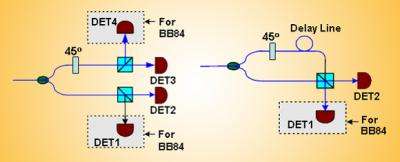
A highly simplified schematic of a recipient's detectors in a quantum cryptography setup. Conventional cryptography setups (left) require at least two detectors, and the most common setup, known as BB84, requires four. By adding an optical component that delays the travel of photons to the detector, the number of required detectors is cut in half. Credit: NIST

Researchers at the National Institute of Standards and Technology have demonstrated a simpler and potentially lower-cost method for distributing strings of digits, or “keys,” for use in quantum cryptography, the most secure method of transmitting data. The new “quantum key distribution” (QKD) method, outlined in an upcoming paper, minimizes the required number of detectors, by far the most costly components in quantum cryptography.

Although this minimum-detector arrangement cuts transmission rates by half, the NIST system still works at broadband speeds, allowing, for example, real-time quantum encryption and decryption of webcam-quality video streams over an experimental quantum network.

In quantum cryptography, a recipient (named Bob) needs to measure a sequence of photons, or particles of light that are transmitted by a sender (named Alice). These photons have information encoded in their polarization, or direction of their electric field. In the most common polarization-based protocol, known as BB84, Bob uses four single-photon detectors, costing approximately $5,000-$20,000 each.

One pair of detectors records photons with horizontal and vertical polarization, which could indicate 0 and 1 respectively. The other pair detects photons with “diagonal”, or +/- 45 degree, polarization in which the “northeast” and “northwest” directions alternatively denote 0 and 1.

In the new method, the researchers, led by NIST’s Xiao Tang, designed an optical component to make the diagonally polarized photons rotate by a further 45 degrees and arrive at the same detector but later, and into a separate “time bin”, than the horizontal/vertical polarized ones.

Therefore, one pair of detectors can be used to record information from both kinds of polarized photons in succession, reducing the required number of detectors from four to two. In another protocol, called B92, the researchers reduced the required number of detectors from two to one. And in work performed since their new paper, the researchers further developed their approach so that the popular BB84 method now only requires one detector instead of four.

Although in theory quantum cryptography can transmit absolutely secure keys guaranteed by fundamental physical principles (measuring them will disturb their values and make an eavesdropper instantly known), the imperfect properties of photon detectors may undermine system security in practice.

For example, photon detectors have an intrinsic problem known as “dead time,” in which a detector is out of commission for a short time after it records a photon, causing it to miss the bit of data that immediately follows; this could result in non-random (and therefore more predictable) bit patterns in which 0s alternate with 1s. Furthermore, inevitable performance differences between detector pairs can also cause them to record less random sequences of digits. The new design avoids these issues and maintains the security of quantum-key-distribution systems in practical applications.

Citation: L. Ma, T. Chang, A. Mink, O. Slattery, B. Hershman and X. Tang. Experimental demonstration of a detection-time-bin-shift polarization encoding quantum key distribution system. IEEE Communications Letters Vol. 12, No. 6, June 2008. In press.

Source: National Institute of Standards and Technology


print this article email this article download pdf blog this article bookmark this article     Stumble it Digg this share on Facebook retweet share on Reddit add to delicious
Rate this story - 4.7 /5 (9 votes)


May 29, 2008 all stories

Comments: 0

4.7 /5 (9 votes)
  • Stumble this up

  • Digg this

  • share this

  • hide
  • Related Stories

  • Physicists Explain How Human Eyes Can Detect Quantum Effects
    created Sep 29, 2009 | popularity not rated yet | comments 0
  • Up-scale: Frequency converter enables ultra-high sensitivity infrared spectrometry
    created Aug 26, 2009 | popularity not rated yet | comments 0
  • Researchers Set New Distance Record for Quantum Key Distribution
    created Jul 21, 2009 | popularity not rated yet | comments 0
  • Nanoscale zipper cavity responds to single photons of light
    created Jun 04, 2009 | popularity not rated yet | comments 0
  • Making quantum cryptography practical
    created Apr 30, 2009 | popularity not rated yet | comments 0


  • hide
  • Relevant PhysicsForums posts

  • Laser spots
    created 1hour ago
  • Do you know elementary physics?
    created 3 hours ago
  • Bicycles and their mad skillz
    created 3 hours ago
  • Clarification of doubts on rolling motion
    created 7 hours ago
  • More from Physics Forums - General Physics

Other News

Aquatic creatures mix ocean water

Physics / General Physics

created 2 hours ago | popularity not rated yet | comments 0

Understanding mixing in the ocean is of fundamental importance to modeling climate change or predicting the effects of an El Niño on our weather. Modern ocean models primarily incorporate the effects of winds and tides. However, ...


Generating electricity from air flow

Physics / General Physics

created 6 hours ago | popularity 3.8 / 5 (5) | comments 1

A group of researchers at the City College of New York is developing a new way to generate power for planes and automobiles based on materials known as piezoelectrics, which convert the kinetic energy of motion into electricity. ...


Nuclear weapons: Predicting the unthinkable

Physics / General Physics

created 6 hours ago | popularity 1 / 5 (1) | comments 0

If a nuclear weapon were detonated in a metropolitan area, how large would the affected area be? Where should first responders first go? According to physicist Fernando Grinstein, we have some initial understanding to address ...


Butterfly proboscis to sip cells

Physics / General Physics

created 3 hours ago | popularity not rated yet | comments 0

A butterfly's proboscis looks like a straw -- long, slender, and used for sipping -- but it works more like a paper towel, according to Konstantin Kornev of Clemson University. He hopes to borrow the tricks of this piece ...


Restored machine to explore mysteries of Big Bang (AP)

Restored machine to explore mysteries of Big Bang

Physics / General Physics

created Nov 21, 2009 | popularity 4.6 / 5 (18) | comments 16

(AP) -- Scientists are preparing the world's largest atom smasher to explore the depths of matter after successfully restarting the $10 billion machine following more than a year of repairs.