Protons Pair Up With Neutrons
May 29, 2008
Protons Pair Up With Neutrons

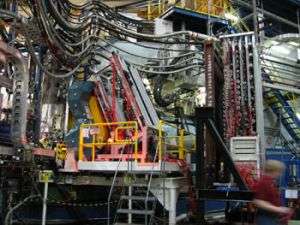
Correlated protons and neutrons were measured in the BigBite large acceptance spectrometer (blue/gold magnet with detector package) and a neutron detector (tall assembly at right).

Research performed at the U.S. Department of Energy’s Thomas Jefferson National Accelerator Facility has found that protons are about 20 times more likely to pair up with neutrons than with other protons in the nucleus. The result will be published online by the journal Science, at the Science Express website.

The result, based on the first-ever simultaneous measurement of such pairings and their constituents, could have implications for understanding the structure of nuclear systems from light nuclei to neutron stars.

Protons and neutrons, or nucleons, in the nucleus of the atom can form a brief pairing with another nucleon, a phenomenon known as a short-range correlation. Previous experiments have shown that roughly one-fifth of nucleons at any one time were in short-range correlations.

Jefferson Lab Staff Scientist Douglas Higinbotham and his colleagues conducted an experiment in Jefferson Lab’s Experimental Hall A to directly and simultaneously measure the constituents of the short-range correlations in the carbon nucleus.

“These correlated nucleons have a high relative momentum. If you knock one out one way, the correlated nucleon will fly out in the opposite direction,” noted Higinbotham. “We set up our detectors to take advantage of this.”

The experiment found that 18 percent of all protons in the nucleus were paired with neutrons. Another one percent of protons were paired with protons, with about the same percentage of neutron/neutron pairs.

“I think it shows, for the first time in a very clear and unambiguous way, this fact that the large momentum nucleons in nuclei are coming in pairs. And they’re coming mainly in proton/neutron pairs,” said Eli Piasetzky, a professor at Tel Aviv University and a spokesperson on the experiment.

Higinbotham agreed. “The result from this experiment is like finding that missing piece needed to finish a puzzle. This experiment, combined with others, gives us a very coherent picture of these short-range correlations in the nucleus.”

In the experiment, a beam of energetic electrons was sent into a thin sheet (0.25 mm) of Carbon-12. The scientists were interested in the electrons that interacted with a member of a short-range correlation. Recoil electrons and knockout protons were measured in Jefferson Lab Experimental Hall A’s High Resolution Spectrometers. Correlated protons and neutrons were measured in the BigBite large acceptance spectrometer and a neutron detector. The ability to clearly resolve the short-range correlated pairs is due to the high energy and large intensity beam at Jefferson Lab.

When combined with a theoretical calculation of the effects of proton/neutron correlations on the momentum distribution of the nucleons in neutron stars, the result also indicates that the presence of short-range correlations may have a disproportionately large effect on neutron star structure.

Source: Thomas Jefferson National Accelerator Facility

4.4 /5 (24 votes)  

Filter


Move the slider to adjust rank threshold, so that you can hide some of the comments.


Display comments: newest first

daqman
May 29, 2008

Rank: 4 / 5 (1)
As someone who works at JLab it's very nice to see a result like this on a site like physorg.com

Well done Doug!
NeilFarbstein
May 29, 2008

Rank: 1.5 / 5 (2)
Might have far reaching implications and impacts in cosmology and nuclear physics.
NeilFarbstein
May 29, 2008

Rank: 1.7 / 5 (3)
It's not surprising since protons repel each other lectrically and nucleons in general have the same strong force interactions keeping them together.
earls
May 29, 2008

Rank: 1.7 / 5 (3)
lol, good call Neil.

"18 percent of all protons in the nucleus were paired with neutrons. Another one percent of protons were paired with protons, with about the same percentage of neutron/neutron pairs."

What was the other 80%?
h0dges
May 30, 2008

Rank: 2 / 5 (1)
No pairing?
ShadowRam
May 30, 2008

Rank: 3 / 5 (1)
Does this impact Fusion at all?

Rank 4.4 /5 (24 votes)
Tags

Related Stories
Relevant PhysicsForums posts
  • Thermodynamics q
    created2 hours ago
  • what is electricity???
    created6 hours ago
  • Can Plasma Be Solid
    created7 hours ago
  • What is delta Δ ?
    created7 hours ago
  • Need some help understanding Hertz–Knudsen formula
    created8 hours ago
  • Anatomy of Fat man: implosion-critical bomb
    created10 hours ago
  • More from Physics Forums - General Physics

More news stories

Explained: Sigma

It's a question that arises with virtually every major new finding in science or medicine: What makes a result reliable enough to be taken seriously? The answer has to do with statistical significance -- but ...

Physics / General Physics

created Feb 09, 2012 | popularity 5 / 5 (20) | comments 78

Quantum physicist explains $100K offer for proof scaled-up quantum computing is impossible

(PhysOrg.com) -- MIT researcher Scott Aaronson has certainly riled the physics community with his offer this past Friday, of $100,000 to anyone who can prove that scaled-up quantum computing is impossible. ...

Physics / Quantum Physics

created Feb 08, 2012 | popularity 4.3 / 5 (15) | comments 37 | with audio podcast weblog

Diamond light, brighter than the sun

It’s the size of five football pitches and generates light 10 billion times brighter than the sun. As the Diamond Light Source celebrates its tenth anniversary this year, Penny Bailey visits one of the ...

Physics / General Physics

created Feb 07, 2012 | popularity 4.1 / 5 (11) | comments 18 | with audio podcast

Physicists 'record' magnetic breakthrough

An international team of scientists has demonstrated a revolutionary new way of magnetic recording which will allow information to be processed hundreds of times faster than by current hard drive technology.

Physics / General Physics

created Feb 07, 2012 | popularity 4.6 / 5 (43) | comments 15 | with audio podcast

Hints of the Higgs - papers are submitted

Back in December 2011, the ATLAS and CMS experiments at CERN presented some exciting results that provided tantalising hints of the Higgs boson.

Physics / General Physics

created Feb 08, 2012 | popularity 4.3 / 5 (8) | comments 10


Scientists discover molecular secrets of 2,000-year-old Chinese herbal remedy

For roughly two thousand years, Chinese herbalists have treated Malaria using a root extract, commonly known as Chang Shan, from a type of hydrangea that grows in Tibet and Nepal. More recent studies suggest that halofuginone, ...

New method to examine batteries -- MRI from the inside

There is an ever-increasing need for advanced batteries for portable electronics, such as phones, cameras, and music players, but also to power electric vehicles and to facilitate the distribution and storage of energy derived ...

A mitosis mystery solved: How chromosomes align perfectly in a dividing cell

Although the process of mitotic cell division has been studied intensely for more than 50 years, Whitehead Institute researchers have only now solved the mystery of how cells correctly align their chromosomes during symmetric ...

Google might launch Drive for cloud storage soon

(PhysOrg.com) -- Google's next big move, according to the Wall Street Journal, is a cloud storage service called Drive. Hardly first to the plate, Google is simply catching up to introducing its cloud reposi ...

Lab study raises questions over nano-particle impact

Tests involving chickens have raised questions about the impact on health from engineered nano-particles, the ultra-fine grains commonly used in drugs and processed foods, scientists said on Sunday.

Starve a virus, feed a cure? Findings show how some cells protect themselves against HIV

A protein that protects some of our immune cells from the most common and virulent form of HIV works by starving the virus of the molecular building blocks that it needs to replicate, according to research published online ...