Engineers whip up the first long-lived nanoscale bubbles
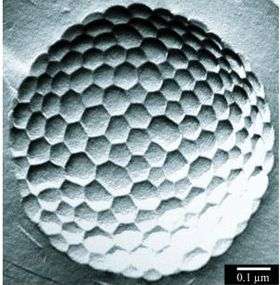
With the aid of kitchen mixers, engineers at Harvard’s School of Engineering and Applied Sciences (SEAS) have whipped up, for the first time, permanent nanoscale bubbles – bubbles that endure for more than a year – from batches of foam made from a mixture of glucose syrup, sucrose stearate, and water. Their study appears in the May 30 issue of the journal Science.
The research, led by Howard A. Stone, had its origins in a conference talk on foams delivered by Dr. Rodney Bee, a retired Unilever physical chemist, in 2005. Bee, who had been researching ice cream for the food, beverage, and personal-care product company, was interested in finding ways to extend the life of foams and other gas-infused mixtures like ice cream. He had produced an unusual bubble formation in the course of his research, and he included a photograph of it in the presentation.
Stone, Vicky Joseph Professor of Engineering and Applied Mathematics and associate dean for applied physical sciences and engineering, was in the audience when Bee projected an image of a micrometer-size bubble with a distinctive polygonal geometry. The bubble surface appeared to be faceted with regular pentagonal, hexagonal, and heptagonal domains that intersected to form a soccer ball-like structure. None of the faces spanned more than 50 nanometers.
“Small bubbles on that scale never last because of surface tension – they instantly disappear. What Rodney showed on that screen was extraordinary,” said Stone. “It was impossible; we all thought it was impossible.”
Smaller bubbles have a greater surface tension and a higher gas pressure than larger ones. As a result, larger bubbles usually grow at the expense of smaller ones, which have very short lifetimes.
“I asked him how he created his foams, and he said he used an ordinary kitchen mixer. The next day I went out and bought a kitchen mixer for the lab,” explained Stone.
The experimental study, conducted by SEAS graduate student Emilie Dressaire in collaboration with Unilever colleagues, revealed that when the bubbles were covered with the chosen surfactant mixture, the surfactant molecules crystallized to form nearly impermeable shells over the bubble surfaces.
The resulting shells possessed an elasticity that allowed them to buckle over time into a remarkably regular and stable pattern. Measurements of the microbubbles’ stability extended over more than a year, and the structural integrity of the bubbles held for the entire period.
The authors note that future applications of these microbubbles could significantly extend the lifetimes of common gas-liquid products that experience rapid disintegration, such as aerated personal-care products and contrast agents for ultrasound imaging.
Source: Harvard University


