Model Reveals How Plasma from Superstorms Affects Near-Earth Space
May 29th, 2008 Model Reveals How Plasma from Superstorms Affects Near-Earth Space

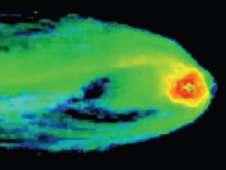
This computer-generated image shows a view of Earth’s inner magnetosphere during a superstorm. Credit: NASA/ Mei-Ching Fok and Thomas E. Moore.

NASA scientists have uncovered new details about how plasma from superstorms interact with Earth’s magnetosphere.

“The surprising result of this model is that the magnetosphere’s main phase pressure is dominated by energetic protons from the plasmasphere, rather than from the solar wind,” says Mei-Ching Fok, an astrophysicist at NASA’s Goddard Space Flight Center in Greenbelt, Md. Fok and her team will present their findings on May 29 at the American Geophysical Union conference in Ft. Lauderdale, Fl.

Violent activity on the sun, such as a solar flare, can produce a monster superstorm that releases plasma into the solar wind. Large flares often result in an ejection of material from the solar corona, called a coronal mass ejection (CME). A CME can spew billions of tons of plasma away from the sun and toward Earth at speeds faster than 1.5 million mph. The plasma affects Earth and the vicinity surrounding Earth dominated by its magnetic field, called the magnetosphere.

As plasma from a superstorm interacts with Earth’s magnetosphere, it can trigger spectacular displays of the Northern Lights, called auroras, interfere with communications between satellites and airplanes traveling near the North Pole, and interrupt global positioning systems and our power grid.

Fok and her team used their global ion kinetic model to evaluate contributions to magnetospheric pressure from the solar wind, polar wind, auroral wind, and plasmaspheric wind. Their model, which simulates sources of superstorm plasmas, found that energetic protons from the plasmasphere dominate the magnetosphere’s main phase pressure. Until now, scientists thought energetic protons from the solar wind most affected the magnetosphere.

The inner region of Earth’s magnetosphere contains a low-density mixture of hot and cold plasmas, which include the ring current, the plasmasphere, and the radiation belt.

The plasmasphere is a donut-shaped region of the inner magnetosphere. During space storms, the plasmasphere is squashed and pressurized by the solar wind, forming a long tail called the plasmaspheric plume. The plume particles are picked up and further energized by the solar wind. When they re-enter the magnetosphere, they supply the majority of energetic protons that affect the magnetosphere’s main phase pressure during a superstorm event.

Simulating the sources of superstorm plasmas will help to better understand superstorms and pave the way to predicting their impact on Earth. The details uncovered in the team’s model provide a new piece of the Sun-Earth puzzle.

For more information about how plasma interacts with the inner magnetosphere: http://mcf.gsfc.nasa.gov/Fok/PUA1911.pdf

Source: NASA


print this article email this article download pdf blog this article bookmark this article     Digg this Stumble it share on Facebook share on Reddit add to delicious save to Yahoo! bookmarks
4.1/5 after 10 votes

Rank Filter

Move the slider to adjust rank threshold, so that you can hide some of the comments.


Display comments: newest first

  • brant - May 29, 2008
    • Rank: 4 / 5 (1)
    "The inner region of Earth's magnetosphere contains a low-density mixture of hot and cold plasmas, which include the ring current, the plasmasphere, and the radiation belt."

    Very cool!!! Nice reporting.....

    More like this.....

May 29th, 2008 all stories
Space & Earth / Earth Sciences

Comments: 1
Rank: 4.1/5 after 10 votes

  • Stumble this up

  • Digg this

  • Share it:
  • share on Facebook
  • share on MySpace
  • share on Slashdot
  • rss-newsfeed
  • share on Google
  • share on Reddit
  • add to delicious
  • save to Yahoo! bookmarks
  • share on Windows Live
  • Add to Mixx!
Rating: 4.1/5 after 10 votes

  • Related Stories

  • IBEX spacecraft detects fast neutral hydrogen coming from the moon
    created Jun 18, 2009 | popularity not rated yet | comments 0
  • New research contributes to defense of Earth's technologies
    created Jun 03, 2009 | popularity not rated yet | comments 0
  • Magnetic Tornadoes Could Liberate Mercury's Tenuous Atmosphere
    created Jun 02, 2009 | popularity not rated yet | comments 0
  • New Solar Cycle Prediction
    created Jun 01, 2009 | popularity not rated yet | comments 0
  • New Solar Cycle Prediction: Fewer Sunspots, But Not Necessarily Less Activity
    created May 27, 2009 | popularity not rated yet | comments 0

Tags


  • Physicists Demonstrate Quantum Memory with Matter Qubits
    Physicists Demonstrate Quantum Memory with Matter Qubits
    Physics / General Physics
    created Jul 03, 2009 | popularity 4.4 / 5 (17) | comments 1
  • 'Holey' Nanosheets for Wastewater Dye Removal
    Nanotechnology / Nanomaterials
    created Jul 01, 2009 | popularity 5 / 5 (5) | comments 1
  • Jellyfish Robot Swims Like its Biological Counterpart
    Jellyfish Robot Swims Like its Biological Counterpart
    Electronics / Robotics
    created Jun 26, 2009 | popularity 4.4 / 5 (8) | comments 1
  • Could Maxwell's Demon Exist in Nanoscale Systems?
    Could Maxwell's Demon Exist in Nanoscale Systems?
    Physics / General Physics
    created Jun 24, 2009 | popularity 4.4 / 5 (18) | comments 29
  • Living Safely with Robots, Beyond Asimov's Laws
    Living Safely with Robots, Beyond Asimov's Laws
    Electronics / Robotics
    created Jun 22, 2009 | popularity 4.6 / 5 (54) | comments 40
  • Other News

    Hurricane Katrina: Phone home

    Space & Earth / Earth Sciences

    created 9 minutes ago | popularity not rated yet | comments 0

    Though New Orleans residents were told to evacuate days before the arrival of Hurricane Katrina, no one could have predicted the real extent of the devastation.


    World's Largest Ocean Observatory Nears Completion

    Space & Earth / Earth Sciences

    created 6 minutes ago | popularity not rated yet | comments 0

    Canada is about to take the world on a 25-year non-stop research expedition—into the deep ocean.


    Space Station Marathon

    Space Station Marathon

    Space & Earth / Space Exploration

    created 1hour ago | popularity not rated yet | comments 0

    The International Space Station (ISS) is about to make a remarkable series of flybys over the United States. Beginning this 4th of July weekend, the station will appear once, twice, and sometimes three times ...


    Researchers test new 'space Internet' system on International Space Station

    Researchers test new 'space Internet' system on International Space Station

    Space & Earth / Space Exploration

    created 2 hours ago | popularity 5 / 5 (1) | comments 0

    The University of Colorado at Boulder is working with NASA to develop a new communications technology now being tested on the International Space Station, which will extend Earth's Internet into outer space ...


    China environmental phenomena monitored from space

    Space & Earth / Earth Sciences

    created 5 hours ago | popularity not rated yet | comments 0

    China is in a very seismically active area and has had many catastrophic earthquakes during its history. A joint European-Chinese team is using satellite radar data to monitor ground deformation across major continental faults ...