Intel, Micron First to Deliver Sub-40 Nanometer NAND Flash Memory Device
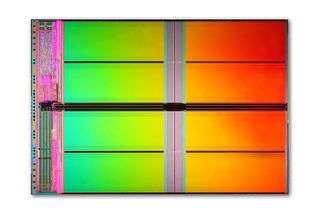
May 29, 2008 Intel, Micron First to Deliver Sub-40 Nanometer NAND Flash Memory Device

New 34nm 32 Gb NAND Chip from Intel and Micron is Industry´s Most Advanced NAND Process Technology Available and Enables Increased Storage Capacity in Small Form-Factor Applications.

Today Intel Corporation and Micron Technology, Inc. introduced the industry's first sub-40 nanometer NAND memory device, unveiling a 34nm 32 gigabit multi-level cell chip. This process technology was jointly developed by Intel and Micron and manufactured by the companies' NAND flash joint venture, IM Flash Technologies (IMFT).

It is the smallest NAND process geometry on the market. The 32 Gb NAND chip is the only monolithic device at this density that fits into a standard 48-lead thin small-outline package (TSOP), providing a cost-effective path to higher densities in existing applications. Shipments of customer samples begin in June and mass production is expected during the second half of this year calendar.

"This new 32 Gb device provides the best bit storage density available in the industry," said Brian Shirley, vice president of Micron's Memory Group. "Together with our partners at Intel, we're proud to have now taken the lead in production process technology."

"The introduction of 34nm process technology highlights IMFT's rapid progress and moves us to the forefront of NAND process technology," said Pete Hazen, director of marketing, Intel NAND Products Group. "These advancements will expand the value proposition and accelerate the adoption of solid-state drive (SSD) solutions in computing platforms."

The 34nm 32 Gb chips will be manufactured on 300 millimeter wafers, each producing approximately 1.6 terabytes of NAND. Measuring just 172mm², less than the size of a thumbnail, the 34nm 32 Gb chip will cost-effectively enable high-density solid-state storage in small form factor applications.

-- A single 32 Gb chip could store more than 2,000 high-resolution digital photos or hold up to 1,000 songs on a personal music player.
-- Two 8-die stacked packages would realize 64 gigabytes (GBs) of storage, enough for recording anywhere from eight to 40 hours of high-definition video in a digital camcorder.

The 34nm 32Gb chip was designed with solid-state drives in mind. The product will enable more cost-effective SSDs, instantly doubling the current storage volume of these devices and driving capacities to beyond 256 GBs in today's standard, smaller 1.8-inch form factor. SSDs are becoming the new storage medium for notebook computers, providing lower power, faster boot-up time, increased reliability, improved performance and reduced noise than hard disk drives. With the innovations in NAND process technology, such as with the 34nm NAND process, SSDs now offer a significant range of capacities to meet market requirements.

Based on the 34nm architecture, Intel and Micron also plan to introduce lower density multi-level cell products including single-level cell products, by the end of this year.

Source: Intel


print this article email this article download pdf blog this article bookmark this article     Stumble it Digg this share on Facebook retweet share on Reddit add to delicious
Rate this story - 3.2 /5 (9 votes)

Rank Filter

Move the slider to adjust rank threshold, so that you can hide some of the comments.


Display comments: newest first

  • plasma_guy - May 30, 2008
    • Rank: 5 / 5 (1)
    Samsung already announced 64 Gb NAND recently, didn't they?

May 29, 2008 all stories

Comments: 1

3.2 /5 (9 votes)
  • Stumble this up

  • Digg this

  • share this

  • hide
  • Related Stories


  • hide
  • Relevant PhysicsForums posts

  • Insulation Resistance Testing - Issue with Hi-Pot Tester
    created 8 hours ago
  • simple Q about induction motor
    created 8 hours ago
  • Sound level meter
    created 18 hours ago
  • Light Dependent Resistor in water
    created 20 hours ago
  • More from Physics Forums - Electrical Engineering

Other News

New 'finFETS' promising for smaller transistors, more powerful chips

New 'finFETs' promising for smaller transistors, more powerful chips

Technology / Semiconductors

created 12 hours ago | popularity 4.9 / 5 (8) | comments 1

(PhysOrg.com) -- Purdue University researchers are making progress in developing a new type of transistor that uses a finlike structure instead of the conventional flat design, possibly enabling engineers ...


Hydrogen milestone moves energy independence one step forward

Hydrogen milestone moves energy independence one step forward

Technology / Energy

created 10 hours ago | popularity 3.7 / 5 (6) | comments 1

(PhysOrg.com) -- Big things often come in small packages. That's certainly the case with the potential created by recent successes in hydrogen research at Idaho National Laboratory.


New search technique for images and videos has broad applications

New search technique for images and videos has broad applications

Technology / Computer Sciences

created 10 hours ago | popularity 5 / 5 (5) | comments 0

(PhysOrg.com) -- Engineers at the University of California, Santa Cruz, have developed a powerful new approach to a fundamental problem in computer vision: how to program a computer to recognize or categorize ...


The user-pays model is already in place at News Corp's Wall Street Journal

News Corp's Murdoch warns he may block Google

Technology / Internet

created 21 hours ago | popularity 2.3 / 5 (4) | comments 7

Global media mogul Rupert Murdoch has accused Google of stealing from his News Corp. empire, and warned he may block the search engine from accessing its content.


Improving security with face recognition technology

Improving security with face recognition technology

Technology / Computer Sciences

created 14 hours ago | popularity 3.3 / 5 (3) | comments 0

A number of U.S. states now use facial recognition technology when issuing drivers licenses. Similar methods are also used to grant access to buildings and to verify the identities of international travelers. ...