Phoenix Mars Lander Puts Arm and Other Tools to Work
May 30, 2008
Phoenix Mars Lander Puts Arm and Other Tools to Work

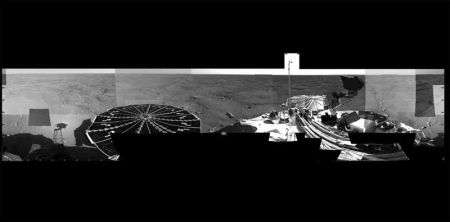
This panoramic view taken by NASA's Phoenix Mars Lander shows the sweeping plains of the Martian polar north. Image credit: NASA/JPL-Calech/University of Arizona

NASA's Mars lander is returning more detailed images from the Martian surface and is now preparing its instruments for science operations.

Phoenix transmitted a 360-degree panorama of its frigid Martian world, freed its nearly 8-foot robotic arm, tested a laser instrument for studying dust and clouds, and transmitted its second weather report on Wednesday evening.

"We've imaged the entire landing site, all 360 degrees of it. We see it all," said Phoenix principal investigator Peter Smith, University of Arizona, Tucson. "You can see the lander in a fish-eye view that goes all the way out to the entire horizon "We are now making plans for where to dig first, and what we'll save for later."

Commands were communicated to Phoenix to rotate the robotic arm's wrist to unlatch its launch lock, raise the forearm and move it upright to release the elbow restraint.

"We're pleased that we successfully unstowed the robotic arm. In fact, this is the first time we have moved the arm in about a year," said Matthew Robinson of NASA's Jet Propulsion Laboratory in Pasadena, Calif. The arm deployment brings the Phoenix mission to a significant milestone.

"We have achieved all of our engineering characterization prerequisites, with all the critical deployments behind us," said JPL's Barry Goldstein, Phoenix project manager. "We're now at a phase of the mission where we're characterizing the science payload instruments. That's a very important step for us."

After a health check that tests the arm at a range of warmer and colder temperatures, the titanium and aluminum arm will soon be tasked with its first assignment: to use its camera to look under the spacecraft to assess the terrain and underside of the lander.

The robotic arm will later trench into the icy layers of northern polar Mars and deliver samples to instruments that will analyze what this part of Mars is made of, what its water is like, and whether it is or has ever been a possible habitat for life.

Another milestone for the mission included the activation of the laser instrument called light detection and ranging instrument, or lidar.

"The Canadians are walking on moonbeams. It's a huge achievement for us," said Jim Whiteway Canadian Science lead from York University, Toronto. The lidar is a critical component of Phoenix's weather station, provided by the Canadian Space Agency. The instrument is designed to detect dust, clouds and fog by emitting rapid pulses of green laser-like light into the atmosphere. The light bounces off particles and is reflected back to a telescope.

"One of the main challenges we faced was to deliver the lidar from the test lab in Ottawa, Canada, to Mars while maintaining its alignment within one one-hundredth of a degree," said Whiteway. "That's like aiming a laser pointer at a baseball at a distance from home plate to the center field wall, holding that aim steady after launch for a year in space, then landing," he added.

Lidar data shows dust aloft to a height of 3.5 kilometers (2 miles). The weather at the Phoenix landing site on the second day following landing was sunny with moderate dust, with a high of minus 30 degrees Celsius (minus 22 degrees Fahrenheit) and a low of minus 80 (minus 112 degrees Fahrenheit).

Source: NASA

4.2 /5 (16 votes)  

Rank 4.2 /5 (16 votes)
Tags

Related Stories
Relevant PhysicsForums posts
  • Never ending outer space.....
    createdFeb 11, 2012
  • Neutron Star fragments?
    createdFeb 11, 2012
  • stationary or not?
    createdFeb 11, 2012
  • Scale of the Universe
    createdFeb 10, 2012
  • Titan's lack of impact craters
    createdFeb 09, 2012
  • Real pictures of black hole eating a star?
    createdFeb 08, 2012
  • More from Physics Forums - General Astronomy

More news stories

With climate change, today's '100-year floods' may happen every three to 20 years: research

Last August, Hurricane Irene spun through the Caribbean and parts of the eastern United States, leaving widespread wreckage in its wake. The Category 3 storm whipped up water levels, generating storm surges ...

Space & Earth / Environment

created 34 minutes ago | popularity 2.3 / 5 (3) | comments 0 | with audio podcast

China's pollution puts a dent in its economy

Although China has made substantial progress in cleaning up its air pollution,a new MIT study shows that the economic impact from ozone and particulates in its air has increased dramatically. ...

Space & Earth / Environment

created 11 minutes ago | popularity not rated yet | comments 0

New European rocket lifts off on maiden flight

A lightweight rocket aimed at securing Europe a stake in the market to launch small satellites lifted off from Kourou space base on its maiden flight on Monday.

Space & Earth / Space Exploration

created 1 hour ago | popularity 5 / 5 (4) | comments 1

Climate change causes harmful algal blooms in North Atlantic: study

Warming oceans and increases in windiness could be causing of an abundance of harmful algal blooms in the North Atlantic Ocean and North Sea, according to new research.

Space & Earth / Environment

created 3 hours ago | popularity not rated yet | comments 0

NASA budget will axe Mars deal with Europe: scientists

US President Barack Obama's budget proposal to be submitted next week for 2013 will cut NASA's budget by 20 percent and eliminate a major partnership with Europe on Mars exploration, scientists said Thursday.

Space & Earth / Space Exploration

created Feb 10, 2012 | popularity 5 / 5 (4) | comments 59


Researchers make better heat sensor based on butterfly wings

(PhysOrg.com) -- Scientists have long known that butterfly wings produce their iridescent colors by bouncing light around and between tiny ridges in structures made of chitin. More recently they’ve discovered ...

Manipulating genes with hidden TALENs

(PhysOrg.com) -- A better understanding of gene function in model plant and animal systems could be used to develop useful traits in livestock and crop plants, and might someday lead to developments in stem ...

The joy of cheques

An electronic cheque which eliminates the need for costly processing by banks but preserves the simplicity and ease of a traditional cheque book has been designed by a team of academics in the UK.

Research shows promise in converting camelina oil into jet fuel

(PhysOrg.com) -- Researchers at Montana State University-Northern have developed a process to convert camelina oil to jet fuel and other high-value chemicals. MSU has applied for a U.S. patent and research is ongoing.

Couples in the same place emotionally stay together, study says

(Medical Xpress) -- Despite life’s ups and downs, couples whose feelings are in sync consistently over time are more likely to stay together, says a University of California, Davis, study.

Researchers make breakthrough in stem cell research

(Medical Xpress) -- University of Queensland scientists have developed a world-first method for producing adult stem cells that will substantially impact patients who have a range of serious diseases.