Excitement Builds as GLAST Readies Its Gamma-ray Vision
Scientists around the world are excited about all the things that the Gamma-ray Large Area Space Telescope, or GLAST, is going to uncover after it launches on June 5 from Cape Canaveral Air Force Station, Fla.
There are many reasons for worldwide excitement about GLAST. Not only is the equipment state-of-the-art, but it will allow us to see objects in space differently.
"The Universe looks remarkably different outside the narrow range of colors in the spectrum that we can see with our eyes," said David Thompson, GLAST Deputy Project Scientist at NASA Goddard Space Flight Center, Greenbelt, Md. "GLAST will give us a spectacular high-energy 'gamma-ray vision,'" said Thompson. Gamma rays are the highest-energy form of light in the electromagnetic spectrum and cannot be seen by the naked eye.
Thompson noted "If you're in space with gamma-ray vision, there are gamma-rays coming from all directions. The Milky Way would be a brilliant swath of light, and you'd see a sky constantly changing with objects dimming and brightening on different time scales. If you see a blinding flash, that would be a gamma-ray burst!"
GLAST's "Gamma-ray vision" will help scientists answer a lot of questions like: How do black holes accelerate jets of material to nearly light speed? What is the mysterious dark matter? What mechanism produces the stupendously powerful explosions known as gamma-ray bursts? How do solar flares generate high-energy particles? How do pulsars work? What is the origin of cosmic rays? and What else out there is shining gamma rays?
"One thing that's exciting is the cutting-edge instrumentation of the Large Area Space Telescope or LAT,” said Peter Michelson, LAT Principal Investigator, Stanford University, Calif. "That's where gamma-rays convert to matter and anti-matter within the telescope designed to detect them. By the direction of the particles, we can detect which direction the gamma-ray came from and find its origin in space. The LAT makes breakthrough improvements in all the key capabilities.”
"Another exciting thing is that the GLAST LAT is the first imaging gamma-ray observatory to survey the entire sky every three hours over a huge energy range," said Steve Ritz, GLAST Project Scientist at Goddard. This is important because the gamma-ray sky is constantly changing in stunning ways. The GLAST observatory, which also includes the GLAST Burst Monitor, spans a factor of 10 million in energy from the highest to the lowest energy gamma rays it will detect.”
Anticipation and excitement are near peak for the GLAST launch from Cape Canaveral Air Force Station CCAFS, Fla. Liftoff is set for June 5 during a window that runs from 11:45 a.m. to 1:40 p.m. EDT.
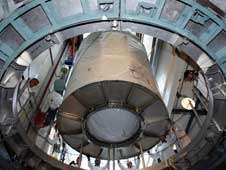
The preparations leading up to the launch are almost complete. During the weekend of May 17, GLAST was rolled out to CCAFS' Launch Pad 17-B and hoisted atop the Delta II rocket. After the spacecraft was placed in the Delta II rocket, technicians then successfully completed the state-of-health checks for the spacecraft.
The GLAST spacecraft is 9.2 feet high by 8.2 feet in diameter when stowed, where it is just under the 9-foot diameter allowed in the fairing. The fairing is basically just the outside shells of the rocket. Once GLAST is launched into space, it becomes a little bit taller and much wider when the Ku-band antenna deploys and the solar arrays are extended.
Five days later, on May 22, the Flight Program Verification was conducted. This is an electrical and mechanical test of the rocket and spacecraft working together as a single, integrated system during countdown and launch milestones. With this test completed, spacecraft closeouts began. On May 27, the Delta II Rocket fairings were closed around the GLAST satellite.
Because there were 18 institutions in six countries involved in the creation of GLAST, everyone is now eagerly awaiting the launch. NASA's GLAST mission is an astrophysics and particle physics partnership, developed in collaboration with the U.S. Department of Energy, along with important contributions from academic institutions and partners in France, Germany, Italy, Japan, Sweden, and the U.S.
Source: NASA, by Rob Gutro


