Famous Supernovae Still Echo Across the Milky Way
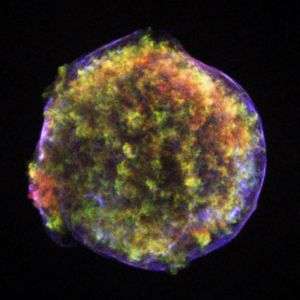
While walking home on November 11, 1572, astronomer Tycho Brahe idly glanced at the sky. He was surprised to see a bright star in the constellation Cassiopeia that hadn’t been there before. The new star, which we now know to be the result of a stellar explosion or supernova, grew brighter than Venus and was visible in daylight for about two weeks. It then slowly faded until vanishing in March 1574, 16 months after its discovery.
The supernova, and the ensuing academic controversy regarding a supposedly unchangeable Universe displaying a spectacular change, prompted Tycho to forfeit his future as a Danish nobleman and become a serious astronomer. Decades later, Tycho's lifelong work became a cornerstone of the Scientific Revolution.
What type of star exploded? Previously, the only way for modern astronomers to answer that question was to sift through the ashes that were scattered into space as a supernova remnant. But now, they have spotted light echoing from the original explosion of the Tycho supernova, as well as a second supernova called Cassiopeia A (Cas A).
A paper describing the team’s results has been accepted for publication in The Astrophysical Journal Letters.
By studying these echoes, explains lead author Armin Rest, currently on sabbatical at Harvard University, astronomers can directly observe light from a supernova that exploded hundreds of years ago. And more poetically, they can see the same light that was observed by famous astronomers of centuries past.
"It's like finding a color photo of Napoleon. We suddenly get a chance to take a snapshot of an event very influential in the history of astronomy," Rest said.
The echo most people are familiar with occurs when noise reflects off a hard surface and back to the listener. In a light echo, a bright pulse of light expanding outward through space reflects from intervening cosmic dust and into our line of sight. The extra travel time for the light to reach the dust, bounce off, and travel to us causes the light echo to arrive hundreds of years after the light that traveled directly to us (the light seen by Tycho).
As a result, light echoes offer astronomers a unique opportunity to study both the supernova itself and the aftermath.
“We can see the ‘before and after’ simultaneously by studying the light echo and supernova remnant, respectively,” explained Rest. "Normally in astronomy, the time scale for events is so long that you can’t watch a single object evolve. You can see a light pulse from a distant supernova, or you can study a nearby supernova remnant, but you can't study both the supernova explosion and the remnant for the same event. With light echoes, though, you CAN do both for the same event."
To find the echoes, Rest and his colleagues first narrowed the search area to regions with the most dust using infrared sky maps. Then they repeatedly photographed large areas of sky in their target regions using the National Science Foundation’s 4-meter-diameter telescopes at Kitt Peak National Observatory and the Cerro Tololo Inter-American Observatory.
They focused their search on the seven brightest supernovas recorded in the past 2000 years. Two proved to have observable light echoes: the Tycho supernova of 1572 and Cas A, which is estimated to have exploded around 1671 although no contemporary observers noted it.
These are the first supernova light echoes discovered in the Milky Way. Other researchers found moving infrared features emanating from Cas A, which are not direct reflections but instead are the result of cosmic dust absorbing the supernova's light, warming and re-radiating at longer wavelengths.
Texas A&M University astronomer Nicholas Suntzeff, who collaborated with Rest on the international project along with McMaster University’s Douglas Welch, has been observing supernovas for more than 25 years, including 20 at Cerro Tololo. Decades and countless discoveries — none bigger than the first evidence for dark energy in 1998 — later, Suntzeff remains in awe of their timeless significance, scientific and otherwise.
"I think it is cool that I can look in the sky and still see the same light that Tycho did, at the time of his truly revolutionary discovery," Suntzeff said. "Beyond that, I love the connection of astronomy to history, both in the arcane nomenclature we use in our science and the effect of astronomy on the course of human thought. Tycho was the astronomer who proved Aristotle wrong. Aristotle believed — and it was taught in all Catholic and Protestant schools for 1,500 years — that the Earth was at the center of the Universe, and all things variable were between the Earth and Moon. This supernova proved that theory wrong and quickly led to a freedom of thought in science — that we can question any theory with observations — which is central to the way science operates today."
In the future, the team hopes to take spectra of the light echoes in order to properly classify the supernovae and identify which type of exploding star fueled each one. Particularly bright echoes are required for this work. A light echo’s brightness depends on the thickness of the reflecting dust. The team will monitor the known echoes for brightening, while also continuing their search for light echoes from other know supernovas in the galaxy.
Their ultimate goal is to improve the understanding of supernovas in general, since past generations of supernovas provided many of the heavy elements on Earth, from the calcium in our bones to the iron in our blood.
The 4-meter telescopes at Kitt Peak and Cerro Tololo are part of the National Optical Astronomy Observatory, which is operated by the Association of Universities for Research in Astronomy under a cooperative agreement with the National Science Foundation.
Source: Harvard-Smithsonian Center for Astrophysics


