Medics solve an ancient riddle -- and offer new tool for diagnosis
May 30, 2008
Leeds medics solve an ancient riddle -- and offer new tool for diagnosis

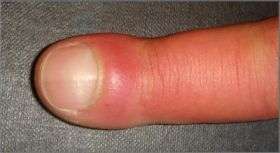
The classic symptoms of finger clubbing. Credit: University of Leeds

A puzzling medical condition, identified more than 2,000 years ago by Hippocrates, has finally been explained by researchers at the University of Leeds.

The phenomenon of "finger clubbing", a deformity of the fingers and fingernails, has been known for thousands of years, and has long been recognized to be a sign of a wide range of serious diseases – especially lung cancer.

"It's one of the first things they teach you at medical school," explained Professor David Bonthron of the Leeds Institute of Molecular Medicine. "You shake the patient by the hand, and take a good look at their fingers in the process."

Lung cancer, heart disease, hyperthyroidism, various gastrointestinal diseases and many other conditions all result in finger clubbing. But exactly why swollen, reddened fingers should be an indicator of serious illness has remained a mystery – until now.

"There are benign cases of clubbing, where it isn't associated with other illnesses, but particularly because of the link to lung cancer, it is generally regarded as rather sinister," said Bonthron. "You look at the range of conditions connected to finger clubbing and wonder what on earth they could have in common."

The researchers found clues in the medical literature, detailing past cases and previous research. "We knew that in cystic fibrosis patients who have undergone a lung transplant, their finger clubbing goes away. The same goes for empyema patients who have had their lungs drained. It suggested that impaired lung function was somehow crucial to finger clubbing – but we didn't understand how."

Prof Bonthron, Dr Chris Bennett of the Yorkshire Regional Genetics Service and their colleagues studied a group of patients suffering from inherited primary hypertrophic osteoarthropathy (PHO), a genetic disorder in which the finger clubbing is accompanied by painful joint enlargement and a thickening of the bone.

Their findings implicated a fatty compound called PGE2, which is produced naturally by the body to mediate the effects of internal inflammation. Crucially, once it has done its work, PGE2 is broken down by an enzyme 15-HPGD, produced in the lungs. The patients followed by the Leeds study were found to have a genetic mutation which prevented the production of 15-HPGD, reulting in up to ten times as much of the PGE2 in their systems.

"If you don't have this enzyme the PGE2 isn't broken down normally and simply builds up," said Bonthron, whose findings are published online this week in Nature Genetics.

In lung cancer patients, it is most likely overproduction of PGE2 by the tumour that causes the clubbing. In congenital heart disease, blood bypasses the lungs, where PGE2 is normally broken down by 15-HPGD.

The researchers have suggested that a straightforward urine test for levels of PGE2 may be a useful first step in the diagnosis of individuals with unexplained clubbing, and to understanding whether it is the symptom of something far more serious. The results also suggest that existing drugs such as aspirin, which are already used to prevent PGE2 production, may be effective in reducing the painful symptoms of finger clubbing.

It has taken 2,000 years to make the connection, but Bonthron adds: "Actually, when you look back, it's rather obvious. When we found this gene, everything else fell neatly into place – it was like a smack on the forehead."

Citation: Uppal S, Diggle CP, Carr IM, Fishwick CWG, Ahmed M, Ibrahim GH, Helliwell PS, Latos-Bielenska A, Phillips SEV, Markham AF, Bennett CP, Bonthron DT (2008) Mutations in 15-hydroxyprostaglandin dehydrogenase cause primary hypertrophic osteoarthropathy is published on the Nature Genetics website.

Source: University of Leeds

4.6 /5 (40 votes)  

Filter


Move the slider to adjust rank threshold, so that you can hide some of the comments.


Display comments: newest first

Glis
May 30, 2008

Rank: 3.3 / 5 (4)
The thumbnail of that image looks questionable, so I'm assuming a nosey officemate will get the complete wrong impression as I read this.
gmurphy
May 31, 2008

Rank: 2 / 5 (4)
some sort of penis finger?, a phallus digit?
MikeMarianiMD,FAAP
May 31, 2008

Rank: 4 / 5 (1)
NSAIDS like aspirin have certainly been given to these patients for painful manifestations other than the distal osteoarthopathy, likely for extended periods. No benefit has ever been documented of which I am aware. Perhaps an oversight?
Adarsh
Jun 04, 2008

Rank: not rated yet
That may explain why lung diseases cause clubbing but clubbing is seen in so many diseases not involving the lung alone. So how does that explain it then?
googleplex
Jun 10, 2008

Rank: not rated yet
That may explain why lung diseases cause clubbing but clubbing is seen in so many diseases not involving the lung alone. So how does that explain it then?

Great question. Perhaps the other ailments inhibit or prevent 15-HPGD enzyme production or affect PGE2 itself.
Rank 4.6 /5 (40 votes)
Tags

Related Stories
Relevant PhysicsForums posts

More news stories

Starve a virus, feed a cure? Findings show how some cells protect themselves against HIV

A protein that protects some of our immune cells from the most common and virulent form of HIV works by starving the virus of the molecular building blocks that it needs to replicate, according to research published online ...

Medicine & Health / Research

created 11 hours ago | popularity 5 / 5 (2) | comments 0 | with audio podcast

Overeating may double risk of memory loss

New research suggests that consuming between 2,100 and 6,000 calories per day may double the risk of memory loss, or mild cognitive impairment (MCI), among people age 70 and older. The study was released today and will be ...

Medicine & Health / Neuroscience

created 7 hours ago | popularity 5 / 5 (2) | comments 0 | with audio podcast

Injured boomers beware: Know when to see doctor

(AP) -- It happened to nurse Jane Byron years after an in-line skating fall, business owner Haralee Weintraub while doing "men's" push-ups, and avid cyclist Gene Wilberg while lifting a heavy box.

Medicine & Health / Health

created 12 hours ago | popularity 5 / 5 (1) | comments 0

Declining health-care productivity in England: Who says so?

Reports that the National Health Service in England has been declining in productivity in the last decade appear to have been accepted as fact. However, a Viewpoint published Online First by The Lancet disputes this. The Vi ...

Medicine & Health / Health

created 5 hours ago | popularity 1 / 5 (1) | comments 0

FDA-approved drug rapidly clears amyloid from the brain, reverses Alzheimer's symptoms in mice

Neuroscientists at Case Western Reserve University School of Medicine have made a dramatic breakthrough in their efforts to find a cure for Alzheimer's disease. The researchers' findings, published in the journal Science, show t ...

Medicine & Health / Neuroscience

created Feb 09, 2012 | popularity 4.9 / 5 (58) | comments 17 | with audio podcast


Scientists discover molecular secrets of 2,000-year-old Chinese herbal remedy

For roughly two thousand years, Chinese herbalists have treated Malaria using a root extract, commonly known as Chang Shan, from a type of hydrangea that grows in Tibet and Nepal. More recent studies suggest that halofuginone, ...

New method to examine batteries -- MRI from the inside

There is an ever-increasing need for advanced batteries for portable electronics, such as phones, cameras, and music players, but also to power electric vehicles and to facilitate the distribution and storage of energy derived ...

Google might launch Drive for cloud storage soon

(PhysOrg.com) -- Google's next big move, according to the Wall Street Journal, is a cloud storage service called Drive. Hardly first to the plate, Google is simply catching up to introducing its cloud reposi ...

A mitosis mystery solved: How chromosomes align perfectly in a dividing cell

Although the process of mitotic cell division has been studied intensely for more than 50 years, Whitehead Institute researchers have only now solved the mystery of how cells correctly align their chromosomes during symmetric ...

Lab study raises questions over nano-particle impact

Tests involving chickens have raised questions about the impact on health from engineered nano-particles, the ultra-fine grains commonly used in drugs and processed foods, scientists said on Sunday.

Researchers find extensive RNA editing in human transcriptome

In a new study published online in Nature Biotechnology, researchers from BGI, the world's largest genomics organization, reported the evidence of extensive RNA editing in a human cell line by analysis of RNA-seq data, demons ...