Shuttle Discovery Launches With Japanese Laboratory
June 1, 2008 Shuttle Discovery Launches With Japanese Laboratory

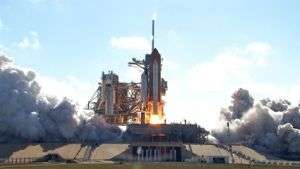
Space shuttle Discovery thunders off the launch pad at NASA's Kennedy Space Center in Florida. Photo credit: NASA TV

Space shuttle Discovery and its seven-member crew lifted off from NASA's Kennedy Space Center at 5:02 p.m. EDT Saturday to deliver and install a Japanese laboratory on the International Space Station. The mission, designated STS-124, is the second of three flights to launch components to complete the Japan Aerospace Exploration Agency's Kibo laboratory. Discovery is carrying Kibo's tour bus-sized Japanese Pressurized Module, or JPM, which will be the station's largest module. The shuttle astronauts will work with the three-member station crew and ground teams around the world to install the JPM and Kibo's robotic arm system.

Commander Mark Kelly promised "the greatest show on Earth," and space shuttle Discovery delivered with a thundering, fiery arc stretching over Florida's East Coast on Saturday. The launch began a 14-day mission for Kelly and his crew of seven astronauts as they install a new Japanese-built laboratory module on the International Space Station.

As the astronauts got used to their new surroundings in space, NASA officials on Earth basked in the satisfaction of a flawless countdown and liftoff from NASA's Kennedy Space Center in Florida.

"(It was) obviously a huge day," said NASA Administrator Mike Griffin. "A huge day for the space station partnership, for the Japanese Space Agency, for NASA and, really, for the people who hoped to see the space station do what it was designed to do, to be a place in orbit where we can learn to live and work in space."

Neither weather nor technical problems cropped up as the launch team and mission controllers went through their checks on the way to an on-time liftoff at 5:02 p.m. EDT.

"I reveled in the (launch) team's performance," said Mike Leinbach, shuttle launch director. "It's really a pleasure to have my job and just sit back and watch the launch team."

Next up for the STS-124 mission is a two-day chase across space to link up with the International Space Station. It will take the crew several hours of robotic arm maneuvers and spacewalks to connect the Pressurized Module of Japan's Kibo laboratory to the station. The 36-foot-long module is the largest habitable section to be launched to the orbiting research post.

Source: NASA


print this article email this article download pdf blog this article bookmark this article     Stumble it Digg this share on Facebook retweet share on Reddit add to delicious
Rate this story - 3.8 /5 (6 votes)


June 1, 2008 all stories

Comments: 0

3.8 /5 (6 votes)
  • Stumble this up

  • Digg this

  • share this

  • hide
  • Related Stories


  • hide
  • Relevant PhysicsForums posts

  • The shape of our solar system's orbits.
    created Nov 07, 2009
  • Above or Below the Line of Nodes
    created Nov 07, 2009
  • Supernova vs. Nova?
    created Nov 07, 2009
  • Supernova's Gamma Rays and Comets
    created Nov 06, 2009
  • More from Physics Forums - General Astronomy

Other News

Deep creep means milder, more frequent earthquakes along Southern California's San Jacinto fault

Deep creep means milder, more frequent earthquakes along Southern California's San Jacinto fault

Space & Earth / Earth Sciences

created 14 hours ago | popularity 4.7 / 5 (3) | comments 0

With an average of four mini-earthquakes per day, Southern California's San Jacinto fault constantly adjusts to make it a less likely candidate for a major earthquake than its quiet neighbor to the east, the ...


Success in 'space elevator' competition (AP)

Success in 'space elevator' competition (Update 3)

Space & Earth / Space Exploration

created Nov 05, 2009 | popularity 4.3 / 5 (33) | comments 50

(AP) -- A robot powered by a ground-based laser beam climbed a long cable dangling from a helicopter on Wednesday to qualify for prize money in a $2 million competition to test the potential reality of the ...


In a Galaxy Far, Far Away...

In a Galaxy Far, Far Away...

Space & Earth / Astronomy

created Nov 06, 2009 | popularity 4.8 / 5 (5) | comments 17

(PhysOrg.com) -- Astronomers have published the discovery of the farthest known object in the cosmos: a star that exploded when the universe was only 630 million years old -- only 4.6% of its current age. ...


'Dropouts' pinpoint earliest galaxies

'Dropouts' pinpoint earliest galaxies

Space & Earth / Astronomy

created Nov 06, 2009 | popularity 4.2 / 5 (10) | comments 13

Astronomers, conducting the broadest survey to date of galaxies from about 800 million years after the Big Bang, have found 22 early galaxies and confirmed the age of one by its characteristic hydrogen signature ...


Space hotel taking bookings for 2012 opening

Space hotel taking bookings for 2012 opening

Space & Earth / Space Exploration

created Nov 05, 2009 | popularity 4.4 / 5 (21) | comments 11

(PhysOrg.com) -- The first orbiting space hotel is on track to open for its first customers in 2012, but hurry, as bookings are filling fast.